By Staff Reporter
ISLAMABAD: Prime Minister Shehbaz Sharif touched down in Davos on Tuesday to lead his country’s delegation at the World Economic Forum, aiming to pitch investment opportunities in energy, agriculture and tech as the South Asian nation pushes forward with reforms under a $7 billion IMF bailout.
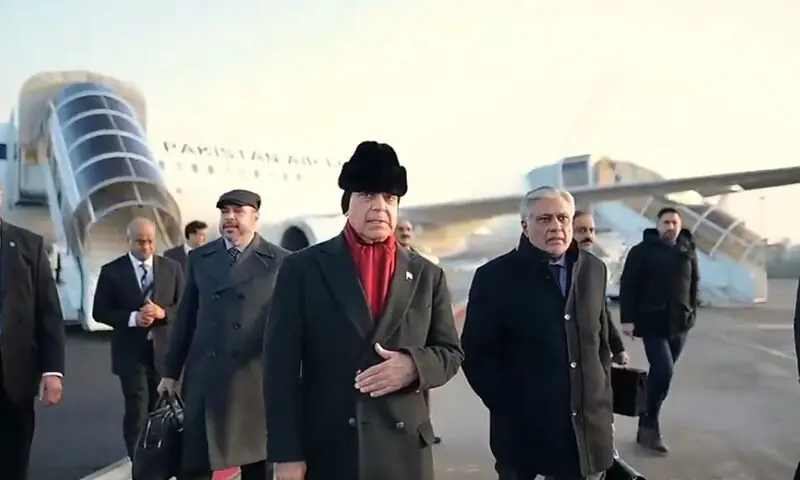
Sharif, accompanied by Deputy Prime Minister and Foreign Minister Ishaq Dar and Finance Minister Muhammad Aurangzeb, arrived in the Swiss alpine town for the forum’s annual meeting, which runs through Jan. 22 and draws political leaders, corporate chiefs and civil society figures to hash out global challenges from geopolitics to climate risks.
In a post on X shortly after landing, Sharif highlighted Pakistan’s “ongoing economic reform journey” as opening up “profound opportunities,” driven by a “resilient and entrepreneurial workforce” and untapped potential in sectors like minerals and emerging technologies. A video clip attached to the post showed the prime minister stepping off his plane alongside Dar and Tarar. “Pakistan is ready to harness this potential into mutually beneficial economic cooperation and long-term investment,” Sharif wrote.
Local media reported that Sharif is set to huddle with International Monetary Fund Managing Director Kristalina Georgieva in, seeking the lender’s backing for a sweeping relief package worth up to Rs2 trillion to roll back crushing taxes and energy tariffs that have squeezed businesses and households. The meeting, confirmed by Sharif’s office, underscores Islamabad’s push to soften some of the austerity measures imposed under last year’s $7 billion IMF bailout, which helped dodge a default but triggered soaring unemployment and poverty. , aims to pitch the plan as a pro-growth effort to revive investment amid signs of economic stabilization.
The proposed package, hammered out with input from the military-backed Special Investment Facilitation Council, business executives and finance officials, targets tax distortions built up since 2013. It includes slashing the corporate tax rate to 25% from 29%, capping individual income taxes at 30% from 45%, limiting salaried workers’ levies to 25%, and potentially trimming the sales tax to 15% from 18%. Other moves would scrap a 10% super tax, a 15% inter-corporate dividend tax and additional levies that have driven effective rates as high as 60%.
The trip marks a reversal from Sharif’s 2023 pledge to Georgieva at a Paris summit to enact tough reforms for stability. Those steps delivered, with inflation easing, reserves climbing and credit rating upgrades, but at the expense of growth, last fiscal year’s expansion hit just 2.5%, below the IMF’s 3.5% target, and widespread hardship.
Lt. Gen. Sarfraz Ahmed, national coordinator of the SIFC, recently decried industrialists as “easy prey” for tax authorities, urging abolition of the super tax, removal of the dividend levy and a corporate rate drop to 25%. The World Bank’s country director, Bolormaa Amarsaikhan, told Aurangzeb last week that investment is falling short of goals in a $20 billion partnership framework. While the Davos meeting won’t delve into technical weeds, those are handled by IMF staff, the prime minister hopes for initial nod, with a deeper review expected during next month’s third bailout assessment.
Sharif’s packed agenda includes joining the WEF’s Informal Gathering of World Economic Leaders session on “Restoring a Spirit of Dialogue in a Divided World,” where he’s set to advocate for multilateralism, UN Charter principles and international law amid rising global conflicts and regional frictions. He’ll also chair a high-level business roundtable tailored to Pakistan, gathering corporate executives to discuss trade ties and investment pipelines.
On the margins, Sharif plans bilateral huddles with world leaders and business honchos to spotlight Islamabad’s economic playbook, including recent gains in stability and openings for overseas partners.
The Foreign Office in Islamabad, in a statement, framed the trip as a chance for Sharif to articulate Pakistan’s stance on peace and development while underscoring government achievements in bolstering the economy. The WEF confab, held in Davos-Klosters, serves as a premier venue for deal-making and policy debates, convening heads of state, CEOs from multinationals and reps from international bodies to tackle pressing issues in geopolitics, economics, society and the environment.
Copyright © 2021 Independent Pakistan | All rights reserved