By Staff Reporter
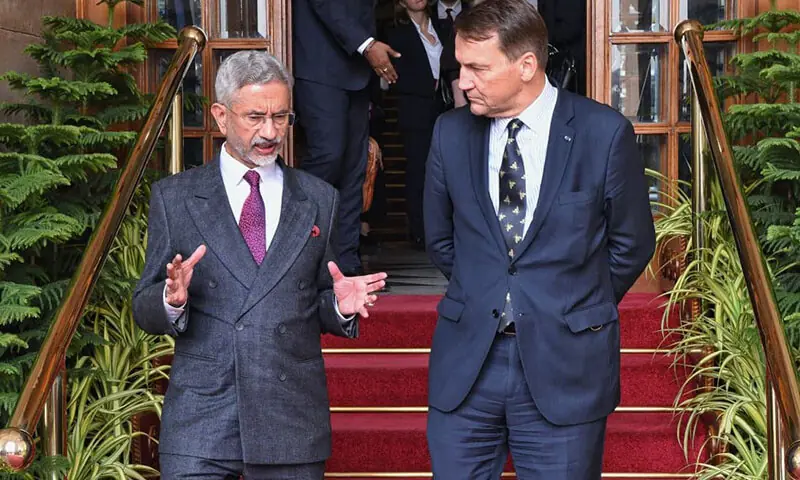
ISLAMABAD: Indian Foreign Minister S. Jaishankar openly rebuked his Polish counterpart during a meeting in New Delhi this week, accusing Poland of potentially aiding what India calls terrorist networks through its growing relationship with Pakistan, a charge that drew a pointed response from Warsaw and highlighted India’s efforts to shape other nations’ foreign policies in South Asia.
The exchange, which took place on Monday at Hyderabad House, stemmed from Polish Deputy Prime Minister and Foreign Minister Radoslaw Sikorski’s trip to Islamabad in October 2025, where he discussed expanding trade and political links with Pakistani leaders. That visit produced a joint statement calling for deeper cooperation and touching on the Kashmir dispute, a move that Indian officials viewed as meddling in what they insist is a strictly bilateral matter between New Delhi and Islamabad. Pakistan, for its part, has long pushed for international attention to the Kashmir issue, citing United Nations resolutions and rejecting India’s claims that the region is an internal affair.
Jaishankar, in comments broadcast during the session and reported by The Hindu newspaper, said he hoped to talk about Sikorski’s “recent travels to the region.” He went on to say Poland ought to show “zero tolerance for terrorism and not help fuel the terrorist infrastructure in our neighbourhood.” Jaishankar brought up Sikorski’s past as a reporter covering the Afghan conflict in the 1980s, saying the Polish official knew the area well and understood the problems with terrorism spilling over borders.
Such language from Jaishankar reflects New Delhi’s deep-seated biased against Pakistan. India view that Pakistan shelters militants who carry out attacks in Indian territory, an accusation Islamabad has always rejected. Pakistani officials say their country has suffered greatly from extremism and point fingers back at India, charging it with supporting separatists in Balochistan and committing abuses in Kashmir.
The October talks between Poland and Pakistan focused on building a “comprehensive and mutually beneficial partnership,” with agreements to boost ties in politics and business — decisions between two sovereign states that some observers say India has no standing to challenge.
Sikorski’s visit came after a tense period in India-Pakistan relations, including clashes along the border in May 2025 that both sides blamed on the other. Pakistan described the incidents as unprovoked Indian aggression, while India claimed they stemmed from infiltrators backed by Pakistani elements.
The episode added weight to Warsaw’s outreach, but Jaishankar’s public dressing-down has raised questions about whether India is overstepping by trying to police the diplomatic choices of other countries. After the closed-door discussions, Sikorski told journalists the conversation had been straightforward. He said the two countries saw eye to eye on fighting terrorism but then shifted to Poland’s own worries, saying India’s role in the Zapad-2025 drills with Russia and Belarus last September came across as a threat. “We also have concerns. India took part in the Zapad exercises in Russia that we find threatening.”
Those maneuvers, held close to NATO’s edges, rattled European governments still dealing with Russia’s invasion of Ukraine. “We all have regional concerns and we all have neighbours,” Sikorski said, “and with neighbours you have opportunities and challenges.” The back-and-forth also touched on economics, with Jaishankar objecting to Sikorski’s earlier words in Paris about India’s purchases of Russian oil. Sikorski had said he was pleased to see those imports dropping because they helped fund “the war machine of Putin.”
Jaishankar called that kind of focus on India “unfair and unjustified,” repeating a line Indian leaders have used against European Union penalties from July 2025 on companies like Nayara Energy for dealing in Russian crude.
Analysts see Jaishankar’s approach as part of a broader Indian strategy to push back against outside views on its neighborhood, even as New Delhi keeps close links with Moscow despite Western pressure. In Pakistan, the Indian minister’s statements sparked backlash on social media, with users calling out what they saw as arrogance from New Delhi in telling other governments whom they can engage with. One commenter asked if India would dare speak that way to the United States, while others said it showed New Delhi thinking it could “dictate the world” on foreign policy.
Spokespeople from the Indian and Polish foreign ministries offered no extra details on the private talks. But people close to the discussions said the mood stayed polite overall, with both sides looking ahead to possible joint work in trade and tech, even as these differences linger. Still, the public barbs point to rough spots in India-Poland relations, especially as Warsaw seeks new partners in Asia while grappling with threats on its own doorstep from Russia.
Copyright © 2021 Independent Pakistan | All rights reserved