By Staff Reporter
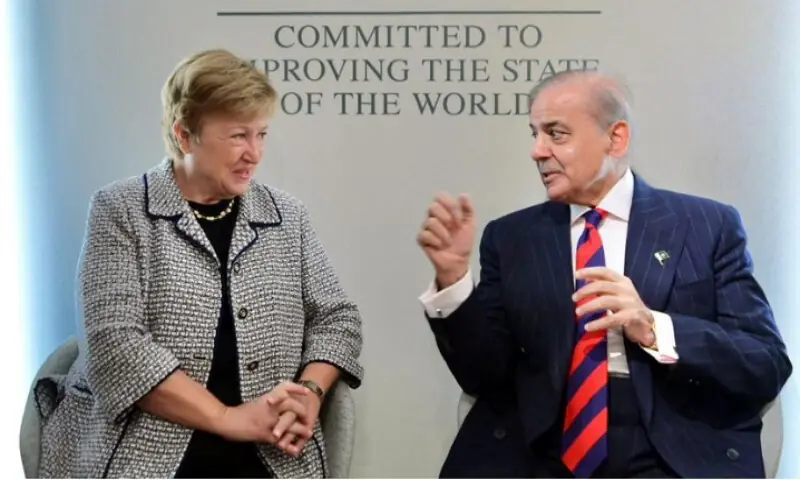
ISLAMABAD: Pakistan Prime Minister Shehbaz Sharif sat down with International Monetary Fund Managing Director Kristalina Georgieva during the World Economic Forum in Davos, putting a spotlight on Islamabad’s work to promote its economic recovery.
Sharif briefed Georgieva on improvements in Pakistan’s macroeconomic indicators, stabilization efforts and progress on institutional reforms, according to a statement from the prime minister’s office. He stressed Pakistan’s commitment to fiscal discipline, revenue mobilization and sustainable development.
Georgieva commended Pakistan’s moves on reforms and called for keeping the push going to lock in stronger defenses against shocks, the release said. The two sides discussed the global economic outlook, challenges faced by emerging economies and the importance of multilateral cooperation in safeguarding economic stability.
The meeting comes as Pakistan seeks to convert recent macroeconomic stabilization into sustained growth, using the World Economic Forum as a platform to re-engage global investors, multilateral lenders and strategic partners. After securing an IMF stabilization program in 2024, Islamabad is now pitching reforms in taxation, privatization, digital payments and energy to attract long-term capital, strengthen financial inclusion and avoid past boom-and-bust cycles that have repeatedly undermined economic confidence.
Sharif is on a three-day visit to the Swiss town from Jan. 20-22, leading a high-level delegation that includes Deputy Prime Minister and Foreign Minister Ishaq Dar. In a post on X, Sharif said he was visiting Davos to advance Pakistan’s engagement at the WEF with global trade and investment partners. “Pakistan’s ongoing economic reform journey is unlocking profound opportunities, driven by a resilient and entrepreneurial workforce and significant potential across energy, agriculture, minerals, and emerging technologies,” Sharif said. He added that Pakistan was “ready to harness this potential into mutually beneficial economic cooperation and long-term investment.”
On Wednesday, Sharif told a breakfast session on the forum’s edges that export-led growth stood as the sole path ahead for Pakistan. Speaking at the event, the prime minister said Pakistan “is moving forward with a sense of achievement and a sense of purpose,” pointing to a fall in inflation and a cut in the main lending rate. Still, he flagged hurdles for exports and the need to lift social measures through shared work that doesn’t let up.
“Our exports, collectively, do face different kinds of challenges,” Sharif said. “But the way forward is very clear: Pakistan has to have export-led growth.” He said the government had rolled out “fundamental structural changes” like putting revenue gathering online. The tax take as a share of output now sits at 10.5%, up from 9% two years back, which he called a “significant achievement.” “We are now in the mines and minerals business in a big way,” Sharif said, mentioning pacts and deals with firms from the U.S. and China.
“Pakistan has been blessed with infinite natural resources still buried in the heap of mountains in the north of Pakistan, in Gilgit-Baltistan, Azad Jammu and Kashmir, Khyber Pakhtunkhwa and Balochistan,” he said. The Prime Minister added that Pakistan was pushing fast in cryptocurrency, artificial intelligence and information technology. “Our IT exports have shown remarkable progress in the last few years, in that we brought a lot of instruments which have facilitated IT exports, which stand at $3bn annually.”
On young people, he said federal and local governments had set up programs to build skills through job training. “As a result, our youth [are] getting productive employment in Gulf states and other parts of the world because they are highly qualified and highly trained.” Sharif spoke of warming ties with the United States, saying he looked for Islamabad and Washington to “cooperate with each other in a big way” on mines and minerals, fighting terrorism, IT and AI. “I think Pakistan is at a point in time where we are going to take off rapidly in agriculture, industry, the mining industry, AI and IT,” he said. “I think that the future is very promising, I have no doubt about it.” His docket also included a low-key meet among world figures on “The Importance of Dialogue in a Divided Global Landscape,” his office said.
Before the IMF session, Sharif bumped into Palestinian Prime Minister Mohammad Mustafa on the sidelines of the forum. Mustafa expressed his heartfelt gratitude to Sharif for “Pakistan’s consistent, principled and unwavering support for the Palestinian people,” according to the prime minister’s office. “Mustafa personally walked up to PM Shehbaz and introduced himself,” the statement said. “The Palestinian prime minister thanked Pakistan for supporting the Palestinian stance at international forums and for its role regarding the Palestinian cause.”
In a video uploaded by state-run television, Sharif is stopped by Mustafa as he walks by. Mustafa introduces himself and shakes Sharif’s hand. “Thank you for your support,” Mustafa can be heard telling Sharif, who exchanges pleasantries with his Palestinian counterpart. Pakistan has consistently supported Palestine over the past two years at international forums such as the UN Security Council and Organisation of Islamic Cooperation during Israel’s war on Gaza, which has killed thousands of Palestinian people, including women and children. Islamabad has increasingly called on international powers to intervene and ensure the fragile ceasefire in Palestine upholds and Israel is held accountable for its “war crimes” in Gaza. The country has also dispatched several consignments of relief items for Gaza and has engaged with other countries to ensure peace in the Middle East.
Pakistan is utilising the World Economic Forum this week to project itself as a stabilising, reform-oriented economy, with Finance Minister Muhammad Aurangzeb holding separate meetings with global payments giant Visa, the Asian Development Bank and Kuwait’s finance minister to attract digital investment and long-term Gulf capital. Aurangzeb met Visa Group President Oliver Jenkyn to discuss cooperation in digital payments, financial innovation and Pakistan’s transition toward a modern, digitally enabled economy, according to a statement from the finance ministry.
Jenkyn reaffirmed Visa’s long-term interest in Pakistan, highlighting the global shift toward digital payments and the importance of enabling policy frameworks, the finance minister said. “Expanding trade reflects a strong foundation that highlights the positive impact of US economic engagement in Pakistan and globally. The United States and Pakistan are pursuing a fair and balanced trade relationship that creates prosperity for both our nations,” the ministry statement quoted Jenkyn as saying, adding that Visa remained keen to support Pakistan’s next phase of growth through innovation, secure payment solutions and knowledge transfer.
Aurangzeb told the Visa delegation that policy consistency and a clear reform roadmap were central to Pakistan’s economic strategy, noting that the government was strengthening digital infrastructure, connectivity and regulatory frameworks to support innovation and private sector participation. The finance minister also emphasized Pakistan’s efforts to promote transparency, documentation of the economy and digitization across sectors, which he said were creating opportunities for trusted global partners to scale market-ready solutions.
Separately, Aurangzeb held talks with Kuwait’s Finance Minister Subaih Abdul Aziz Al-Mukhaizeem, as Pakistan sought to deepen economic and investment cooperation with Gulf partners increasingly looking beyond traditional markets. The Kuwaiti minister shared a positive assessment of Pakistan’s economic potential and described Kuwait’s investment approach as long-term and partnership-oriented, according to the finance ministry. Aurangzeb briefed his counterpart on Pakistan’s improving macroeconomic indicators, saying the country had moved toward stability and was now focused on achieving sustainable and inclusive growth while avoiding past boom-and-bust cycles.
He highlighted strengthening external accounts, rising remittances, growing information technology exports and renewed momentum in structural reforms, including privatization initiatives that had attracted strong interest from domestic investors. The finance minister said new opportunities were emerging across priority sectors such as agriculture, minerals and mining, pharmaceuticals and technology, offering scope for long-term investment partnerships.
Aurangzeb also met Asian Development Bank President Masato Kanda, where both sides reviewed Pakistan’s reform agenda, macroeconomic stabilization and their long-standing development partnership. The finance minister cited improving indicators including easing inflation, lower policy rates, stronger foreign exchange reserves and rising investor confidence, while briefing Kanda on progress in structural reforms, privatization and private sector participation. Kanda welcomed Pakistan’s progress and reaffirmed the ADB’s commitment to continued support, including cooperation on energy reforms, sustainable development and access to international capital markets, the finance ministry said.
Copyright © 2021 Independent Pakistan | All rights reserved