By Staff Reporter
ISLAMABAD: President Donald Trump presided over the formal launch of a new international organisation called the Board of Peace on Thursday, an entity he described as a tool for resolving conflicts starting with Gaza but potentially extending further, as leaders from nearly two dozen countries, including Pakistan, signed on during a ceremony at the World Economic Forum.
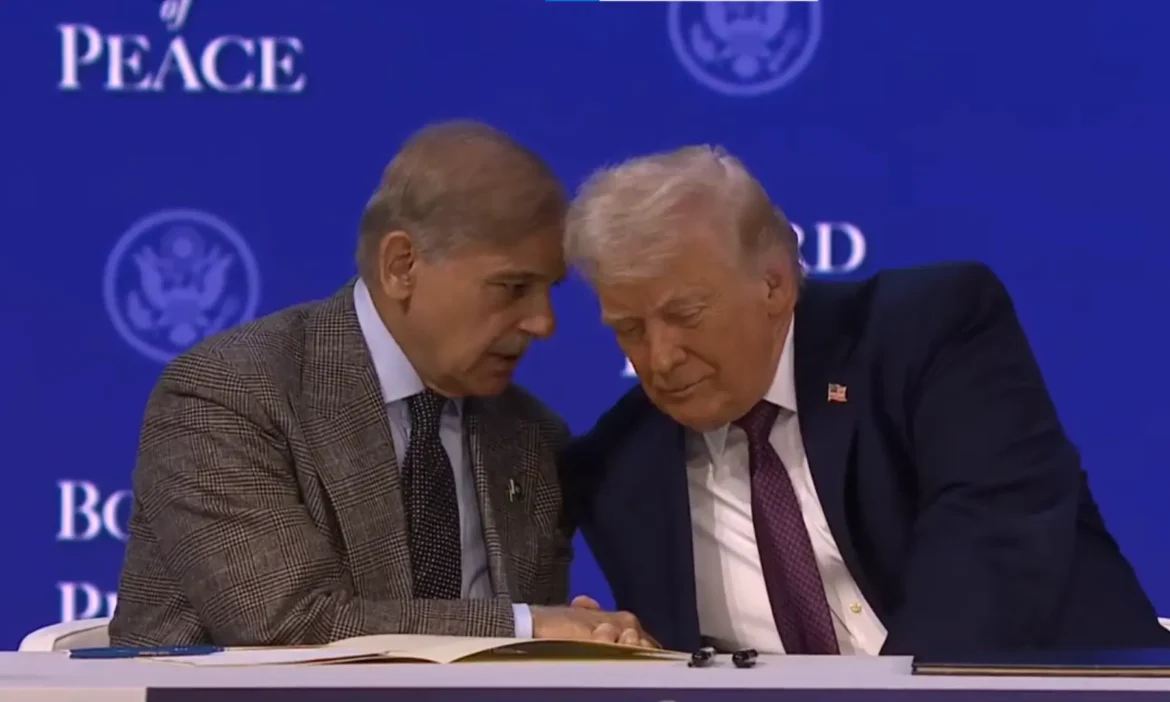
The event brought together officials from 19 nations, including Prime Minister Shehbaz Sharif, who added his signature to the founding charter at Trump’s invitation. The group, which Trump will chair, was initially focused on overseeing peace efforts in Gaza after more than two years of Israeli genocide in the territory, but its charter outlines a broader mission to address global disputes.
Trump, speaking at the Congress Center in Davos, called the signatories “stars” and said their involvement would make peace inevitable. “Everybody in this room is a star,” he told the audience. “There’s a reason that you’re here. When you use that inspired genius for peace, the opposite of peace has no chance.”
The US president noted that invitations had gone out just days earlier, taking advantage of the forum’s gathering of world leaders. “Just about every country wants to be a part of it,” Trump said. “We sent out the letters a couple of days ago and countries that are here just happened to be in Davos.”
White House press secretary Karoline Leavitt announced the body’s official status after the signing. “Congratulations, President Trump,” she said. “The charter is now in full force, and the Board of Peace is now an official international organization.”
Pakistan’s participation shows its consistent position on the Palestinian issue. “On the occasion of the 56th Annual Meeting of the World Economic Forum, the Gaza Board of Peace is being formally signed. Pakistan will also become part of the Board of Peace,” a statement from Sharif office said. The day before, Pakistan joined seven other Muslim-majority countries — Saudi Arabia, Turkey, Egypt, Jordan, Qatar, the United Arab Emirates, Indonesia and Bahrain — in a joint statement accepting Trump’s invitation and calling for a permanent ceasefire in Gaza.
Analysts noted that the presence of these nations could keep Palestinian rights, including self-determination and statehood, at the center of discussions. Pakistan has long advocated for an independent Palestinian state on pre-1967 borders with Al-Quds Al-Sharif as its capital, while opposing occupation and collective punishment. During the forum, Palestinian Prime Minister Mohammad Mustafa approached Sharif for a handshake on Wednesday and thanked Pakistan for its support in seeking peace in Gaza, ending the genocide and standing with the Palestinian people.
Back in Islamabad, opposition lawmakers accused Sharif of bypassing Parliament in deciding to join the board, warning that the move could weaken Pakistan’s long-standing support for the Palestinian cause. They said the initiative risks sidelining the United Nations, marginalising Palestinian voices and drawing Pakistan into efforts shaped largely by Washington and Israel.
Parliamentary Affairs Minister Dr. Tariq Fazal Chaudhry pushed back, insisting that Islamabad’s position on Palestine remained unchanged. “Pakistan has consistently stood with the Palestinian people at every international forum,” Chaudhry said, arguing that participation in the board serves national interests while reflecting the collective concerns of the Muslim world.
The debate laid bare deep political divisions. Hard-line Islamist Jamiat Ulema-i-Islam Fazl (JUI-F) leader Maulana Fazlur Rehman delivered a sharp rebuke, warning that Pakistan risked becoming complicit in any attempt to disarm Hamas or legitimize Israel’s actions in Gaza. “Expecting peace from Trump is like living in a fool’s paradise,” Rehman said, questioning the credibility of a board chaired by Trump and accusing him of unilateral decision-making and geopolitical adventurism.
Rehman also asked why Israeli Prime Minister Benjamin Netanyahu had not declined a seat on the board. “No so-called peace board led by Trump and Netanyahu is acceptable under any circumstances,” he told the chamber. He argued that Pakistan’s foreign policy was increasingly shaped by external pressure rather than national consensus. “It is the government’s duty to inform Parliament about the decisions it is making,” Rehman said. “If you did not take the house into confidence, did you at least take the cabinet into confidence?”
Former Prime Minister Imran Khan’s Pakistan Tehreek-e-Insaf party said the absence of Palestinian representation on the board was particularly troubling. “There is not a single Palestinian representative on the Board of Peace,” the party said. “Any decision not acceptable to the Palestinians will not be acceptable to the PTI.” In a statement posted on X, PTI rejected the government’s decision, arguing that major international commitments require parliamentary debate and broad political consensus. The party warned against weakening the UN system and creating parallel mechanisms that could undermine global governance.
Sharif and Trump exchanged cordial words at the signing, and Trump gave a thumbs-up to Pakistan’s army chief, Field Marshal Syed Asim Munir, in what was seen as recognition of Pakistan’s unified leadership. Pakistani officials stressed that membership does not mean involvement in any military missions or forces. The country favors balanced diplomacy and active engagement on Palestine without aligning with blocs.
Other signatories included officials from Argentina, Armenia, Azerbaijan, Bulgaria, Hungary, Kazakhstan, Kosovo, Mongolia, Morocco, Paraguay, Qatar, Saudi Arabia, Turkey, the UAE and Uzbekistan, along with the United States. No other permanent UN Security Council members have joined. France has declined, Britain said Thursday it is not participating at this time, and China has not responded.
Trump extended invitations to controversial figures, including Israeli Prime Minister Benjamin Netanyahu, who faces an International Criminal Court arrest warrant for war crimes in Gaza. Netanyahu has said Israel will join but was not present. Russian President Vladimir Putin, whose invasion of Ukraine began four years ago, was also invited; Trump said Putin agreed, but the Kremlin indicated it is still reviewing. Reuters reported no visible representatives from major powers, Israel or the Palestinian Authority at the ceremony.
Trump addressed the Gaza situation directly, saying Hamas must disarm under the ceasefire deal or face its end. “They have to give up their weapons, and if they don’t do that, it’s going to be the end of them,” he said. The US president committed to a “demilitarized, properly governed and beautifully rebuilt” Gaza and suggested the board could expand its work. “Once this board is completely formed, we can do pretty much whatever we want to do, and we’ll do it in conjunction with the United Nations,” Trump added, calling the setup “very, very unique for the world.”
Recalling the ceasefire’s first phase, Trump pointed to sustained aid and the release of 20 Israeli hostages plus most deceased captives’ bodies. “We’ve given aid, you know, you used to hear that all the people were starving and it was terrible. You don’t hear that anymore.” Trump claimed Iran seeks talks with the US and expressed willingness to engage. “And Iran does want to talk, and we’ll talk.” He referenced U.S. strikes on Iranian uranium sites in June 2025, saying, “Can’t let that happen,” in regard to Tehran’s alleged nuclear plans.
A significant portion of the event focused on Gaza’s future. Trump’s son-in-law, Jared Kushner, presented slides for a “master plan” showing new settlements, hotels and apartments under the label “New Gaza.” “It could be a hope. It could be a destination,” Kushner said. He outlined next steps on reconstruction funding and Hamas disarmament, warning, “If Hamas doesn’t demilitarize, that would be what holds this plan back.” “The next 100 days, we’re going to continue to just be heads down and focused on making sure this is implemented. We continue to be focused on humanitarian aid, humanitarian shelter, but then creating the conditions to move forward,” Kushner added.
Secretary of State Marco Rubio and Middle East envoy Steve Witkoff also spoke. Rubio praised Trump’s engagement style. “Now we have this Board of Peace … [its] possibilities are endless,” he said, with a primary focus on enduring peace in Gaza. “This is not just a Board of Peace but a board of action, just like President Trump is a president of action,” Rubio said. He described the Gaza vision as “not just possible and promising, but it is our destiny” and a model for other conflicts. Rubio noted more countries would join after internal processes. The board requires permanent members to pay $1 billion, raising concerns it could resemble a “pay to play” version of the UN Security Council.
Trump referred to the signatories as “in most cases very popular leaders, some cases not so popular.” “That’s the way it goes in life,” he said and added, “Every one of them are friends of mine. I like every single one of them.” Trump called Gaza “great real estate” and said: “The first steps toward a brighter day for the Middle East and a much safer future for the world are unfolding before your very eyes. Together we are in a position to have an incredible chance — I don’t even call it a chance, it’s gonna happen — to end decades of suffering, stop generations of hatred and bloodshed and forge a beautiful, everlasting and glorious peace for that region, and for the whole region of the world, because I’m calling the world a region.”
Amnesty International criticised the launch in a statement on X as a “brazen disregard for international law and human rights.” It called the board “fundamentally at odds with the international legal system” and a “slap in the face” to global governance efforts, urging adherence to universal norms rather than ad hoc arrangements driven by interests or ambition.
Copyright © 2021 Independent Pakistan | All rights reserved