By Staff Reporter
ISLAMABAD: Pakistan has fitted the dome to the reactor building of Chashma-5, its largest nuclear power project, with prime minister Shehbaz Sharif saying the work was finished ahead of schedule.
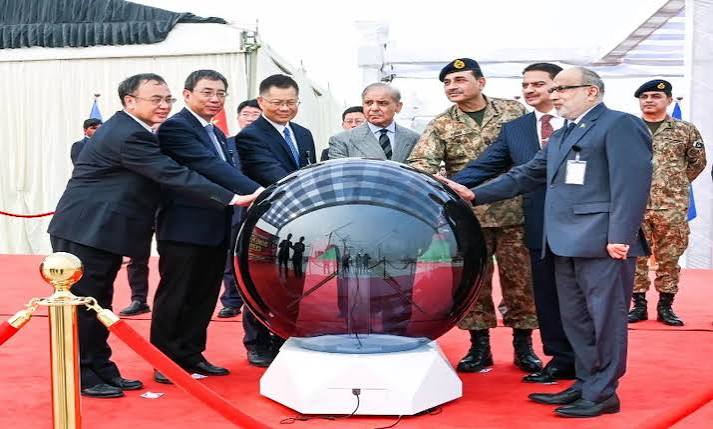
Sharif led the ceremony on Tuesday at the site on the Indus river in Mianwali district, Punjab, according to a statement from his office. Field Marshal Asim Munir, chief of defence forces and army staff, attended, along with Chinese officials and representatives of the organisations involved in the project.
Dome placement is the point at which the large, domed roof is installed on the building that houses the reactor and its equipment. It means the main structure is essentially complete.
The 1,200MW unit is due to begin generating electricity in September 2030. “C-5 Project is a manifestation of clean and emissions-free electricity generation in Pakistan,” Mr Sharif said.
He described the occasion as historic and noted that the dome had gone up three and a half years after the project’s launch ceremony in July 2023. He thanked the Pakistani and Chinese engineers, technicians and workers on the site. “China’s dedication and hard work have helped achieve this milestone, and I am confident that, with the same commitment, we will see this project commissioned ahead of time,” he said.
The prime minister made the case for the plant on grounds of energy security. “Power that does not rise or fall with the price of imported fuel, power that does not depend on whether the sun shines or the wind blows, power that runs through the night for the factory that must not stop, the hospital that must not go dark and the studies by its light,” he said. Pakistan, he added, is a climate-vulnerable country with a responsibility to pursue energy that supports its economy while protecting the environment.
He said nuclear plants supplied about 16.6 per cent of the country’s electricity despite making up only 8.6 per cent of installed capacity. Their share of generation rises to 26 per cent in winter.
The chairman of the Pakistan Atomic Energy Commission (PAEC) told the ceremony that Pakistan’s nuclear plants were generating 3,530MW “safely and efficiently”. That, he said, helps avoid about 15 million tonnes of carbon dioxide emissions a year. Pakistan operates six nuclear plants with a combined installed capacity of that size.
Sharif said Chashma-5 was the seventh nuclear unit China had helped build in Pakistan, and called each a “living testament” to relations between the two countries. He thanked President Xi Jinping, the Chinese government and the China National Nuclear Corporation (CNNC), and said Chinese engineers had worked “shoulder to shoulder” with their Pakistani counterparts. With both countries entering the second phase of the China-Pakistan Economic Corridor, he said, the plant showed the strength of the partnership.
He also praised Field Marshal Munir for his leadership during Marka-e-Haq, the name Pakistan gives to its military confrontation with India in May 2025. He credited him as well with supporting efforts to revive the economy, saying such resolve could help Pakistan attract investment and speed up development.
Sharif closed with a call to build the country envisioned by its founder, Muhammad Ali Jinnah: “A Pakistan that is economically dominant, energy independent and environmentally resilient.” He congratulated the PAEC, the China Atomic Energy Authority, contractors, engineers and financial institutions, and thanked the people of Mianwali for hosting the project.
Chashma-5 uses China’s Hualong One pressurised water reactor design. The PAEC’s cooperation agreement with Beijing dates from 2017, and the regulator licensed construction after the 2023 groundbreaking. Sharif announced a $4.8bn (£3.6bn) deal with China for the unit in 2023, and the project had originally been planned to start around 2021. CNNC agreed to build the reactor and to provide 85 per cent of the estimated cost.
Chashma-5 is the third Hualong One unit Pakistan has taken from China if the two reactors at the Karachi plant are counted. Those Karachi units, K2 and K3, entered service in 2021 and 2022. Chashma-5 was described by CNNC as the seventh Chinese nuclear unit exported to Pakistan. The Chashma complex already has four CNP-300 reactors in operation, each with a capacity of 325MW.
The IAEA’s board of governors unanimously approved a safeguards agreement for the new unit in March. PAEC chairman Raja Ali Raza Anwar and IAEA director general Rafael Mariano Grossi signed it at the agency’s Vienna headquarters on the sidelines of its general conference. Pakistan, India and Israel, which are not party to the Non-Proliferation Treaty, have safeguards applied through item-specific agreements of this kind.
–
Copyright © 2021 Independent Pakistan | All rights reserved