By Staff Reporter
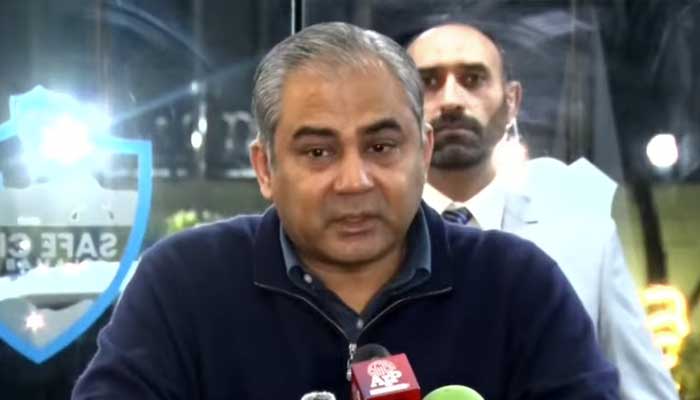
ISLAMABAD: Pakistani authorities arrested four suspects, including an Afghan national described as the main mastermind, in connection with a suicide bombing at a Shiite mosque in Islamabad that killed dozens and marked the capital’s deadliest attack in nearly two decades, Interior Minister Mohsin Naqvi said on Saturday.
The arrests came during overnight raids in the northwestern province of Khyber Pakhtunkhwa, where one police officer was killed and several others injured in a shootout with militants, Naqvi told reporters in the capital. He credited a joint operation by the Counter-Terrorism Department and provincial police, along with other security agencies, for apprehending the group. “All those people linked to this, and the mastermind, at around 3am, all of them were apprehended,” Naqvi said, hailing the effort as a “test case” for the country’s counterterrorism forces.
The explosion at the Imambargah Qasr-i-Khadijatul Kubra in the Tarlai Kalan suburb during Friday prayers had initially killed at least 31 people and injured 169 others. But by Saturday, officials at the Pakistan Institute of Medical Sciences (PIMS) confirmed the higher tally, with expectations it could climb further given the critical condition of several survivors. The explosion tore through the last row of worshippers after being challenged by security guards at the entrance. Police said the attacker opened fire on the guards before rushing farther into the compound, injuring two of them.
The Islamic State claimed responsibility for the assault, which marked the second major bombing in Islamabad in recent months and heightened fears that militant groups operating along Pakistan’s volatile borders are expanding their reach into the heavily fortified capital. The blast was the deadliest in Islamabad since a 2008 suicide bombing at the Marriott Hotel that killed 63 people and wounded more than 250. In November, a suicide bomber struck outside a court in the capital, killing 12 people.
Shiite Muslims, a minority in predominantly Sunni Pakistan, have long been targeted by extremist groups, especially in border regions adjacent to Afghanistan. But large-scale sectarian violence in Islamabad has been relatively rare, making Friday’s assault a stark reminder of the country’s persistent security challenges.
The latest attack comes as Prime Minister Shehbaz Sharif’s government deals with a surge in militancy across Pakistan. Pakistani officials have said the attacker was a Pakistani national who had recently traveled to Afghanistan.
Naqvi also linked the attack directly to the Islamic State, known locally as Daesh, saying the Afghan suspect in custody was affiliated with the banned militant group. “The main mastermind is linked to Daesh and is in our custody,” he said, adding that the planning and training had occurred in Afghanistan under the auspices of “Daesh Afghanistan.” “We have people who are telling us details about how he (the attacker) went there and how he was trained,” Naqvi added, without elaborating on the bomber’s identity or the specifics of the interrogation.
The minister’s remarks showed Pakistan’s longstanding accusations against neighboring Afghanistan, where he claimed a web of terrorist groups — including the Tehreek-i-Taliban Pakistan (TTP), Afghan Taliban, Daesh and other outlawed outfits — operate in concert. “We have been saying for a while that whether it be Tehreek-i-Taliban Pakistan (TTP), Afghan Taliban, Daesh or other kharji terrorist organisations — they are all working together,” Naqvi said. “At this time, 21 terrorist bodies’ setups … name any terrorist body, it is operating from Afghanistan.”
In a pointed escalation, Naqvi accused India of funding and directing these groups, saying their budgets had tripled since May and that payments to operatives had risen from $500 to $1,500 per mission. “I say again with clarity that all of their funding comes from India. India is giving them all the targets; they are planning each and every thing behind the scenes,” he said. “These organisations are at the front, while India is at the back.”
The minister vowed to raise the issue internationally, saying he would brief Pakistan’s deputy prime minister in the coming days to inform foreign missions. “We know about this and it is our duty to take this case to all international platforms,” Naqvi said, asserting that India had turned to proxy terrorism because it “cannot beat us in a war.” He dismissed any potential impact from increased funding, saying, “Even if they increase their budget tenfold, it will have no impact.”
Naqvi also referenced recent attacks in Balochistan, where the Baloch Liberation Army (BLA) claimed responsibility for a series of strikes last weekend. He accused Indian media of amplifying BLA propaganda, including “high-production value” content that portrayed the group as controlling territory in Pakistan — a claim he flatly rejected. “Not one inch [of land] is under their control,” he said.
In those operations, Naqvi added, no attackers were spared, and he promised a forthcoming briefing on the Balochistan situation. But he warned of broader regional risks. “We will continue fighting this war, but the world needs to realise that this is becoming a regional threat.”
The interior ministry in a statement on the social media platform X, confirmed the arrests of “four facilitators, including the Afghan ISIS mastermind” based on technical and human intelligence. The ministry also mentioned the martyrdom of a law enforcement official and injuries to four others, while reiterating that the “nexus of terrorism under Afghan Taliban patronage remains a serious threat to regional peace.”
Security sources, speaking on the condition of anonymity because they were not authorized to discuss the matter publicly, provided additional details on the raids. One operation unfolded in the Hakeemabad area of Nowshera district, where an exchange of fire erupted between law enforcement and suspected militants. An assistant sub-inspector was killed, and a constable was wounded, according to a Nowshera police official who confirmed the raid was part of the broader probe into the Islamabad bombing but declined to share more.
Naqvi, responding to reporters’ questions, urged the public to report suspicious activity, emphasising that Pakistan is “in a state of war” across provinces like Balochistan and Khyber Pakhtunkhwa. “The intelligence [from] the community matters the most,” he said. “When people get to know about an unknown person living in their community, report it to the police — when this system is activated, [terror incidents] will decrease.”
He defended security agencies against criticism, revealing that while one attack succeeds, “99 others are being foiled.” Naqvi said he had instructed officials to share details of thwarted plots with the media, even if it risks causing panic. On social media’s role, Naqvi expressed frustration over unblocked terrorist accounts on platforms like X. “We have caught multiple accounts on Twitter being used by terrorists and they are not being shut down,” he said. “The government has written to them … but they are not blocked here, so we have taken this up very seriously.” He hinted at potential further measures if the platforms do not comply. “If they do not do it, we may have to adopt another strategy.”
Islamabad has long accused Kabul of allowing its soil to be used by militant groups and New Delhi of backing their cross-border attacks against Pakistani civilians and security forces. The Afghan and Indian governments have consistently denied the allegations.
Copyright © 2021 Independent Pakistan | All rights reserved