By Staff Reporter
ISLAMABAD: A former judge of Islamabad High Court has petitioned the Federal Constitutional Court to challenge his removal from the bench, arguing that the decision undermines judicial independence and was based on flawed assumptions about his qualifications.
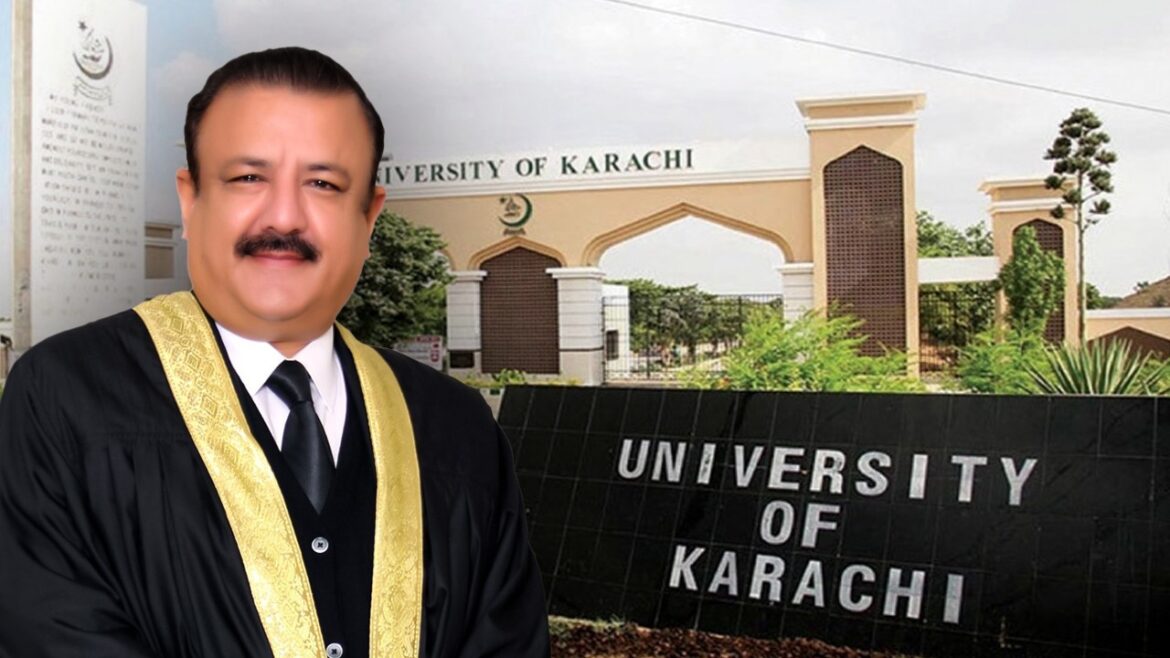
Tariq Mehmood Jahangiri, who was removed as a judge in December last year by President Asif Ali Zardari, filed the plea on Monday against an order by his own court that declared his appointment invalid due to questions over the validity of his law degree. The removal followed a ruling by a division bench of the Islamabad High Court (IHC), comprising Chief Justice Sardar Muhammad Sarfraz Dogar and Justice Muhammad Azam Khan, which upheld a challenge brought by lawyer Mian Dawood. The bench found that Jahangiri’s elevation to the court in 2020 was “without lawful authority” because he did not hold a valid LLB degree, a prerequisite for enrollment as an advocate and, by extension, for judicial appointment.
In his petition, Jahangiri named Dawood as a respondent along with the federation of Pakistan, the president, the Judicial Commission of Pakistan, the defunct parliamentary committee for the appointment of judges to superior courts, the Higher Education Commission and the University of Karachi. The plea described the events leading to his removal as the culmination of an “orchestrated campaign” against him, resulting in the ouster of a constitutionally appointed high court judge through a writ of quo warranto issued by the IHC.
While acknowledging the personal impact, the petition emphasised that the development was not merely a “personal tragedy” for Jahangiri. “He is satisfied with the public service he has rendered and his adherence to the dictates of his conscience and his constitutional oath,” it stated, adding that the removal represented “a mortal blow to the independence of judiciary as enshrined in the very preamble and Articles 2-A, 37 and 175 of the Constitution.” If left unaddressed, the plea warned, it “shall surely serve as a grim lesson for serving and future judges.”
Jahangiri’s filing contended that the IHC order proceeded on “certain assumptions” rather than a proper appreciation of the record before the court to determine whether he met the constitutional qualifications for appointment. “The impugned order incorrectly assumes that the petitioner was ‘not holding a valid LLB degree, which is a prerequisite for enrolment as an advocate’,” the plea said. It quoted the IHC ruling as concluding that since Jahangiri “could not be considered as an advocate, then consequently he was not eligible for elevation as a judge of a high court in terms of the requirements of Article 175-A of the Constitution.”
However, the petition argued that the qualifications for high court judges are outlined in Article 193 of the Constitution, not Article 175-A, and that an LLB degree is not explicitly listed among them. Furthermore, it noted that from the date of the IHC order until the filing of the current petition, no competent authority or court had declared Jahangiri’s degree invalid. The University of Karachi, which issued the degree, had informed the IHC that it was declared invalid for the first time in 2024. “Consequently, the assumption in the impugned order that the petitioner did not possess a valid degree at the time of his elevation is completely contrary to the record that was placed before the court,” the plea stated. “At no stage, any party before the court asserted that the Jahangiri’s degree was invalid in the year 2020 when he was considered for elevation.”
The filing also challenged the IHC’s reliance on the University of Karachi’s declaration of invalidity, pointing out that this declaration had been suspended by the Sindh High Court and thus had no legal effect. Moreover, the IHC order improperly gave it “retrospective effect,” according to the plea. Jahangiri argued that the IHC division bench lacked jurisdiction to declare the validity of his degree, and instead made unwarranted assumptions about both the degree and his license as an advocate. “It asserts that Jahangiri ‘could not have been considered as an advocate’,” the plea said.
Yet, representatives of the relevant bar council, who appeared before the IHC, had repeatedly affirmed that Jahangiri held a valid license and that no complaints had been received against it. They urged the court to summon the bar council’s records, but the bench chose to rely on assumptions rather than the evidence, the petition contended. The plea described the IHC order as “being solely based on assumptions and conjectures,” rendering it “unconstitutional, devoid of any constitutional basis and coherence, and beyond the quo warranto jurisdiction of the high court.” It further asserted: “Indeed in the present case, it is not even disputed that Jahangiri fulfilled the constitutional qualifications prescribed by Article 193 for appointment as a judge (namely, that he has been an advocate of the high courts for more than 10 years and is over the age of 45). Rather, it is alleged (which allegations are factually disputed) that the petitioner was wrongly awarded an LLB degree (and hence was wrongly enrolled as an advocate of the high courts). Clearly, such factual disputes lie beyond the limited purview of quo warranto proceedings and require a full-fledged trial.”
Additionally, the petition noted that the University of Karachi proceedings canceling Jahangiri’s degree “presently stand suspended.” The filing also raised concerns about procedural fairness, stating that the IHC had not heard Jahangiri on the maintainability of Dawood’s original plea. It overruled office objections and declared the petition maintainable without issuing a pre-admission notice to him. “It is, of course, well-settled that the over-ruling of office objections does not preclude the court from examining the issue of maintainability subsequently nor does it prohibit a litigant from raising the question of maintainability (especially when he has not been heard in this regard),” the plea said. “On this ground alone, the IHC order is liable to be set aside.”
Jahangiri further contended that the proceedings before the division bench were “vitiated by bias” and that the order was “legally and constitutionally unsustainable” because he had been denied due process and a fair trial under Article 10-A of the Constitution.” In particular, he was deprived of a fair trial and impartial tribunal; an opportunity to be heard on legal maintainability; and a reasonable opportunity to file a reply” to Dawood’s plea and address its merits, the petition stated. Finally, it argued that the IHC lacked jurisdiction to assess the validity of the University of Karachi’s proceedings regarding Jahangiri’s degree, as only the Sindh High Court could do so—and it had already suspended the university’s declaration canceling the degree and related results, along with prior proceedings.
Copyright © 2021 Independent Pakistan | All rights reserved