By Staff Reporter
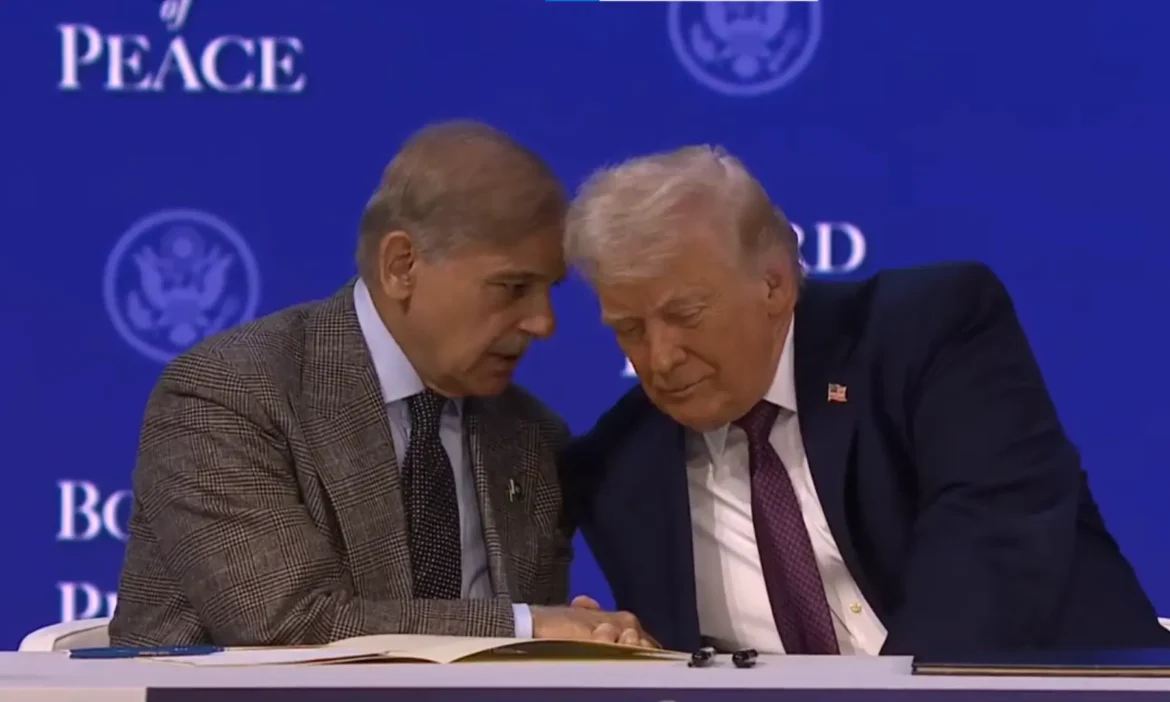
ISLAMABAD: Pakistan confirmed on Thursday that Prime Minister Shehbaz Sharif will attend the inaugural meeting of US President Donald Trump’s “Board of Peace” in Washington next week, as Islamabad pushes for a lasting resolution to the Palestinian conflict amid broader diplomatic efforts in the region.
The announcement came during a weekly Foreign Office briefing in the capital, where spokesman Tahir Andrabi also urged the United States and Iran to pursue direct negotiations on Tehran’s nuclear programme, highlighted financial support from the United Arab Emirates and reiterated calls for Afghanistan’s Taliban rulers to crack down on militant groups operating from their territory.
The Board of Peace, chaired by Trump, was established under a US-brokered plan that secured a fragile ceasefire in Gaza in October, with Israel and the Palestinian militant group Hamas agreeing to terms. A UN Security Council resolution adopted in mid-November authorized the board and associated countries to form an international stabilization force for the territory. Trump has since expanded the board’s mandate to address global conflicts, with its first formal gathering set for Feb. 19 focusing on Gaza’s reconstruction, fundraising, ceasefire implementation, transitional governance and security arrangements.
“Yes, I can confirm that the prime minister will attend the Board of Peace meeting… He will be accompanied by the deputy prime minister,” Andrabi said, referring to Deputy Prime Minister and Foreign Minister Ishaq Dar. He described Pakistan’s involvement as part of a coordinated push by Muslim-majority nations, noting two joint statements issued by foreign ministers of eight Islamic-Arab countries that condemned Israeli ceasefire violations in Gaza and unlawful settlement activities in the occupied West Bank. “We have joined the Board of Peace in good faith… We are in it, not in isolation, not as one voice, but as a collective voice of eight Islamic Arab countries,” Andrabi said. “Our collective voice is resonating in the Board of Peace, and we will continue to strive for the right and progress and prosperity of the people of Palestine. And also aimed at the long-term solution of the Palestine issue in order to create a state of Palestine in accordance with the pre-1967 border with Al-Quds Al-Sharif as its capital.”
Pakistan, which does not recognize Israel, has long advocated a two-state solution based on pre-1967 borders, with East Jerusalem as the capital of a future Palestinian state. Andrabi said Sharif’s delegation details and any additional US engagements would be shared later, declining to confirm reports that army chief General Asim Munir might join.
On the US-Iran front, Andrabi welcomed recent indirect talks in Muscat as a “positive progression towards a negotiated solution” and encouraged both sides to shift to direct dialogue. “Whilst we stand ready to participate in any format of dialogue and diplomacy on Iran, we encourage the relevant parties to have as direct a negotiation framework as possible,” he said. “We hope the positivity (in Oman talks) would be carried forward by the parties in the conduct of these talks.”
The Feb. 6 session in Oman, mediated by Foreign Minister Badr al-Busaidi, involved shuttle diplomacy between US and Iranian delegations, with both describing it as a “good start.” A follow-up visit by Ali Larijani, secretary of Iran’s Supreme National Security Council, occurred around Feb. 9-10 to discuss next steps, though no further round has been announced as consultations continue in Washington and Tehran.
The talks, originally planned for Istanbul with broader regional participation, were relocated at Iran’s request, narrowing the agenda and excluding players like Turkey, Saudi Arabia and Pakistan. Diplomatic sources have noted a top Pakistani official’s visit to Oman and meetings with US envoy Steve Witkoff on the sidelines, but Andrabi did not confirm any behind-the-scenes role, reiterating Islamabad’s readiness to assist if asked. Pakistan has acknowledged serving as a messenger between Tehran and Washington since June last year. Recent contacts include Iran’s ambassador briefing Dar on Tehran’s stance post-Muscat, a phone call between Iranian Foreign Minister Abbas Araghchi and Dar, and conversations between Sharif and Iranian President Masoud Pezeshkian. “Our deputy prime minister and foreign minister spoke twice with his Iranian counterpart. We are maintaining close contact at the leadership level,” Andrabi said. “Our support for dialogue and diplomacy continues.”
Turning to Afghanistan, Andrabi stressed ongoing diplomacy despite tensions, urging the Taliban to act against groups like the banned Tehreek-e-Taliban Pakistan (TTP) launching attacks into Pakistan. “Diplomacy continues even in wars. Diplomacy continues even during skirmishes,” he said, adding that Pakistan seeks peace for “our Afghan brothers and sisters” and would neither close doors to talks nor open them to conflict. He cited a recent UN Security Council report corroborating Pakistan’s concerns, noting the Taliban’s “permissive environment” for terrorists since their 2021 takeover, with al Qaeda aiding other groups and TTP gaining operational freedom. “The report corroborates Pakistan’s position that TTP resurgence is linked to post-2021 interim government takeover,” Andrabi said, adding that Islamabad is following up with U.N. bodies and international stakeholders.
In response to India’s External Affairs Ministry statement on a recent blast in Islamabad, Andrabi criticized it for appearing to justify terrorism. “It reflects an undertone of justification of terrorism on the pretext of one thing or another…It goes against India’s stated position that they oppose terrorism in all forms,” he said. “We conclude from these statements that India may oppose terrorism in all its forms, but it supports when it takes place against Pakistan.” He also condemned ongoing lynching of Muslims in India, with at least 55 incidents last year often involving complicity from local authorities and political leaders in a climate of Hindutva-driven hostility. Andrabi called for Indian investigations and international monitoring, describing the pattern as “disturbing and persistent” with Muslims portrayed as outsiders.
On US President Trump’s references to the May 2024 “90-hour war” between India and Pakistan, Andrabi expressed appreciation for Washington’s role in preventing escalation. He noted Pakistan had shot down several Indian Rafale jets, with evidence corroborated by international reports and the aircraft’s manufacturers. Separately, Andrabi said Pakistan’s agreement to a T20 cricket match against India stemmed from outreach by Sri Lanka and Bangladesh, and a recognition by international cricket bodies that politicizing the sport was “wrong, unwarranted and it defied the game that we all cherish.”
Copyright © 2021 Independent Pakistan | All rights reserved