By Staff Reporter
KARACHI: Pakistan’s total government debt rose to Rs78.5 trillion by the end of December, up 0.82% from mid-year levels, as the cash-strapped South Asian nation continued to rely heavily on domestic borrowing amid tight external financing, central bank data showed on Wednesday.
The increase of Rs641 billion from Rs77.8 trillion at the end of June came despite Islamabad recording a budget surplus of Rs542 billion, or 0.4% of gross domestic product (GDP), in the first half of fiscal year 2026, which runs from July to June. That marked a sharp turnaround from a deficit of Rs1.5 trillion, or 1.3% of GDP, in the same period a year earlier.
Month-on-month, the debt stock climbed 1.3%, while year-on-year growth stood at 9.6%, according to figures from the State Bank of Pakistan (SBP). The rise in central government debt underscores ongoing fiscal pressures and the need to roll over existing obligations, analysts said. “The increase remains primarily domestic-debt driven, particularly through PIBs, sukuk and Treasury bills, indicating the government’s ongoing reliance on local banking liquidity amid relatively tight external financing conditions,” said Saad Hanif, head of research at Ismail Iqbal Securities.
“External debt growth stayed comparatively contained, suggesting stable FX borrowing but persistent pressure on domestic interest costs,” he added. “Overall, while the MoM pace appears manageable, the elevated debt stock continues to highlight fiscal consolidation challenges and is sensitive to interest-rate movements going forward.”
Domestic debt reached Rs55.4 trillion at end-December, up 1.63%, or Rs891 billion, from June. Compared with November, it rose 1.4%, and was 11% higher than a year ago. External debt, meanwhile, fell 1%, or Rs251 billion, to Rs23.1 trillion in the first six months of FY26. But it edged up 1.1% from the previous month and was 6.4% higher year-on-year.
The country’s gross public debt increased to Rs81.3 trillion by the end of the first half, from Rs80.5 trillion in June. Total debt and liabilities climbed to Rs95.5 trillion, compared with Rs87.9 trillion at the end of December 2024. Despite the buildup, debt and liabilities servicing dropped to Rs5.2 trillion in July-December FY26, down from Rs6.9 trillion a year earlier. Interest payments totalled Rs3.7 trillion, versus Rs5.5 trillion in the prior period.
The government has said its fiscal position is strengthening, pointing to the retirement of Rs3.65 trillion in domestic debt ahead of schedule since late 2024, as part of efforts to shift toward early repayments and cut refinancing risks. Still, gross public debt hit 70.7% of GDP in fiscal year 2025, breaching the ceiling set under the Fiscal Responsibility and Debt Limitation Act. Such high debt levels eat up about half the annual budget, squeezing funds for development and social programs, and adding to the tax load on citizens already grappling with economic hardship.
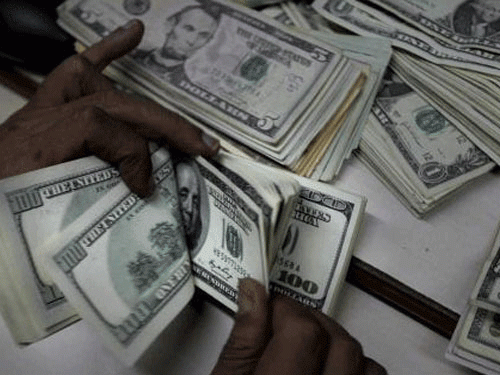
In U.S. dollar terms, Pakistan’s outstanding external debt and liabilities rose to $138 billion as of Dec. 31, from $136 billion at end-June. External debt servicing in the second quarter of FY26 totaled $4.1 billion, up from $3.5 billion in the prior quarter. That included $1.3 billion in interest, compared with $1.2 billion previously, and $2.7 billion in principal repayments, versus $2.3 billion.
Copyright © 2021 Independent Pakistan | All rights reserved