By Staff Reporter
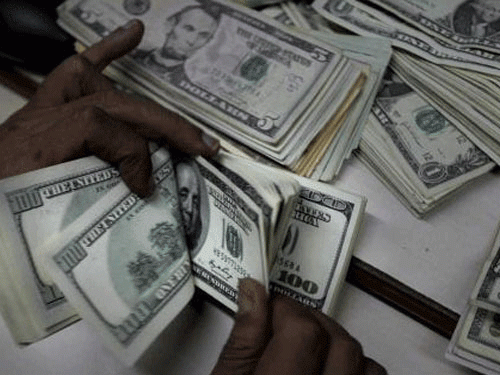
KARACHI: Pakistan’s current account swung to a surplus in January as remittances from overseas workers climbed, helping offset a widening trade deficit and offering a brief respite in the South Asian nation’s efforts to stabilise its external finances.
The surplus reached $121 million last month, reversing a $265 million deficit in December and improving from a $393 million shortfall in January 2025, according to data released on Tuesday by the State Bank of Pakistan. The shift was driven primarily by stronger inflows of workers’ remittances, which analysts said likely enabled higher imports while allowing the central bank to build up its foreign-exchange reserves.
Still, the broader picture remains challenging. For the first seven months of the fiscal year that started in July, the current account posted a deficit of $1.074 billion, compared with a surplus of $564 million in the same period a year earlier. That marks a stark deterioration from the full-year surplus of $1.932 billion in fiscal 2025, which government officials had touted as evidence of improving external stability.
The deficit’s expansion over July-January stemmed largely from a ballooning trade gap, with imports jumping to $36.662 billion from $33.383 billion a year ago, while exports slid to $18.26 billion from $19.327 billion. Economists attribute the import surge to resurgent industrial activity and elevated global oil prices amid regional tensions, even as exports grapple with persistent headwinds, including weaker demand in key markets.
Monthly trends in the current fiscal year have been volatile, with the account alternating between red and black ink. It started with a $254 million deficit in July, widened to $325 million in August, then flipped to a $100 million surplus in September. October brought a $291 million deficit, followed by a $98 million surplus in November and the $265 million gap in December. Cumulatively, the first quarter (July-September) showed a $737 million deficit, while the second quarter (October-December) narrowed to $458 million short.
On the brighter side, remittances rose 11% year-on-year in the July-January period, positioning inflows to potentially surpass the government’s $40 billion target for the full year — with some projections now pointing to around $42 billion. These transfers from Pakistanis abroad have been a critical buffer, helping sustain foreign reserves and manage the exchange rate, which the central bank has actively steered to project economic steadiness.
Yet financial analysts caution that mounting deficits could unsettle the rupee, which has stabilised the country’s external image in recent years. The State Bank holds relatively higher reserves bolstered by remittances, but challenges persist: foreign direct investment remains lackluster, and recent outflows from the equity market have compounded pressures on the government to maintain a positive front externally.
Regional uncertainty has further pushed up oil prices, exacerbating import costs, while exports continue to face obstacles that could weigh on overall growth. The central bank anticipates the current-account deficit will stay modest, within 0% to 1% of gross domestic product by the fiscal year’s end, according to Governor Jameel Ahmad.
Copyright © 2021 Independent Pakistan | All rights reserved