By Staff Reporter
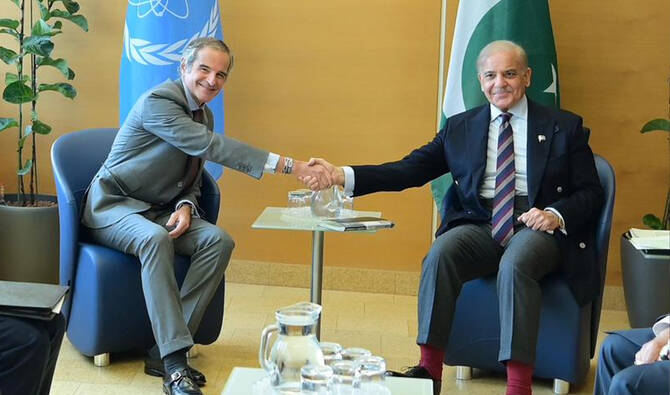
ISLAMABAD: Prime Minister Shehbaz Sharif reaffirmed his country’s backing for the International Atomic Energy Agency’s (IAEA) efforts to promote the responsible use of nuclear technology during a meeting with the agency’s director general in Vienna on Tuesday.
Sharif met IAEA Director General Rafael Mariano Grossi at the Vienna International Centre, according to a statement from the prime minister’s office. The prime minister highlighted Pakistan’s support for the IAEA’s work in fields including cancer diagnosis and treatment, agriculture, nuclear power generation and industrial applications, the statement said.
He commended the robust partnership between Pakistan and the IAEA, noting that Islamabad not only benefits from the agency’s technical cooperation programme but also contributes through its experts and by hosting international training for member states. Grossi, in turn, recognised Pakistan’s expertise in the peaceful applications of nuclear technology and praised the calibre of its engineers, scientists and technicians, according to the handout.
The IAEA chief also appreciated Pakistan’s input on nuclear safety and security issues, the statement said, adding that Grossi viewed Pakistan as well positioned to aid other member states in advancing peaceful nuclear uses. Grossi expressed anticipation for Pakistan’s active involvement in the Nuclear Energy Summit set to be hosted by France in March 2026, it said.
Following the discussions, an agreement was signed designating the Institute of Nuclear Medicine and Oncology (INMOL) in Lahore as an IAEA collaborating centre. Deputy Prime Minister and Foreign Minister Ishaq Dar, who attended the meeting, signed the pact alongside Grossi, the statement said.
In a post on social media platform X, Dar described the encounter as a “good catching up” with Grossi.”We discussed the vital role of the IAEA in advancing peaceful uses of nuclear technology and strengthening global nuclear safety and security,” Dar wrote. Grossi, in his own X post on Monday night, said he was honoured to host Sharif, underscoring Pakistan’s dedication to the safe and responsible deployment of nuclear technology for peaceful ends.
The Vienna meeting follows Grossi’s trip to Pakistan last year, where he assessed joint efforts on peaceful nuclear applications, including in energy, agriculture and cancer care .During that visit, he toured Pakistan Atomic Energy Commission cancer hospitals, opened new treatment units and met Sharif to discuss broadening ties under the IAEA’s “Rays of Hope” programme, which seeks to boost radiotherapy availability in developing nations.
Later that day, Sharif addressed an event at the United Nations Office in Vienna titled “Sustainable Development: Pathway for Global Peace and Prosperity,” where he urged a renewed global push for inclusive and equitable development. He described such a commitment as the sole effective route to lasting peace and shared prosperity amid overlapping crises. The world is at a juncture where geopolitical tensions, climate pressures and technological shifts are merging into a unified destabilising element, Sharif said. “The defining danger of our time is not any single threat, but the combination of many,” he told the gathering, pointing to poverty, debt burdens, mass displacement and lingering political disputes as amplifiers of global unrest.
Sustainable development must encompass all and ensure fairness, leaving no one out, the prime minister stressed. “Development cannot be called sustainable if it excludes millions from the promise of a better life,” he said. Sharif drew attention to the uneven load shouldered by developing nations, which contribute minimally to global emissions yet suffer the most from climate change, economic instability and debt woes.
Pakistan, emitting under 1% of worldwide greenhouse gases, ranks among the most exposed to climate disasters. He referenced the catastrophic 2022 floods that killed more than 1,700 people, ravaged crops and infrastructure, and uprooted millions, with later floods exacerbating the fallout. “These disasters erode human security at its core,” Sharif said, insisting that sustainable progress must rest on equity, justice and fair dealing.
Reaffirming Pakistan’s allegiance to the U.N. Sustainable Development Goals (SDGs), he said Islamabad has woven them into its national planning, prioritising human development, education, healthcare, food security and social safeguards, especially for women and young people. Pakistan’s sizable youth demographic poses both hurdles and prospects, Sharif said, calling for investments in skills, digital shifts and institutional bolstering to tap their capabilities.
Despite facing aggression and breaches of international pacts, Pakistan continues to champion dialogue, diplomacy and multilateral approaches as the key to settling disputes and averting strife, he said. Sharif advocated reinforcing and reforming the United Nations framework to better fulfil its role as a cornerstone of global peace and collaboration. He noted Vienna’s pivotal position in the U.N. ecosystem, housing bodies focused on counter-terrorism, crime prevention, industrial growth and the peaceful utilisation of nuclear technology and outer space.
Copyright © 2021 Independent Pakistan | All rights reserved