By Staff Reporter
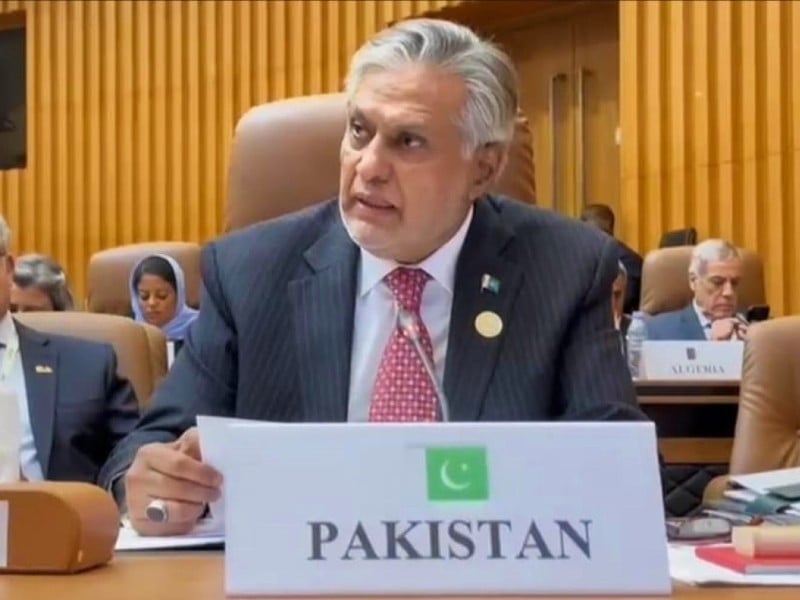
ISLAMABAD: The Deputy Prime Minister and Foreign Minister Ishaq Dar will travel Thursday to Saudi Arabia for a three-day visit, where he will take part in an emergency ministerial gathering of the Organization of Islamic Cooperation focused on Israel’s recent steps to expand control over the occupied West Bank.
The Open-Ended Extraordinary Ministerial Session of the OIC Executive Committee is scheduled for Thursday in Jeddah. It will examine the illegal decisions by Israeli authorities aimed at expanding settlements, pursuing annexation and attempting to impose Israeli sovereignty over the territory, Pakistan’s Foreign Office said in a statement on Wednesday.
The session comes against the backdrop of the Israeli government’s approval this month of procedures to register large areas of the West Bank as “state property” — the first such move since Israel occupied the territory in 1967. The action, which would ease the path for settlement expansion, has been widely criticized as a violation of international law prohibiting an occupying power from confiscating land in occupied territories.
Dar is expected to outline Pakistan’s position on what the Foreign Office described as “the latest illegal measures by Israel to convert areas of the Occupied West Bank into so-called ‘state land.’” He will also hold bilateral meetings with counterparts from OIC member states and make brief visits to the holy cities, the statement said.
The Israeli decision has drawn sharp condemnation from across the Muslim world and beyond. Pakistan joined 21 other Muslim nations and several European countries in a joint statement Wednesday that labeled the measures a “flagrant violation of international law, including previous United Nations Security Council Resolutions and the 2024 Advisory Opinion of the International Court of Justice.” “These latest decisions are part of a clear trajectory that aims to change the reality on the ground and to advance unacceptable de facto annexation,” the countries said.
The Palestinian presidency called the move a “serious escalation” that nullifies signed agreements and contradicts UN Security Council resolutions, according to the official Wafa news agency. Hamas described it as an attempt “to steal and Judaise lands in the occupied West Bank by registering them as so-called ‘state lands.’”
Most Palestinian land in the West Bank is not formally registered, largely because Israel halted the process after the 1967 war. Formal registration establishes permanent ownership. More than 500,000 Israeli settlers now live in settlements and outposts in the West Bank, excluding Israeli-annexed East Jerusalem, alongside roughly 3 million Palestinians. The settlements are considered illegal under international law.
Dar’s trip to the kingdom underscores the importance Islamabad places on its relationships with Arab and Islamic nations at a moment of heightened regional tensions. Speaking Wednesday at the Pakistan Governance Forum 2026 in Islamabad, he highlighted a Strategic Mutual Defense Agreement signed with Saudi Arabia on Sept. 17 last year as having lifted bilateral ties to “new heights.” “In the Middle East, our landmark Strategic Mutual Defense Agreement with Saudi Arabia has elevated our brotherly ties to new heights,” Dar said.
The pact formalises decades of military and security cooperation by stipulating that aggression against one would be treated as an attack on both. The two countries followed up in October 2025 with an economic cooperation framework aimed at boosting trade and investment.
Dar described enduring bonds with Islamic and Arab nations as “a vital pillar of our foreign policy.” He pointed to strengthened partnerships with the United Arab Emirates, Qatar, Jordan, Oman, Egypt and Bahrain that have produced concrete agreements in investment, agriculture, infrastructure and energy. He also noted recent visits to Pakistan by the presidents of Kazakhstan, Uzbekistan and Kyrgyzstan, reflecting growing interest from Central Asia. Ties with Bangladesh have been transformed into “a substantive partnership,” he said, while a new trilateral mechanism involving China, Pakistan and Bangladesh seeks to deepen regional cooperation. Pakistan’s “all-weather” partnership with China has been reinforced through the second phase of the China-Pakistan Economic Corridor, with both sides offering unwavering support for each other’s core interests.
Relations with the United States, Dar added, have been reinvigorated in areas including trade, technology, investment and regional stability. “This calibrated approach has enhanced our ability to navigate complexity with skill and confidence, ensuring that our national interests are served without compromising our core foreign policy principles,” he said.
Copyright © 2021 Independent Pakistan | All rights reserved