By Staff Reporter
ISLAMABAD: Pakistan’s main opposition alliance has decided to respond positively to any government offers for dialogue, a move that could open a narrow path toward easing the country’s long-running political standoff even as leaders issued sharp warnings about the health of imprisoned former prime minister Imran Khan.
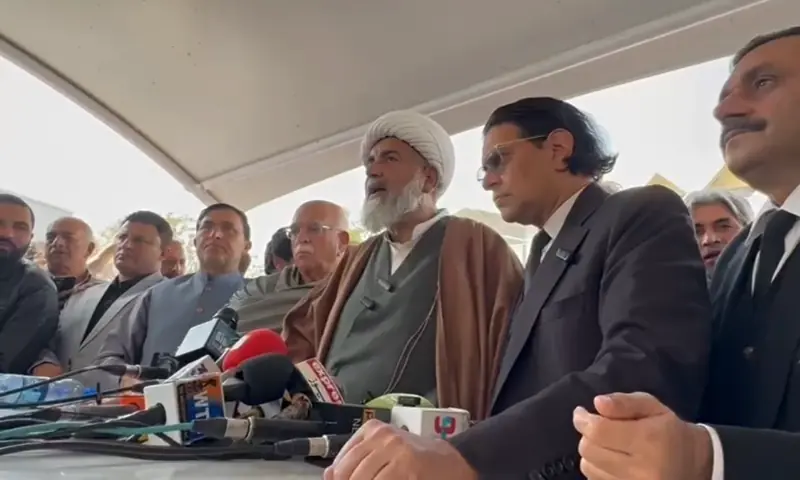
The decision was reached late Wednesday night after senior figures in the Tehreek Tahafuz Ayeen-i-Pakistan (TTAP) broke their fast together at the residence of alliance leader Mustafa Nawaz Khokhar in Islamabad and then held a closed-door meeting to review the political situation. Among those present were National Assembly opposition leader Mehmood Khan Achakzai, Senate opposition leader Allama Raja Nasir Abbas, PTI secretary general Salman Akram Raja, former prime minister Shahid Khaqan Abbasi, former National Assembly speaker Asad Qaiser, Sunni Ittehad Council leader Sahibzada Hassan and others.
One participant, speaking on condition of anonymity, said the discussion turned on a recent contact from a senior figure in the ruling Pakistan Muslim League-Nawaz. The PML-N emissary had reached out to Abbas, the source said, conveying that Prime Minister Shehbaz Sharif wanted to resolve outstanding issues between the government and the opposition and would not backtrack from any agreement reached. “It was then unanimously decided that the TTAP would give a positive response to any offer for talks by the government,” the participant told local media.
The same source quoted the gathering’s mood as cautiously skeptical. “We want to see if the government will once again backtrack from its words,” the participant said. “If the government backtracks, people will judge it and will know who is serious about the future of the country.”
Qaiser, contacted separately, was blunt about the alliance’s bottom line. The TTAP has just one immediate demand, he said: that Khan’s family be allowed to meet him and that his personal physicians be permitted to examine him. “Now it is in the hands of the government whether it wants to cool down the temperature or not,” Qaiser said. The overture comes a few days after PML-N Senator and prime ministerial aide Rana Sanaullah used a Senate speech to extend what he called an olive branch. Sanaullah urged opposition lawmakers to rejoin parliamentary standing committees and help advance the Charter of Democracy, the 2006 pact between the PML-N and the Pakistan Peoples Party that has long been invoked as a blueprint for civilian rule. “Let us sit together to strengthen and take forward the charter of democracy,” Sanaullah said in the Senate. “The government is ready for a dialogue to strengthen democracy and avoid confrontation and deadlock.”
It is not the first such invitation. Similar offers were made by government leaders in November and December, but none produced tangible progress. Formal talks collapsed last month after both sides refused to yield on core demands. The PTI had insisted on two separate judicial commissions — one to investigate the May 9, 2023, riots and another for events on Nov. 26, 2024 — along with the release of jailed party leaders and workers.
Later on Thursday the TTAP issued a detailed statement on X laying out its position. The alliance demanded that Khan receive immediate treatment at Shifa International Hospital in Islamabad, be examined by his personal doctors, Dr. Faisal Sultan and Dr. Aasim Yusuf, and that all restrictions on meetings with his lawyers and family be lifted immediately. It described Khan’s continued imprisonment as unjust and called for his release, along with that of other political prisoners including Sunni Ittehad Council chairman Sahibzada Hamid Raza, Bushra Bibi, Shah Mahmood Qureshi, Yasmin Rashid, Umar Sarfaraz Cheema, Ejaz Chaudhry, Ali Wazir and Mahrang Baloch.
The statement voiced “grave concern over the continued concealment of Imran’s medical reports and test results from his family,” warning that “criminal negligence regarding the former prime minister’s health could push the country’s political crisis onto an even more dangerous path.” Khan, who has been in custody since August 2023, was diagnosed with central retinal vein occlusion, a serious eye condition. A medical report submitted to the Supreme Court this month said he has lost approximately 85 percent of the vision in his right eye. On Feb. 24 he was taken to the Pakistan Institute of Medical Sciences for a second dose of anti-VEGF intravitreal injection. The PTI has repeatedly demanded that he be shifted to Shifa under the care of his own doctors; the government has accused the party of politicizing the issue.
Separately, PTI leaders confirmed the alliance’s decision to engage. Atif Khan, a senior party figure, said all opposition parties at the meeting had unanimously authorised Achakzai and Abbas to represent the TTAP in any future talks. “We were told to engage in dialogue for the sake of Pakistan and the Constitution, and we have agreed,” he said. Junaid Akbar, president of the PTI’s Khyber Pakhtunkhwa chapter, added that the opposition remained committed to political engagement. “We are political people and have faith in the negotiation process,” he said. “If political space is not provided, the negotiation process cannot move forward.”
Beyond the immediate question of dialogue, the TTAP statement catalogued a broad set of national challenges. It expressed alarm at the surge in terrorist attacks, particularly in Khyber Pakhtunkhwa and Balochistan, and called on the federal and provincial governments to work with all stakeholders on a concrete national strategy. It urged Islamabad and Kabul to open “concrete, sincere and meaningful negotiations” to address cross-border militancy and asked Pakistan to reach out to Saudi Arabia and Turkey for help in averting wider regional bloodshed.
On the economy, the alliance cited official figures showing poverty at 29 percent and unemployment at a 21-year high. It noted the recent departure of hundreds of multinational companies and accused the government of lacking any serious plan to reverse the decline in both foreign and domestic investment. Opposition leaders said they would present an alternative budget and a series of policy proposals in the coming months.
The statement also condemned any prospect of a US military strike on Iran, calling on Islamabad to play a diplomatic role to prevent it and declaring that “Pakistan’s solidarity with Iran is the need of the hour.” It sharply criticised the government for joining what it termed Donald Trump’s “Board of Peace,” describing the initiative as an attempt to create a non-representative alternative to the United Nations that deliberately excludes Palestinians. Opposition leaders are expected to begin reaching out to government figures during the remaining weeks of Ramadan, according to participants.
Copyright © 2021 Independent Pakistan | All rights reserved