By Staff Reporter
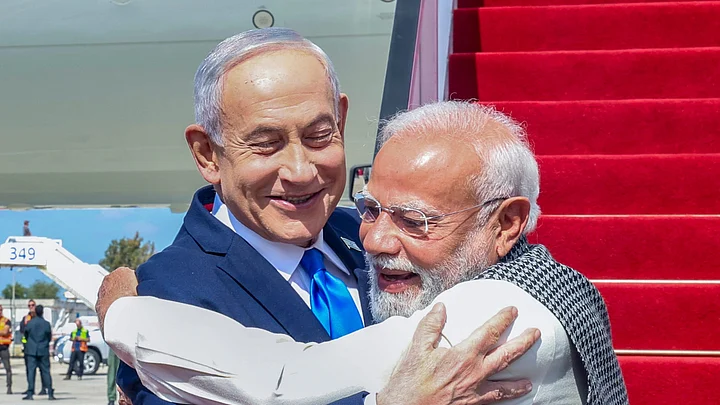
When Narendra Modi stood in Israel’s Knesset last week and received a standing ovation, the timing could scarcely have been more revealing. Just days later, joint US-Israeli strikes assassinated Iran’s Supreme Leader Ayatollah Ali Khamenei in an attack on his compound in downtown Tehran. India’s prime minister, fresh from hugs with Benjamin Netanyahu and the signing of a sweeping new “Special Strategic Partnership”, offered little more than a muted call for “early cessation of hostilities” and a phone conversation expressing “concerns”.
There was no condemnation of the assassination of a head of state, no expression of condolence, and no defence of the sovereignty India has historically claimed to uphold. This was not an oversight. Modi’s visit was a deliberate political statement. He became the first Indian prime minister to address the Knesset, denounced Hamas’s 7 October attack as “barbaric”, spoke warmly of shared “democratic values” and endorsed a Trump-brokered “peace plan” for Gaza without once mentioning the more than 70,000 Palestinian deaths reported by authorities there.
Netanyahu, facing accusations of war crimes and isolation, gratefully called Modi “more than a friend, a brother”. Sixteen new agreements followed, including deep defence co-production on missile systems and a plan to import 50,000 Indian workers to replace Palestinians barred from Israeli jobs. Bilateral arms trade, already worth billions, continues to flourish: India remains Israel’s largest customer, taking roughly a third of its exports and supplying components even during the Gaza offensive.
The shift is stark. For decades after independence, India – itself born of partition – viewed Israel through the prism of Palestinian dispossession. Nehru opposed its creation and championed a secular state for all. Successive governments supported Palestinian statehood at the UN and kept Israel at arm’s length. That changed with Modi. Since his 2017 visit, the first by any Indian prime minister to Israel, New Delhi has pursued defence, technology and intelligence ties with enthusiasm. Analysts say the relationship has become ideological as well as pragmatic.
Azad Essa, author of Hostile Homelands: The New Alliance Between India and Israel, said Delhi is now “Israel’s strongest non-Western ally”. The partnership, he argues, rests on “ideological convergence” between Hindutva and Zionism – both “expansionist and exclusionist”, fuelled by narratives of historical grievance and civilisational destiny. Muhammed Karakus of Adiyaman University is blunter: both ideologies are “anti-Muslim in their nature”, seeking to suppress or expel large Muslim populations. He draws direct parallels between Israel’s demolition of more than 55,000 Palestinian structures since 2022 and India’s “bulldozer justice” against its own Muslim communities; between the dreams of Eretz Israel and Akhand Bharat; and between the military lockdown in Kashmir since 2019 and Israel’s occupation policies. “They both see Muslims as outsiders and as a demographic threat,” Essa adds. “Both ideologies view Kashmir and Palestine as ordained through religious mythology.”
Netanyahu clearly needed the visit. As Muhammed Athar Javed, a Copenhagen-based security expert, noted, “the Israeli Prime Minister needs a global and regional consent” while facing accusations of genocide and crimes against humanity. India, unlike Russia and China, has refused to criticise the US military build-up in the Gulf – a silence Israeli officials have read as tacit approval. The proposed “hexagon alliance” that Netanyahu is promoting, with India as a central pillar, fits the pattern. Described by supporters as flexible “minilateral” cooperation on security, technology and the India-Middle East-Europe Corridor (IMEC), critics see it as part of Israel’s long-standing “neo-periphery doctrine” – an attempt to build alliances beyond its Arab neighbours.
Tehran-based analyst Ali Akbar Dareini calls it little more than “an attempt to sell an idea that doesn’t exist on the ground”. India insists it is merely protecting its interests. Yet the costs of this alignment are already visible. Opposition parties have reacted with fury. Priyanka Gandhi Vadra called the killing of Iran’s leadership “despicable” and accused Modi of having “genuflected” before Netanyahu and Trump. Jairam Ramesh labelled the visit itself “shameful moral cowardice”, noting that Modi was in Jerusalem on 25-26 February, fully aware an attack was imminent. “The assault began just two days after Mr Modi left Israel,” he wrote. Congress spokesperson Pawan Khera called the government’s silence “a complete betrayal” that makes India “look this weak”. CPI leader D Raja warned that the US-Israel “nexus represents evil in its most naked form” and that India’s strategic investment in Iran’s Chabahar port – vital for access to Afghanistan and Central Asia – is now directly threatened. Asaduddin Owaisi called the assassination “immoral and unlawful”. Even in occupied Kashmir, Chief Minister Omar Abdullah and Mehbooba Mufti expressed “profound anguish”.
Iran had already signalled its displeasure. A foreign ministry spokesperson criticised Modi for ignoring Palestinian suffering and “rewarding” Israel at a moment when it stands accused of war crimes in Gaza. Tehran had expected a historic friend to restrain the Zionist regime, not embrace it. The risks for India are concrete. More than 80% of its oil passes through the Strait of Hormuz. Remittances from nine million Indians in the Gulf are at stake. A wider conflict could derail Chabahar entirely. Yet New Delhi appears prepared to accept these dangers in exchange for deeper integration into an American-Israeli economic and security orbit – including the IMEC project, in which the Adani Group already holds a major stake in Haifa port. What we are seeing is the consolidation of something larger: an emerging “nationalist international” of ethno-nationalist governments bound by shared hostility to liberal norms, minority rights and international law. In a world where old constraints on power are fraying, leaders such as Modi and Netanyahu can pursue ideological affinity without the need even to pay lip service to human rights concerns. India’s traditional claim to strategic autonomy – balancing relations with Iran, the Gulf states, Russia and the West – is being tested as never before. The silence after Khamenei’s death, the warmth in Jerusalem, the ideological parallels at home: all suggest that New Delhi has made a choice. Whether that choice ultimately strengthens India or merely isolates it in a region it once sought to navigate with principle intact remains to be seen. The coming weeks of turmoil from Tehran to the Gulf will provide the answer.
Copyright © 2021 Independent Pakistan | All rights reserved