By Staff Reporter
ISLAMABAD: A senior Pakistani security official has dismissed as baseless any suggestion that Islamabad could become the next target of US-Israeli military action in the wake of fresh strikes on Iran, describing the speculation as “devoid of facts” and the work of “agents of chaos”, Dawn Newspaper reported on Tuesday.
In a briefing shared with the newspaper, the official rejected outright any parallel between Pakistan and Iran, insisting the two countries were fundamentally different in military strength, foreign policy orientation and internal cohesion. Those circulating “alarmist narratives”, he said, were driven by “nefarious and vested interests”.
The comments come as the Middle East conflict escalates sharply. For the second time in eight months, Israel and the United States launched coordinated airstrikes against Iranian targets. Tehran responded by striking Israeli territory and American military facilities in neighbouring countries, raising the spectre of a wider regional war.
In the days since the latest exchanges, speculation has grown in some quarters – including analyses from Western thinktanks – that the conflict could spill over to other nuclear-armed states in the region, with Pakistan occasionally mentioned as a potential flashpoint.
The official, however, was categorical in his rebuttal. “The misperception of Pakistan likely to be the next target is devoid of facts and is highly misplaced,” he said, according to the briefing. “Pakistan can never be equated with Iran as both countries are different militarily and in terms of foreign policy, external engagement and internal dynamics.”
He portrayed Pakistan as a country deeply integrated into the international system and fully capable of defending itself. Islamabad, he said, pursued “a robust foreign policy” rooted in engagement with multiple global players “for the sake of stability and prosperity of the people of Pakistan”. Relations with the outside world were built on “mutual respect and trust”, he added – a stance often described as hedging, balancing ties with Washington, Tehran and Riyadh while avoiding entanglement in rigid bloc politics.
Unlike Iran’s openly adversarial relationship with the West, Pakistan maintains active defence cooperation with Saudi Arabia, economic engagement with the United States, and a working, if sometimes strained, relationship with Iran, with whom it shares a long border and limited trade. Officials have long argued that this multi-vector approach secures economic stability, including energy supplies, while insulating the country from the worst shocks of regional turmoil.
On the military front, the official emphasised deterrence. “Pakistan is fully capable of defending its sovereignty and territorial integrity, and the same has been displayed during recent events of Marka-i-Haq and our protracted fight against the scourge of terrorism,” he said. The phrase Marka-i-Haq refers to Pakistan’s military confrontation with India in May 2025, which included a 96-hour operation codenamed Bunyan-un-Marsoos in which 26 targets were struck inside Indian-held territory.
“Pakistan’s armed forces, with the support of the brave and resilient nation, will thwart all nefarious designs of our enemies,” the official added. “Anyone having any doubt is most welcome to get his notions settled.”
The briefing also underscored Islamabad’s longstanding ties with Riyadh. “Pakistan greatly values its decade-old brotherly and strategic relations with Saudi Arabia,” the official said, pointing to deep defence and economic partnerships built over many years.
On the question of possible Pakistani involvement in the International Stabilisation Force (ISF) being assembled by US President Donald Trump’s Board of Peace for post-ceasefire arrangements in Gaza, the official indicated that no decision had yet been taken. “Details regarding ISF are yet to be worked out. The decision of Pakistan’s participation will be taken by the government of Pakistan after due diligence.”
The official also addressed the wave of protests that swept Pakistan following the assassination of Iran’s supreme leader, Ayatollah Ali Khamenei. Demonstrations were held in several cities, and at least 20 people died in related unrest. “Pakistan has expressed concerns over unfortunate events in Iran,” he said. While acknowledging that “peaceful protest is the right of people”, he warned that “violence in the garb of protests cannot be condoned”. Any attempt to exploit the situation to create chaos, he added, would be dealt with according to the law. “Few miscreants cannot be permitted to bring a bad name to peaceful protesters.”
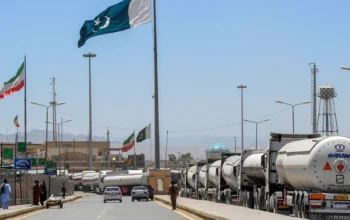
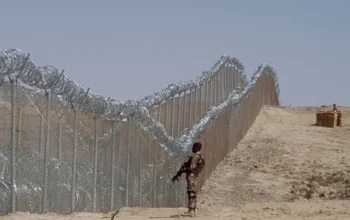
On Pakistan’s western border, the official made clear there would be no early end to Operation Ghazab lil-Haq, the cross-border military campaign launched on 26 February after Afghan Taliban fighters attacked Pakistani posts. The operation followed Pakistani strikes four days earlier on terrorist hideouts in Afghanistan.
Islamabad says those 22 February strikes targeted infrastructure used by the banned Tehreek-i-Taliban Pakistan (TTP) – which the Pakistani state routinely refers to as Fitna-al-Khawarij – along with other groups operating from Afghan soil. “Pakistan is in no hurry to end Operation Ghazab lil-Haq,” the official said. “It’s time for terrorism supporters and abettors to bleed and suffer.”
Operations would continue, he added, until the Taliban regime in Kabul provided “verifiable assurance of compliance” with Pakistan’s demand that it stop facilitating the TTP and groups the state has labelled Fitna-al-Hindustan – a term used to highlight alleged Indian involvement in destabilisation efforts, particularly in Balochistan.
The official was scathing about the Afghan Taliban, describing them as a “proxy master harbouring multiple terrorist groups to disturb regional peace” and accusing their leaders of flourishing on a “war economy in the garb of their perverted religious ideology” where “their leaders’ only religion is money and nothing else”. He rejected suggestions that Pakistan was seeking regime change in Kabul. “Pakistan has nothing to do with regime change in Afghanistan, it is the prerogative of the Afghan people,” he said. “They are happy that someone has stood up to these cruel warlords.”
Defending the conduct of the current operation, the official insisted targets were “specific and intelligence-driven” and focused on terrorist infrastructure rather than random sites or civilians. “We have destroyed more than 180 posts and captured more than 30 … All these are those posts from where terrorists were being facilitated as launch pads,” he said. Pakistan had “no issue with the people of Afghanistan”, he added; operations were aimed solely at “perverted kharjis and their supporters”. He also accused the Taliban regime and “their Indian masters” of running a disinformation campaign through official accounts and urged observers to “fact-check everything”.
The official linked the Pakistani army’s continued heavy involvement in internal security to shortcomings in civilian governance. “Pakistan Army’s involvement in internal security is due to governance gaps,” he said. “Our involvement is because of the non-implementation of the National Action Plan (NAP) in totality and the politicisation of institutions that are primarily responsible for internal security.” He called on political parties and successive governments to improve governance and fully implement the NAP. “We have no interest in politics and other matters.”
Copyright © 2021 Independent Pakistan | All rights reserved