By Staff Reporter
ISLAMABA: Iranian President Masoud Pezeshkian said Wednesday that reparations and firm international guarantees against future aggression were the only way to end the war ignited by Israel and the United States, issuing the demand in a late-night post on X after separate conversations with the leaders of Pakistan and Russia.
Pezeshkian wrote that he had “reaffirmed Iran’s commitment to peace in the region,” adding that any resolution must include “recognising Iran’s legitimate rights, payment of reparations, and firm int’l guarantees against future aggression.”
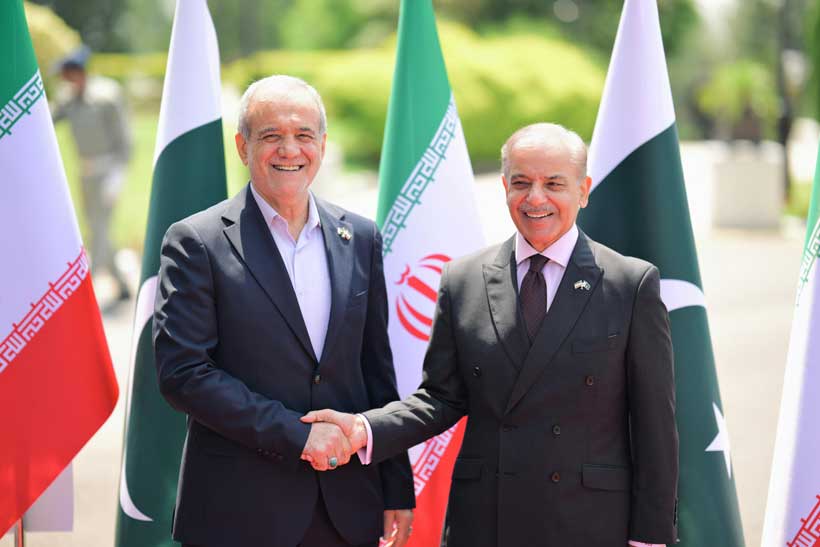
He described the conflict — now in its second week — as one started by “the Zionist regime [of Israel] & US.” The Iranian leader’s statement came hours after Prime Minister Shehbaz Sharif telephoned him to quietly explore prospects for a cease-fire. Officials from both the prime minister’s office and the Foreign Ministry privately confirmed the conversation took place, though neither institution issued a public statement.
Sharif’s outreach followed a congratulatory message he sent a day earlier to Iran’s new supreme leader, Ayatollah Mostafa Khamenei. During the call, Sharif offered condolences over the assassination of former supreme leader Ali Khamenei and congratulated Pezeshkian, the government and the Iranian people on the election of Ayatollah Seyyed Mojtaba Khamenei as his successor. He expressed hope that Iran would achieve even greater prosperity under the new leadership, the officials said.
Diplomats familiar with the exchanges told Dawn newspaper that US envoy Steve Witkoff had sent two separate proposals to Tehran on Tuesday outlining possible dates to halt hostilities. Iranian officials did not reply. When no response came, the United States turned to European and regional governments to relay the ideas or help arrange mediation, the diplomats said.
Pezeshkian also cited in his post a conversation he had held a day earlier with Russian President Vladimir Putin. The Kremlin said Putin had reiterated support for a swift de-escalation and a political resolution to the fighting. It was the second contact between the two presidents this month. Putin later spoke with President Donald Trump and offered suggestions for lowering tensions in the Middle East, according to the Kremlin.
Iranian state media, as quoted by Turkey’s Anadolu Agency, carried additional remarks from Pezeshkian underscoring Tehran’s position. He said Iran had “no intention of targeting or engaging in conflict with regional countries” and would strike only “bases from which Iranian territory was attacked” and only “within the framework of the right to self-defence.” “If the international community and international organizations do not pay attention to and address the main factors behind this imposed war and military aggression against Iran,” he warned, “the conditions governing global order and security will become chaotic and unstable.”
Meanwhile, Pakistan made clear its alignment with Saudi Arabia as the conflict reverberates across the region. In an interview broadcast Wednesday on Bloomberg Television, Mosharraf Zaidi, the prime minister’s spokesperson for foreign media, said Islamabad would stand by Riyadh “before it is needed… no matter what, no matter when.”
Zaidi was asked whether Pakistan would provide military or other aid to Saudi Arabia in the war triggered by U.S.-Israeli strikes on Iran. “The question is not whether Pakistan might come to Saudi Arabia’s aid,” he replied. “Both countries, even before the strategic mutual defence agreement, have operated on a principle of being there for the other before they need the other. So there is no question that we might; we will. No matter what, no matter when.”
He said the more pressing issue was what Pakistan was doing to keep the situation from escalating and drawing its closest partners deeper into conflict. Zaidi pointed to the recent visit to Saudi Arabia by Field Marshal Asim Munir, Pakistan’s chief of defence forces and chief of the army staff, and said Islamabad remained in regular contact with both Saudi and Iranian officials. He noted that Prime Minister Sharif and Munir also maintained close ties with American leaders.
Saudi Arabia has already arranged additional support for Pakistan’s energy needs, including supplies of oil, diesel and crude to ensure supply-chain stability, Zaidi said. On Pakistan’s dealings with Iran, Zaidi described the country as “very conscious of its responsibility as a close ally and friend” to all parties. He said Deputy Prime Minister and Foreign Minister Ishaq Dar had held several conversations with Iranian Foreign Minister Abbas Araghchi over the past two weeks. “We don’t like our friends getting into quarrels with each other, and we certainly don’t like innocent people dying needlessly,” he added.
Zaidi also highlighted the practical risks of escalation, noting that reliance on alternative supply routes for fuel could stretch delivery times to 18, 19 or 20 days — compared with the normal five to six days — complicating Pakistan’s planning.
Copyright © 2021 Independent Pakistan | All rights reserved