By Staff Reporter
ISLAMABAD: The government has ruled out any risk of fertiliser shortages for the ongoing Rabi 2025-26 season and the upcoming Kharif 2026 planting, even as the escalation of conflict in Iran and the broader Middle East sharply raises threats to global energy and agrifood supply chains.
The Ministry of National Food Security and Research said in an internal situation report that domestic production and existing inventories are more than sufficient to meet demand through both cropping cycles. The assessment underscores the resilience of Pakistan’s fertiliser sector at a time when international markets face heightened volatility from potential disruptions to energy feedstock and shipping routes.
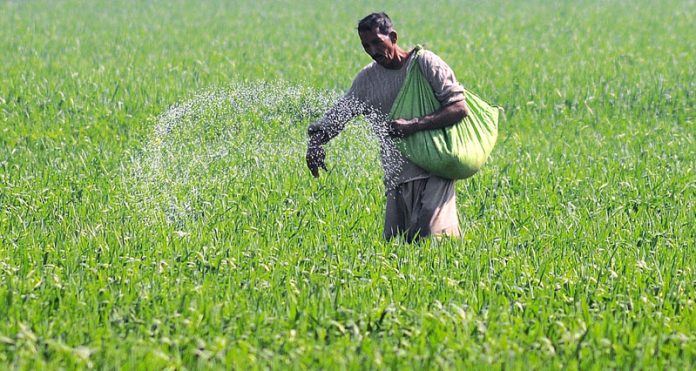
The country’s fertiliser industry is operating in close alignment with demand, covering 90% to 95% of total urea requirements through local output and relying on imports only for the residual gap, the ministry said. Fertiliser consumption has been expanding at an annual rate of 2% to 5%, a pace that officials link directly to rising agricultural productivity across the country’s 22 million to 23 million hectares of cultivated land.
Buffer stocks equivalent to 5% to 10% of seasonal requirements provide an additional layer of protection, the report noted. Sustained natural-gas deliveries of 700 million to 800 million cubic feet a day will be essential to maintain that stability, it added.
Surpluses Already Visible in Current Rabi Season
Data compiled for the current Rabi season show urea availability has already topped 3.5 million tons against demand of roughly 3.3 million tons, generating a surplus of 150,000 to 200,000 tons. DAP availability has exceeded 700,000 tons while demand stands at about 650,000 tons, the ministry said.
Looking ahead, projected urea supply for Kharif 2026 is estimated at 3 million to 3.2 million tons against expected demand of 2.9 million to 3 million tons. DAP availability is forecast at 750,000 to 800,000 tons versus demand of around 700,000 tons, leaving a comfortable cushion of 50,000 to 100,000 tons.
Domestic urea prices have remained stable at Rs3,700 to Rs4,000 per 50-kg bag, well below international equivalents that now exceed Rs5,500 to Rs6,000 per bag. DAP is trading locally between Rs11,500 and Rs12,500 per bag, compared with global levels above Rs14,000, according to the report.
Robust Production Base Anchored by Gas Supply
Pakistan’s installed urea production capacity stands at about 7 million tons a year. The sector is dominated by a handful of large players: Fauji Fertiliser Company with more than 2.5 million tons, Engro Fertilisers at 2.3 million tons, Fatima Fertiliser with 700,000 to 800,000 tons, and Fauji Fertiliser Bin Qasim, which holds DAP capacity of roughly 650,000 tons.
The industry consumes 700 million to 800 million cubic feet of gas daily. Roughly 60% to 65% of output depends on supplies from the Sui Northern Gas Pipelines Ltd network, with the balance running on dedicated or diverted gas fields. Even if one or two plants are temporarily offline for maintenance, remaining capacity still covers 85% to 90% of national demand, the ministry said.
Over the past five years, urea consumption has risen from 6 million tons to between 6.8 million and 7 million tons, implying a compound annual growth rate of 2% to 3%. DAP usage has climbed from 1.1 million tons to nearly 1.4 million tons, reflecting a 4% to 5% CAGR.
Annual urea demand now fluctuates between 6.5 million and 7 million tons, while DAP requirements range from 1.2 million to 1.5 million tons. Seasonal patterns are pronounced: Rabi planting, dominated by wheat on about 9 million hectares plus another 2 million to 3 million hectares of gram and oilseeds, accounts for 55% to 60% of yearly urea consumption. Kharif, featuring rice on roughly 3 million hectares, cotton on 2 million to 2.5 million hectares and sugarcane on more than 1.2 million hectares, drives about 60% of annual DAP demand.
The ministry described the latest figures as evidence of “a stable, growing and well-managed fertiliser ecosystem supporting the agricultural economy.” Officials said the combination of domestic capacity, strategic stocks and controlled gas allocations has insulated Pakistan’s farming sector from the supply shocks now rippling through global markets.
Copyright © 2021 Independent Pakistan | All rights reserved