By Staff Reporter
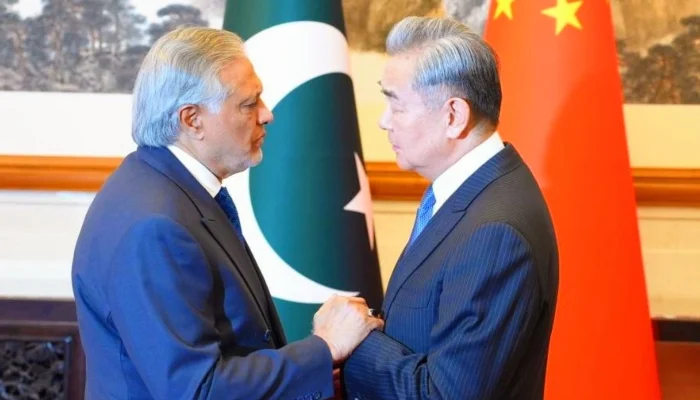
ISLAMABAD: Chinese Foreign Minister Wang Yi told Pakistan’s deputy prime minister and foreign minister that Beijing appreciates Islamabad’s “active diplomatic role” in trying to end the Middle East conflict, Pakistan’s Foreign Office said on Wednesday, as the two countries unveiled a joint five-point initiative aimed at halting hostilities in the Gulf and broader region.
The remarks came during Wang’s meeting on Tuesday with Ishaq Dar in Beijing, part of a visit that both sides described as warm and focused on regional crises as well as deepening their long-standing strategic partnership. The encounter produced a five-point peace proposal calling for an immediate cessation of hostilities and the prompt start of talks, the Foreign Office said in a detailed statement.
“The meeting was marked by traditional warmth and cordiality,” the statement said. “Both dignitaries exchanged notes on the regional developments in West Asia as well as bilateral relations.”
Dar used the session to brief Wang on Pakistan’s persistent diplomatic push to stop the fighting and restart dialogue, including a recent quadrilateral meeting hosted in Islamabad that brought together the foreign ministers of Saudi Arabia, Turkey and Egypt. Both ministers reviewed the regional security picture and voiced “deep concern” over the serious socioeconomic fallout the conflict is having on developing countries, the Foreign Office reported.
In the five-point initiative, Pakistan and China jointly urged an end to the violence and the opening of peace negotiations “as soon as possible,” according to the statement. The document reflects Islamabad’s growing profile as a potential broker in the crisis and Beijing’s explicit backing for that role.
The two sides also expressed satisfaction with the trajectory of their bilateral relationship, which is marking the 75th anniversary of diplomatic ties this year. They pledged to advance “high-quality development and strategic cooperation” under the second phase of the China-Pakistan Economic Corridor, known as CPEC 2.0, and to expand high-level exchanges.
Dar thanked Wang for the “warm welcome and exceptional hospitality” extended to him and his delegation. The ministers also discussed Afghanistan, agreeing on the need for peace and stability there and on the “critical importance of countering terrorism effectively,” the Foreign Office said. They committed to staying in regular contact.
Dar later posted on X, the social media platform formerly known as Twitter, to express his personal appreciation. “Well done Team Pakistan at our Embassy in Beijing, the Ministry of Foreign Affairs of Pakistan, for their professionalism and support in ensuring the successful conduct of this visit,” he wrote. He also described Wang as “my dear friend” and praised the “warm hospitality and excellent arrangements” during the trip.
The Beijing meeting comes against the backdrop of Pakistan’s broader diplomatic initiative on the Middle East. On Sunday, Islamabad signalled that it could host direct talks between the United States and Iran in the coming days, following the quadrilateral gathering in the Pakistani capital.
Pakistan’s mediation efforts between Washington and Tehran have attracted notable international support, particularly from China. Beijing has endorsed Islamabad’s role and encouraged Iran to engage in dialogue.
In a telephone call with Dar last week, Wang described the task of starting peace talks amid “the war on Iran” as “no easy task” but one that would be “conducive to restoring normal navigation through the Strait of Hormuz,” according to Pakistani officials.
Copyright © 2021 Independent Pakistan | All rights reserved