By Staff Reporter
ISLAMABAD: Pakistan has decided to repay its entire $3.5 billion debt to the United Arab Emirates this month, a senior cabinet minister said on Friday, resolving weeks of speculation over whether Abu Dhabi would continue rolling over the short-term financing that had become a monthly ritual.
The political leadership in Islamabad has opted to settle the full amount rather than seek further extensions, the minister told journalists in a background briefing at his office. Government authorities outlined a precise repayment schedule: $450 million on April 11, $2 billion on April 17 and the remaining $1 billion on April 23. The payments will be made from the State Bank of Pakistan’s foreign-exchange reserves, which stood at $16.4 billion, officials said.
The $450 million tranche dates back to 1996-97 and was originally a one-year loan that Pakistan is now clearing nearly three decades later, according to a separate government official familiar with the matter. The larger portions stem from more recent support: $2 billion extended by the UAE in 2018 for an initial one-year term, and an additional $1 billion provided in 2023 to help meet external financing needs tied to the country’s International Monetary Fund program.
The decision marks a shift from recent patterns. In January, the UAE rolled over two $1 billion loans — which had matured on Jan. 16 and Jan. 22 — for just one month, rejecting Pakistan’s request for a two-year extension and an interest-rate reduction to about 3%. Abu Dhabi maintained the existing 6.5% rate. A further short-term rollover to April 17 had been agreed in principle as recently as February, following outreach by Deputy Prime Minister Ishaq Dar, officials said.
While the cabinet minister confirmed the full repayment, some senior government officials indicated that discussions were still under way to potentially convert a portion of the debt into direct investment. Pakistan had been paying roughly 6% interest on the amounts in recent months, down from the original 3% rate on the 2018 facility before it rose last year.
The repayment comes against a backdrop of heightened geopolitical tensions. Officials and analysts familiar with the talks said the UAE’s earlier reluctance to extend the financing gave way after the recent US-Israel-Iran conflict accelerated Abu Dhabi’s decision to call in the funds, which had originally been extended on a one-year basis. The move will contribute to a heavy debt-service calendar for Pakistan in April. Including a $1.3 billion Eurobond repayment due on April 8, the country will clear a cumulative $4.8 billion in external obligations this month.
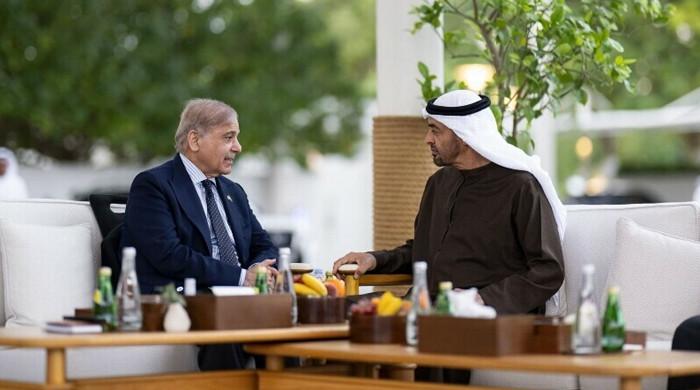
Under its $7 billion IMF program, the UAE, Saudi Arabia and China had committed to keeping a combined $12.5 billion in cash deposits with the State Bank of Pakistan at least until the facility expires in September 2027. State Bank Governor Jameel Ahmad had formally requested a two-year rollover of the $2.5 billion UAE portion in December, followed by a similar appeal from Prime Minister Shehbaz Sharif to the UAE president. Sharif later said the UAE had agreed to an extension but provided no further details at the time.
In early February, Ahmad had told reporters that the UAE was no longer demanding immediate repayment of the $2 billion facility and had instead moved to monthly rollovers. That stance has now reversed. Prime Minister Sharif has repeatedly highlighted the strains of relying on such bilateral support. Addressing exporters and industrialists earlier this year, he acknowledged that the rise in central bank reserves owed much to the $12 billion in deposits from friendly countries. “Our self-respect suffers greatly when we take on debt,” he said, adding that lender nations sometimes seek concessions in return “and we cannot say too many things they want us to do.”
Pakistan’s external accounts remain under pressure. Exports have fallen 8% in the first nine months of the current fiscal year, and the government is struggling to devise a credible plan to double them from $32 billion to $64 billion over the next three years — a target tied to eventually exiting IMF support. Foreign direct investment has declined sharply this fiscal year despite official efforts to attract fresh capital. A planned $250 million Panda bond issuance scheduled for January was shelved after internal mismanagement.
Still, officials sought to project confidence. The senior cabinet minister noted that official reserves remain at “comfortable levels” and pointed out that Pakistan had previously managed with as little as one week’s worth of import cover.The Abu Dhabi Fund for Development had placed the $3 billion in three separate $1 billion tranches with the central bank. The two that matured in January were rolled over for one month; a third $1 billion tranche is due in July and will be addressed closer to maturity, officials said. Pakistan is separately seeking rollovers of roughly $12 billion in total external deposits this fiscal year, including $5 billion from Saudi Arabia and $4 billion from China.
Copyright © 2021 Independent Pakistan | All rights reserved