By Staff Reporter
ISLAMABAD: Pakistan’s behind-the-scenes diplomacy to avert full-scale war between the United States and Iran reached a “critical, sensitive stage” on Tuesday even as Tehran rejected a proposed ceasefire, Iranian missiles struck Saudi industrial targets and President Donald Trump warned that a “whole civilization will die” if Iran failed to reopen the Strait of Hormuz by his 8 pm Eastern time deadline.
Two Pakistani sources with direct knowledge of the talks told Reuters that Iran’s overnight strike on Saudi Arabia’s Jubail industrial complex — home to facilities linked to U.S. firms — had pushed the fragile negotiations to the brink. One senior Pakistani security official said any Saudi retaliation would end the dialogue immediately and could pull Pakistan into the conflict under its defence pact with Riyadh. The second source described Iran as “walking on thin ice,” warning that the next three to four hours would determine whether talks survived.
Pakistan has served as the primary conduit between Washington and Tehran for weeks, shuttling proposals in both directions. Yet no compromise has emerged. The senior security official said Iranian officials had recently signaled flexibility about joining negotiations but continued to insist on preconditions that Islamabad was urging them to drop.
Iran’s ambassador to Pakistan, Reza Amiri Moghadam in a post on X, said that Pakistan’s “positive and productive endeavors in goodwill and good office to stop the war” had reached a pivotal moment. “Stay tuned for more,” he added.
Iranian officials have made clear their position. A senior Iranian source told Reuters that Tehran had rejected a Pakistani-brokered framework for an immediate ceasefire and temporary reopening of the strait. Any lasting peace talks, the source said, could begin only after the United States and Israel halted their strikes, provided guarantees against future attacks and offered compensation for damage. Iran’s foreign ministry spokesman confirmed on Monday that messages were still being exchanged through mediators, while the state news agency IRNA reported that Tehran’s formal response to the latest US proposal consisted of 10 clauses, including a permanent end to the conflict, a protocol for safe passage through the strait, lifting of sanctions and reconstruction aid.
The framework Pakistan had assembled, according to a Reuters report citing a source, called for an immediate ceasefire, reopening of the strait within 15 to 20 days and eventual in-person talks in Islamabad under the tentative name “Islamabad Accord.” It also envisioned a broader regional agreement governing the waterway. Iran has effectively sealed the Strait of Hormuz — the narrow chokepoint through which roughly 20 percent of the world’s oil and liquefied natural gas passes — in retaliation for U.S. and Israeli airstrikes that began Feb. 28. The closure has sent global oil prices soaring. Brent crude futures rose 0.4 percent to $110.19 a barrel on Tuesday, while West Texas Intermediate climbed 0.8 percent to $113.31.
The International Energy Agency’s executive director, Fatih Birol, told the French newspaper Le Figaro that the disruption was “more serious than the ones in 1973, 1979 and 2022 together,” warning that developing nations would face the sharpest pain through higher fuel, food and inflation costs. Pakistan, already struggling with energy shortages, has raised fuel prices and imposed conservation measures. Several other countries have taken similar steps.
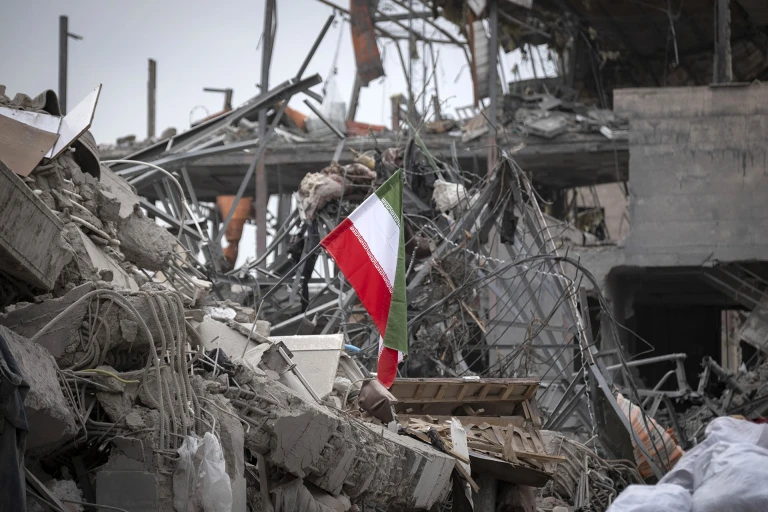
Fighting continued across Iran on Tuesday. Israeli warplanes struck government infrastructure in Tehran and other cities, Iranian state media reported. Explosions rocked Kharg Island in the Persian Gulf, a key oil export terminal, and Mehr News Agency said US and Israeli aircraft hit Khorramabad airport. In central Tehran, a US-Israeli strike flattened a residential building and destroyed an adjacent synagogue, according to Mehr; surrounding structures were also damaged. In Alborz province, 18 people, including two children, were killed and 24 wounded in strikes on residential areas, the province’s deputy governor told Fars News Agency.
Iranian President Masoud Pezeshkian posted on X that 14 million Iranians had registered to sacrifice their lives for the country. “I too have been, am, and will remain devoted to giving my life for Iran,” he wrote. Iran also launched projectiles at Saudi Arabia’s Jubail petrochemical complex. Earlier, Iranian state media reported damage in central Israel from Iranian missiles, including cluster submunitions that overturned a vehicle but caused no injuries.
The United Nations high commissioner for human rights, Volker Turk, condemned “the tirade of incendiary rhetoric” from all sides and warned that deliberate attacks on civilians and civilian infrastructure constitute war crimes. “Threats that spread fear and terror among civilians are unacceptable and must cease immediately,” he said, singling out vows “to annihilate a whole civilization and to target civilian infrastructure.”
Trump, speaking at the White House on Monday, framed the conflict in stark terms. In a Truth Social post, he wrote: “A whole civilization will die tonight, never to be brought back again. I don’t want that to happen, but it probably will. However, now that we have complete and total regime change, where different, smarter and less radicalised minds prevail, maybe something revolutionarily wonderful can happen, who knows? We will find out tonight, one of the most important moments in the long and complex history of the world. 47 years of extortion, corruption and death will finally end. God bless the great people of Iran!”
At a news conference, Trump described a daring Easter weekend rescue of a U.S. airman shot down over Iran, calling it a providential success. He declined to say whether he would escalate or end the war, telling reporters, “I can’t tell you. I don’t know.” White House press secretary Karoline Leavitt said only the president knew his plans, adding that Iran had until 8 p.m. Eastern time “to meet the moment and make a deal with the United States.”
The New York Times reported on Tuesday, citing three senior Iranian officials, that Iran had informed Pakistan it would no longer participate in ceasefire talks. Since the conflict began, Israel has assassinated senior Iranian figures, including former Supreme Leader Ali Khamenei and Ali Larijani. At least 2,076 people have been killed and 26,500 wounded in Iran.
Copyright © 2021 Independent Pakistan | All rights reserved