By Staff Reporter
ISLAMABAD: Prime Minister Shehbaz Sharif said on Monday that the fragile ceasefire between the United States and Iran remained in force and that “full efforts” were underway to resolve the issues still separating the two sides, one day after Pakistan hosted the first direct, face-to-face negotiations between senior American and Iranian officials in nearly half a century.
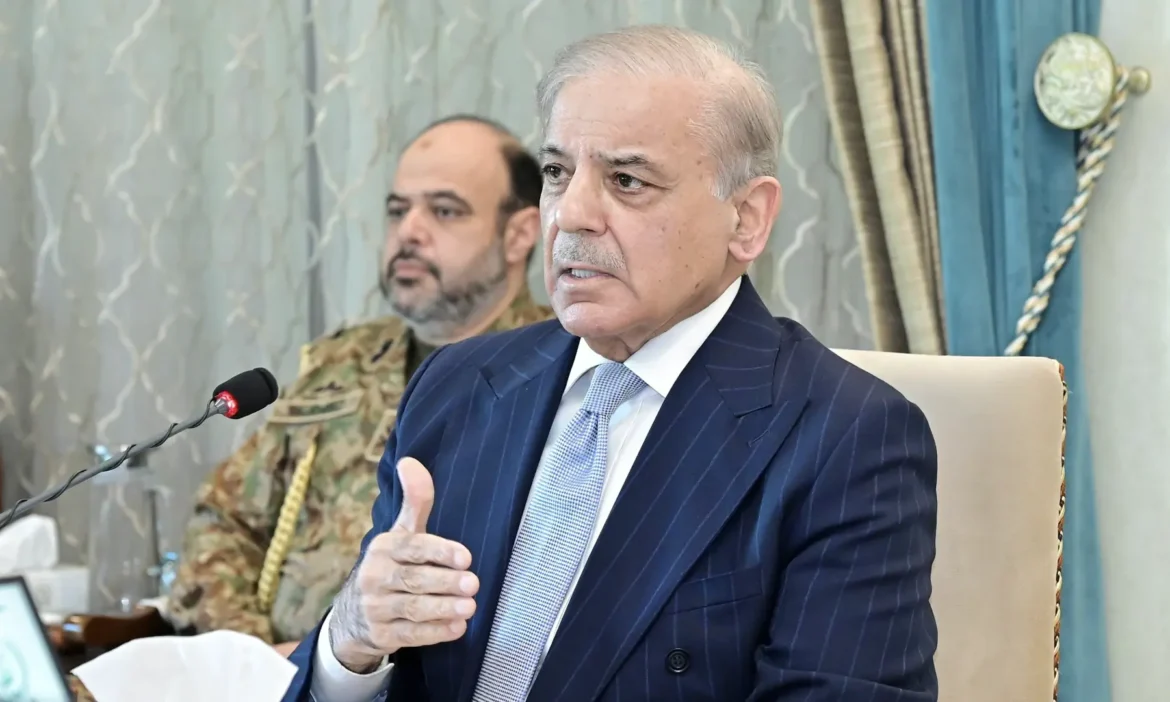
In a televised address to the federal cabinet, Sharif described the weekend talks here as a “historic moment” that had allowed Pakistan to turn “looming clouds of war into lasting peace.” The negotiations, which he said lasted continuously for 21 hours, marked the first time the two delegations had sat across from each other rather than communicating through intermediaries. “As I am talking to you, matters that are not resolved, full efforts are underway to resolve them,” Sharif said. “Today, the ceasefire still stands.”
The prime minister credited Pakistan’s political and military leadership with the breakthrough that produced the two-week ceasefire announced on April 8, after weeks of escalating violence that began when the United States and Israel launched a joint bombing campaign against Iran on Feb. 28. The conflict quickly broadened, with Iran blocking the Strait of Hormuz — the narrow waterway through which one-fifth of the world’s oil and liquefied natural gas once flowed — and launching attacks on Israel and US interests across the Gulf. The fighting has killed thousands, triggered a global fuel crisis and sent oil prices spiking above $100 a barrel.
Sharif was careful not to overstate what had been achieved. He compared the Islamabad talks to protracted historical peace processes — the Oslo Agreement, the Geneva Accord, the Good Friday Agreement — noting that “it took months and sometimes years to end hostilities and establish peace.” Yet he left no doubt that Pakistan viewed the mere fact of the meeting as significant. “It was the first time that the two delegations sat face-to-face. I am a witness to it,” he said. “God had given Pakistan the opportunity to mediate between the two sides that were not ready even to see each other for 47 years.”
The US delegation was led by Vice President JD Vance and included Trump special envoy Steve Witkoff and Jared Kushner, the president’s son-in-law. The Iranian side was headed by Parliament Speaker Mohammad Bagher Ghalibaf and included Foreign Minister Abbas Araghchi. The sessions were facilitated by Pakistan’s deputy prime minister and foreign minister, Ishaq Dar, and the country’s top military officer, Field Marshal Asim Munir, who also serves as chief of army staff and chief of defence forces.
Sharif said the Pakistani leadership had worked “day and night” to bring the parties together. He singled out Munir and his team for particular praise, saying their “wisdom” had been instrumental in brokering the initial ceasefire. “The Field Marshal and his team spent sleepless nights,” Sharif said. “There were moments when matters were close to falling apart, but then they were resolved.” He added that he was personally guarding “national secrets” about the negotiations and would reveal no more.
Both delegations issued separate statements after the talks that contained “commonalities,” Sharif said. Each expressed gratitude to Pakistan for hosting the negotiations and praised the country’s political and military leaders “for playing a brotherly role.” The prime minister said he had received congratulatory telephone calls Monday from the Japanese prime minister and several European leaders who commended Pakistan’s mediation efforts. He described the weekend diplomacy as “a moment of pride for 240 million Pakistanis.”
A formal resolution adopted by the federal cabinet and released by the prime minister’s office echoed that sentiment. “The federal cabinet is thankful to God for giving Pakistan the opportunity to play a central role for peace in the region and the world,” the statement said. It paid tribute to Sharif, Dar and Munir “for their efforts for bringing the two warring sides to the table and ending a nearly half-century-long stalemate.” “Undoubtedly, this role of Pakistan will always be remembered in the history of the world,” the resolution continued. “We pray that these efforts of the Pakistani leadership turn out to be successful and lead to peace in the world.”
The talks themselves produced no immediate breakthrough on the core issues dividing Washington and Tehran. Officials from both sides indicated privately that the process had not collapsed and could continue, but the atmosphere remained tense. On Sunday, President Donald Trump told reporters at Joint Base Andrews in Maryland that he was indifferent to whether Iran returned to the table. “I don’t care if they come back or not. If they don’t come back, I’m fine,” he said.
On Monday, US Central Command notified seafarers that a blockade would take effect at 1400 GMT in the Gulf of Oman and the Arabian Sea east of the Strait of Hormuz. The measure, the command said, would apply to all vessel traffic “regardless of flag.” Any ship entering or leaving the blockaded area without authorization would be subject to interception, diversion and capture. The notice added that the blockade “will not impede neutral transit passage through the Strait of Hormuz to or from non-Iranian destinations.”
The announcement came against the backdrop of the two-week ceasefire that Trump himself had agreed to extend after an urgent personal appeal from Sharif. On April 5, Trump had set a precise deadline — 8 p.m. Eastern time on April 7 — for Iran to accept a ceasefire and reopen the strait, warning that failure to comply would bring strikes on Iranian power plants and bridges. In an expletive-laden social-media post that day, he wrote that “a whole civilisation will die tonight, never to be brought back,” a statement that drew widespread condemnation even inside the United States.
With hours to spare, Sharif publicly asked Trump to extend the deadline by two weeks, saying diplomatic efforts were “progressing steadily, strongly and powerfully.” He made a parallel request to Iran to reopen the strait for the same period. Trump responded on Truth Social that, provided Iran agreed to the “COMPLETE, IMMEDIATE, and SAFE OPENING” of the waterway, he would suspend bombing and attacks for two weeks. Iran’s Foreign Minister Abbas Araghchi, speaking for the Supreme National Security Council, said his country would cease defensive operations if the attacks stopped.That sequence produced the ceasefire on April 8 and set the stage for the Islamabad talks.
Even as Sharif spoke Monday, the global economic stakes remained high. The conflict had already disrupted shipping through the Strait of Hormuz and sent energy prices soaring. The US blockade announced on Monday added a new layer of uncertainty for the world’s oil and gas markets.
Sharif struck a note of cautious optimism. Pakistan, he said, had been honored to help both sides reach the ceasefire and to host the talks at a moment when the global economy was suffering. “When I am speaking to you,” he told the cabinet, “I am trying my best to resolve the issues that are stuck.”
After Marathon Talks in Islamabad, Sharif Says Efforts Continue to Turn Fragile Ceasefire Into Enduring Peace
Copyright © 2021 Independent Pakistan | All rights reserved