By Staff Reporter
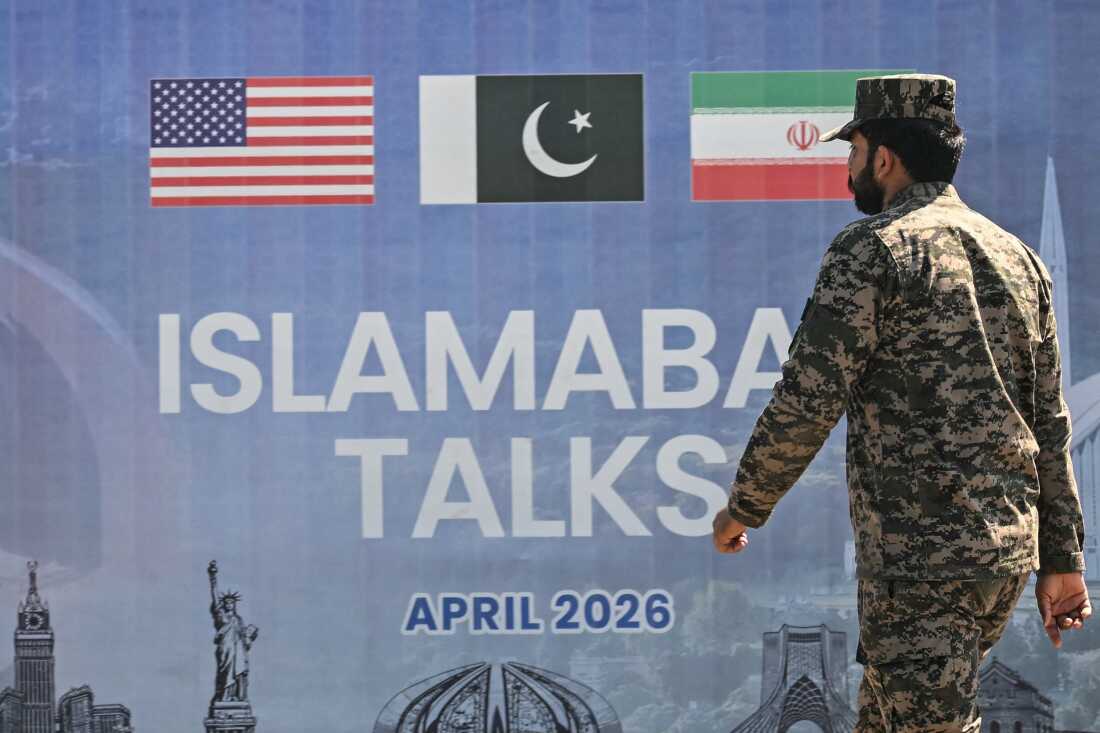
ISLAMABAD: Uncertainty clouded plans for a second round of direct peace talks between the United States and Iran on Monday, even as President Donald Trump said a high-level American delegation led by Vice President JD Vance was en route to Islamabad and would arrive within hours.
The negotiations, hosted by Pakistan, were originally expected to begin as early as Monday, just days before a fragile ceasefire between the two nations is set to expire. But conflicting accounts from Washington and Tehran — compounded by fresh tensions over the Strait of Hormuz — left it unclear whether the meeting would take place at all, or whether Iran would even send a delegation.
Trump, in a brief interview with the New York Post conducted shortly after 9 am Eastern time, insisted the talks were proceeding. “We’re supposed to have the talks,” he said, brushing aside questions about whether the negotiations might collapse. “So I would assume at this point nobody’s playing games.” He added that Vance and the American team “are heading over now” and “they’ll be there tonight, Islamabad time.” Trump also said he would be willing to meet personally with senior Iranian leaders if a breakthrough emerged from the talks.
Yet multiple indicators suggested the situation was more fluid than the president portrayed. A source familiar with the arrangements told Reuters that Vance remained in the United States and had not yet departed. A second source said the US delegation planned to travel to Islamabad soon but had not left. The first round of talks, held April 11 and 12 in the same Pakistani capital, had involved Vance along with White House envoy Steve Witkoff and Trump’s son-in-law Jared Kushner.
Iranian officials, meanwhile, offered a markedly different assessment. In a weekly press briefing in Tehran on Monday, Foreign Ministry spokesman Esmaeil Baqaei said Tehran had made no decision on attending the next round. “As of now, while I am at your service, we have no plans for the next round of negotiation, and no decision has been made in this regard,” he told reporters.
Baqaei accused the United States of undermining the diplomatic process through what he described as repeated violations of the two-week ceasefire. He cited the US naval blockade of Iranian ports, the seizure of an Iranian cargo ship early on Monday, and delays in implementing aspects of the ceasefire in Lebanon as evidence that Washington was not negotiating in good faith. “While claiming diplomacy and readiness for negotiations, the US is carrying out behaviours that do not in any way indicate seriousness in pursuing a diplomatic process,” Baqaei said.
He explicitly rejected any suggestion that Iran had discussed transferring enriched uranium to the United States, calling the idea a nonstarter. “Regarding the issue of transferring enriched uranium, neither during this period of negotiations nor before has transferring it to the United States been discussed,” he said. “It was never raised as an option for us.”
The Iranian parliament speaker, Mohammad Bagher Ghalibaf — who led Tehran’s delegation to the first round of talks — struck a similarly cautious tone in televised remarks. “We do not trust the enemy,” he said, according to Iran’s semi-official Mehr News Agency. “At any moment, it may escalate the war. We are negotiating, but we are prepared for the necessary measures.”
Ghalibaf said the current conflict had begun “through American deception in the middle of negotiations” and said Iran had drawn lessons from the 12-day war with the United States and Israel in June 2025. He asserted that Tehran remained ready for any future confrontation. Iran’s first vice president, Mohammad Reza Aref, used unusually blunt language to link the maritime dispute to the broader talks. In a post on X, Aref warned that security in the Strait of Hormuz — through which roughly one-fifth of global oil trade passes — could not be guaranteed if Iran’s oil exports remained restricted by the US blockade. “No one can restrict Iran’s oil exports while expecting free security for others,” he wrote. “The security of the Strait of Hormuz is not free.”Aref framed the choice facing the world in stark terms: “a free oil market for all” or “significant costs for everyone.” Stability in global fuel prices, he said, depended on “a guaranteed and lasting end to the economic and military pressure against Iran and its allies.”
The latest flare-up over the strait began when Iran closed the waterway on Saturday, declaring it would remain shut until the United States lifted its blockade. Trump later said the US Navy had targeted an Iranian ship attempting to evade the blockade, though accounts of the incident diverged between the two sides. The mixed signals from Tehran echoed the atmosphere immediately before the first round of talks earlier this month. At that time, Iranian officials repeatedly emphasised “preconditions” even as their delegation was preparing to board a plane for Islamabad. A last-minute dispute over Israeli strikes in Lebanon was resolved only hours before the talks began.
Pakistan, which has positioned itself as a neutral facilitator, was nevertheless on high alert on Monday. Extraordinary security measures were in place across the capital and the adjacent garrison city of Rawalpindi. Advance US security teams arrived on Sunday, and Interior Minister Mohsin Naqvi met with the US chargé d’affaires, Natalie Baker, to coordinate arrangements.
More than 10,000 security personnel, including commandos and snipers, were deployed around key sites. Public transport in the twin cities was suspended, major routes were sealed, and the high-security Red Zone in central Islamabad was closed to ordinary traffic. Two luxury hotels were reportedly vacated to accommodate the expected delegations. A US Air Force Boeing C-17A Globemaster III transport aircraft was photographed preparing to land at Nur Khan airbase in Rawalpindi on Monday, underscoring the logistical scale of the American presence.
Iranian Foreign Minister Abbas Araghchi had told his Pakistani counterpart on Sunday that US actions, statements and “excessive demands” reflected Washington’s “lack of seriousness for diplomacy.” A hard-ine Iranian outlet affiliated with the Islamic Revolutionary Guard Corps, Tasnim News Agency, reported on Monday that Tehran had not changed its position of abstaining from the talks. The blockade remained an “obstacle,” the agency said, and US messages contained further demands that “cloud the prospects for the upcoming talks.” Iran, it added, remained “fully prepared for military confrontation and to once again punish the U.S.”
President Masoud Pezeshkian, speaking during a visit to the Ministry of Justice on Monday, took a somewhat more measured tone. “War benefits no one,” he said, “and while standing firm against threats, every rational and diplomatic route should be used to reduce tensions.” He urged Iranian officials to keep the public honestly informed about both achievements and challenges, warning that “providing inaccurate information or unrealistic promises not only fails to help resolve issues, but also undermines public trust.”
The stakes for the second round are high. The first talks produced a short-term ceasefire after US and Israeli strikes on Iran that began Feb. 28. That truce is now nearing its end, and both sides have signaled that a durable agreement remains elusive. Shuttle diplomacy of this nature is often punctuated by last-minute changes and public posturing. Yet the degree of public dissonance on display on Monday — with the American president announcing an imminent arrival and Iranian officials stating no decision has been made — is unusual even by the standards of such negotiations.
Analysts tracking the process say the Hormuz dispute has become the central immediate obstacle. The waterway’s security is not merely a bilateral issue but one with immediate consequences for global energy markets. Any prolonged closure or escalation risks driving up oil prices and roiling international shipping. Whether the talks proceed, and whether they produce more than a temporary pause in hostilities, will depend on whether the two sides can bridge deep mutual distrust. Trump’s public optimism contrasts sharply with the skepticism voiced repeatedly by Iranian officials, who have made clear they view Washington’s actions as inconsistent with its diplomatic overtures.
Copyright © 2021 Independent Pakistan | All rights reserved