By Staff Reporter
ISLAMABAD: Pakistan’s economy is on track to expand about 4% in the current fiscal year, Finance Minister Muhammad Aurangzeb said Tuesday, as the government prepares to issue its first $250 million Panda bond in China’s domestic market in May and shifts toward commercial borrowing after a fresh Saudi deposit.
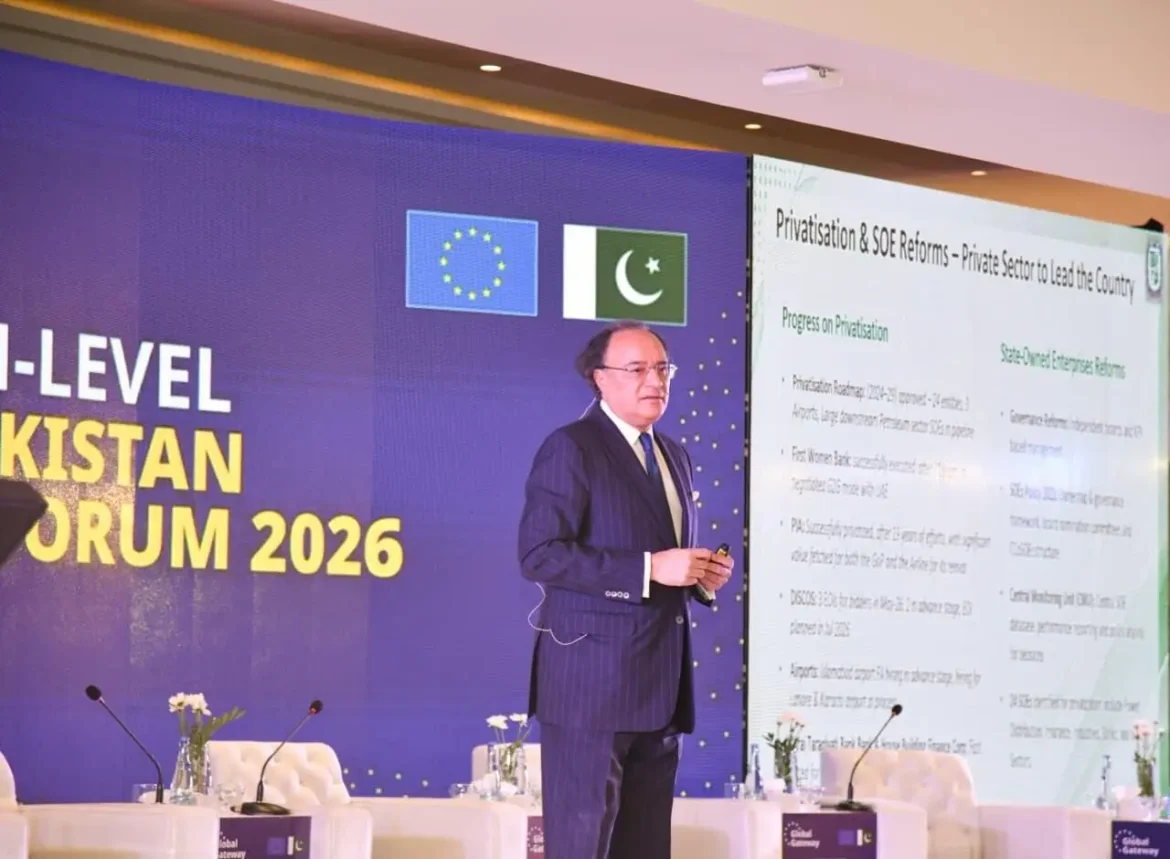
Aurangzeb laid out the growth forecast and financing plans while inaugurating the first high-level EU-Pakistan Business Forum in the capital, organised jointly by the European Union and the Pakistani government. The event drew about 1,000 policymakers, European and Pakistani executives, investors and bankers, marking Islamabad’s latest effort to turn macroeconomic stabilisation into fresh foreign investment.
The minister told the audience that the economy grew 3.89% in the October-December quarter of fiscal 2025-26, up from 2.18% a year earlier, according to National Accounts Committee data released April 2. The Asian Development Bank upgraded its full-year projection to 3.5% earlier this month; the government is now guiding for 4%.
Pakistan is preparing to issue the yuan-denominated Panda bond in May, with guarantees from the Asian Development Bank and the Asian Infrastructure Investment Bank, Aurangzeb said. Discussions with Chinese authorities are in the final stages. The government also plans to issue Eurobonds and Sukuk over the next two to three years. The Panda bond comes weeks after Pakistan returned to international capital markets for the first time in four years, raising $500 million through a three-year Eurobond under its Global Medium-Term Note program. Investor demand was strong despite global volatility, according to advisers.
Speaking separately to reporters, Aurangzeb said the government has no plans to seek additional bilateral financing from friendly countries following Saudi Arabia’s $3 billion deposit this month. Riyadh transferred $2 billion on April 15 and $1 billion on April 21. The funds allowed Pakistan to repay $3.45 billion in deposits previously held by the United Arab Emirates. “Pakistan is moving towards commercial rather than bilateral financing,” he said. The minister expressed confidence that Pakistan will receive a $1.2 billion tranche from the International Monetary Fund next month under its $7 billion program. Budget consultations for the next fiscal year are already under way.
Aurangzeb also said there is no immediate food-security or fertilizer crisis despite Middle East conflicts affecting power infrastructure, and that remittances — including from the UAE — have remained stable.
Reserves, External Position Strengthen
Foreign-exchange reserves are expected to reach around $18 billion by the end of June, providing about three months of import cover, the minister said. The current-account balance posted a surplus of $1.07 billion in March, according to State Bank of Pakistan figures released April 16, compared with $23 million in February. The country has recorded a current-account surplus for the first nine months of the fiscal year.
Information-technology exports, gains in higher value-added sectors and steady remittances have all supported the external accounts, Aurangzeb said. The State Bank raised its key interest rate by 100 basis points to 11.5% this week to counter inflation risks linked to global energy prices, yet debt-servicing costs have still declined.
Forum Shifts Focus From Trade to Investment
Special Assistant to the Prime Minister on Industries and Production Haroon Akhtar Khan told the forum that the EU remains Pakistan’s largest export destination, especially under the Generalized System of Preferences Plus scheme. But the relationship’s future, he added, lies “beyond trade, focusing on investment, technological collaboration, and integration into global value chains.”
European Union Ambassador Raimundas Karobolis echoed the point in his opening remarks. “It is a source of pride for me to say that the EU is the top export destination for Pakistan,” he said. “The purpose of the forum is not just to celebrate our trade relations, but to deepen, diversify, ‘green’, and transform them into long-lasting investments. Through this, our mutual prosperity will thrive.”
The opening session launched the EU-Pakistan Business Network, which brings together more than 300 European companies already operating in Pakistan. The network will serve as their collective voice with policymakers and help new entrants explore opportunities. A dedicated session highlighted the EU’s Global Gateway initiative — its flagship program to mobilize and de-risk €400 billion in investments outside the bloc between 2021 and 2027. Speakers included Peteris Ustubs, director for Asia and the Pacific at the European Commission’s Directorate-General for International Partnerships; Thouraya Triki, director at the European Investment Bank; and Hans Bogaard, director of agribusiness, food and forestry at FMO, the Dutch entrepreneurial development bank.
Discussions across the two-day event focused on agribusiness, digital innovation and fintech, green logistics, sustainable textiles, and responsible mining. Organizers scheduled more than 600 business-to-business meetings, with new financial programs and partnerships expected to be announced.
Reform Push
Much of Aurangzeb’s presentation centered on structural changes aimed at making Pakistani industry more competitive. The government has cut tariffs and duties on intermediate goods and raw materials “so that our industry actually gets competitive,” the minister said. He reiterated plans to accelerate privatization of airports, electricity distribution companies and other state-owned enterprises, building on recent progress with Pakistan International Airlines. “The private sector has to lead the country,” Aurangzeb said.
The minister also noted that Pakistan has about 40 million cryptocurrency users and that authorities are in advanced stages of issuing licenses under a new regulatory framework. He framed the reforms as the beginning of an export-led transformation, telling the audience that international institutions have compared Pakistan’s trajectory to Southeast Asia’s early growth years. “This can very well be our South Asia moment,” he said.
Copyright © 2021 Independent Pakistan | All rights reserved