By Staff Reporter
ISLAMABAD: The Judicial Commission of Pakistan approved on Tuesday the transfer of three judges from the Islamabad High Court to provincial high courts, a decision reached by majority vote after weeks of procedural maneuvering and sharp constitutional concerns raised by the country’s top judge.
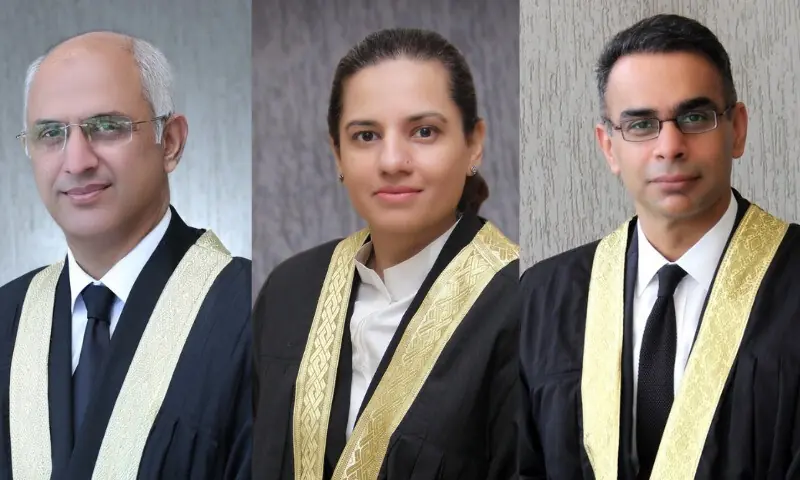
The transfers involve Justice Mohsin Akhtar Kayani to the Lahore High Court, Justice Babar Sattar to the Peshawar High Court and Justice Saman Rafat Imtiaz to the Sindh High Court, according to an official statement issued after the meeting chaired by Chief Justice of Pakistan Yahya Afridi. The commission also ruled that any vacancies created by the transfers must be filled exclusively through further transfers and cannot be treated as openings for fresh appointments.
The meeting itself was convened under unusual circumstances. The JCP secretary called the session under powers granted by clause (22) of Article 175A of the Constitution after Afridi, as commission chairman, declined to do so in response to a requisition from one-third of the members. The statement noted that Afridi had given reasons for his refusal.
The proposal had originated with Islamabad High Court Chief Justice Sardar Mohammad Sarfraz Dogar, who sought a commission meeting to consider moving five judges from his court. Afridi had responded to informal requests from Dogar with a detailed written objection, warning that such transfers — particularly of five out of the nine judges on the Islamabad bench — risked creating significant vacancies and institutional instability. He argued that moving judges without clearly stated reasons could assume a punitive character, effectively bypassing the constitutional safeguards for addressing judicial misconduct under Article 209 through the Supreme Judicial Council.
Afridi had further cautioned that treating judicial appointments as temporary and reversible administrative decisions could undermine federalism and equitable representation among the provinces. Despite his reservations, five commission members submitted a formal requisition on April 7, obliging the meeting under the constitutional timeline. Proposals to transfer two additional Islamabad judges — Justice Arbab M. Tahir to the Balochistan High Court and Justice Khadim Hussain Soomro to the Sindh High Court — were withdrawn by the members who had advanced them.
The transfers come at a delicate moment for the Islamabad High Court. Deliberations are underway for the induction of new judges to fill eventual vacancies. Among the prominent lawyers under consideration are Ayyaz Shaukat, a former advocate general and tax-law specialist recently appointed chairman of the Social Media Protection and Regulatory Authority; Usman G. Rashid Cheema; Umair Majeed Malik; and Sultan Mazhar Sher Khan. Two serving district and sessions judges, Shahrukh Arjumand and Humayun Dilawar, are also leading candidates for elevation.
The three transferred judges had been central figures in earlier public expressions of dissent within the Islamabad court. In March 2024, they were among a group of five Islamabad High Court judges who wrote to members of the Supreme Judicial Council accusing the country’s intelligence apparatus of interfering in judicial affairs, including alleged attempts to pressure judges through the abduction and torture of relatives and secret surveillance inside their homes.
The same judges were also part of the five who formally opposed, in February 2025, the proposed transfer of then-Lahore High Court Justice Dogar to head the Islamabad court, arguing that the move violated constitutional procedures and judicial norms. Dogar was nevertheless appointed acting chief justice on Feb. 13, 2025. The following day, when he took the oath in a ceremony to which all Islamabad judges had been invited, five of them — including those now transferred — boycotted the event.
Dogar was sworn in as permanent chief justice on July 8, 2025. In the months that followed, the court underwent a major administrative restructuring. The authority of the senior puisne judge — Justice Kayani — who had previously held significant decision-making roles, was curtailed through amendments to the high court rules. The Islamabad High Court Administration Committee, previously composed of the chief justice, the senior puisne judge and one other senior judge, was reconstituted to include only Dogar and two of his nominees.
The five dissenting judges were subsequently sidelined in the reshuffling of key committees. In September 2025, they filed separate petitions in the Supreme Court challenging several administrative practices. They asked the court to declare that a high court chief justice could not deploy administrative powers to undermine the judicial authority of individual judges, could not unilaterally exclude available judges from the roster, and could not transfer cases once a bench had been constituted.
The transfers approved Tuesday were made possible by a recent change to the Constitution. An amendment to Article 200, introduced through the 27th Constitutional Amendment, empowered the Judicial Commission to recommend the transfer of a high court judge without the judge’s consent. Previously, such transfers required the judge’s agreement. The revised provision also states that a judge who refuses a transfer may face proceedings before the Supreme Judicial Council under Article 209. The commission’s decision, while procedural in form, caps a period of open friction at Pakistan’s capital high court and underscores the delicate balance between administrative authority and judicial independence in a system still navigating the boundaries of its own constitutional framework.
Copyright © 2021 Independent Pakistan | All rights reserved