By Staff Reporter
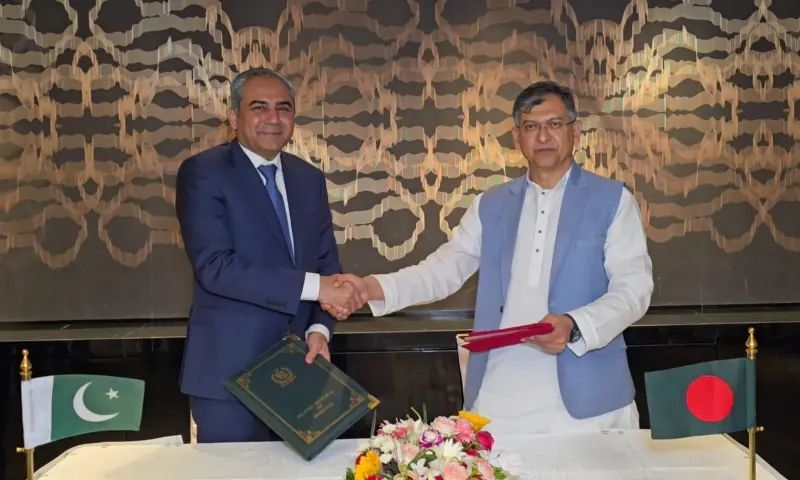
ISLAMABAD: Pakistan’s Interior Minister Mohsin Naqvi and his Bangladeshi counterpart, Salahuddin Ahmed, signed a memorandum of understanding on Saturday aimed at deepening cooperation against drug trafficking and narcotics abuse, officials said.
The pact, signed during Naqvi’s visit to the Bangladeshi capital, commits both governments to joint efforts to halt the illegal movement and smuggling of narcotics across their borders, to dismantle drug-sale and supply networks, and to curb the rising trend of drug abuse and its social consequences, according to a statement from Pakistan’s Ministry of Interior.
Under the agreement, the two countries will establish a secretary-level joint working group to coordinate their interior ministries’ efforts. Relevant agencies will share timely intelligence on traffickers and smuggling routes. They also pledged to exchange training for personnel, adopt modern technology and apply best practices in narcotics enforcement.
The ministry said Naqvi offered Bangladesh full Pakistani support for its Safe City surveillance and security project. “We will support the government of Bangladesh in the project in every possible way,” he was quoted as saying. The ministers held broader talks on expanding cooperation in internal security, training for civil armed forces, counterterrorism and the prevention of human trafficking. They discussed joint measures against cybercrime, organized crime and financial fraud, and explored enhanced training programs between their police academies.
Naqvi invited Ahmed to visit Pakistan. The Bangladeshi minister thanked him for the offer of assistance on the Safe City initiative. Also present at the meeting were Bangladesh’s Foreign Secretary Asad Alam Siam, Cabinet Secretary Naseem Al Ghani, Home Secretary Manzoor Chaudhry and Pakistan’s High Commissioner to Bangladesh, Imran Haider.
The agreement marks the latest step in a noticeable thaw in relations between the two countries, which were once part of a single nation until Bangladesh’s secession after a bloody civil war in 1971. Ties had remained strained for decades, particularly during the long rule of ousted Prime Minister Sheikh Hasina, who was widely viewed as aligned with India.
Relations have improved markedly since her government was toppled by a popular uprising and she went into exile in 2024. High-level contacts have accelerated in the months since. In February, Pakistan’s Planning Minister Ahsan Iqbal attended the oath-taking ceremony of Bangladesh’s Prime Minister Tarique Rahman. Last December, National Assembly Speaker Ayaz Sadiq traveled to Dhaka to attend the funeral of Khaleda Zia, the country’s first female prime minister. In August 2025, Deputy Prime Minister and Foreign Minister Ishaq Dar visited Dhaka and met interim leader Professor Muhammad Yunus.
Economic and people-to-people links have also expanded. The two countries resumed sea trade last year and broadened government-to-government commerce in February. In January, Bangladesh’s national carrier operated its first regular flight to Karachi since 2012. Saturday’s agreement on narcotics and security cooperation reflects the broader effort by both governments to move past historical grievances and address shared regional challenges, Pakistani officials indicated. The joint working group is expected to begin its work in the coming months.
Copyright © 2021 Independent Pakistan | All rights reserved