By Staff Reporter
ISLAMABAD: Prime Minister Shehbaz Sharif on Saturday said that Pakistan “can neither be intimidated nor subdued by any aggressor,” as the government observed the first anniversary of the military confrontation with India that the country has christened Marka-e-Haq, or Battle of Truth.
The events that Pakistan now commemorates as a seminal national triumph began last year with an attack in Pahalgam on April 22, escalated into open hostilities across multiple domains and ended with a ceasefire on May 10. In an official statement issued by the Prime Minister’s Office, Sharif described the episode as a “resounding victory” for Pakistan and a moment that demonstrated the country’s resilience in the face of what he portrayed as unprovoked Indian aggression.
“Marka-e-Haq bears testimony that Pakistanis are a peace-loving, yet courageous, resilient, and dignified nation who can neither be intimidated nor subdued by any aggressor,” the statement quoted Sharif as saying. He expressed gratitude to the Almighty for the nation’s “valiant stand in adversity” and the “crushing defeat” inflicted upon India.
The prime minister paid tribute to the Pakistani soldiers who died in the fighting, their families and the “ghazis” — veterans of the conflict — whom he said “stood like a steel wall to defend their homeland.” He credited the armed forces’ “well-coordinated and synchronised response” across land, sea, air and cyber domains with establishing Pakistan as an “invincible nation” and etching “an epic feat of achieving overwhelming dominance over an enemy bent on unprovoked aggression.”
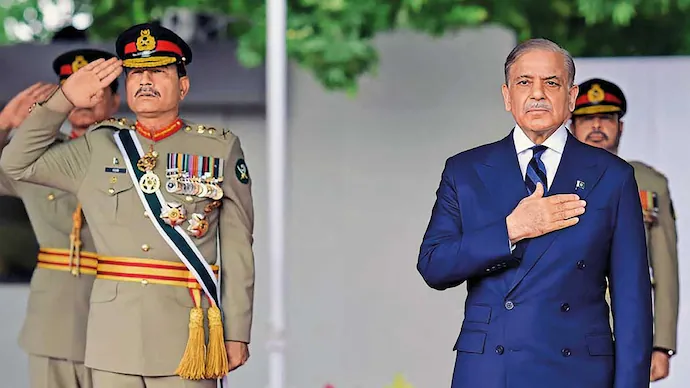
Sharif said India had been given “a heavy dose of reality serum to dispel its illusion of invincibility.” He warned that any future aggression against Pakistan would meet an “immediate, befitting and full-spectrum response,” adding that the nation remained “determined and vigilant to ensure security” along its frontiers. The statement singled out senior military leaders for praise. Sharif commended Chief of Defence Forces and Chief of the Army Staff Field Marshal Syed Asim Munir for his “bold and courageous leadership,” as well as Air Chief Marshal Zaheer Ahmed Baber and Admiral Naveed Ashraf for their “strategic prudence.” He extended salutations to the officers and soldiers of the armed forces, saying they had “inscribed a new chapter in Pakistan-India context” with the unflinching support of the Pakistani people.
Throughout the conflict, Sharif maintained, Pakistan had demonstrated its desire for peace while simultaneously re-establishing deterrence and safeguarding its security, sovereignty and territorial integrity. The prime minister also addressed domestic security challenges, reaffirming the government’s commitment to eradicating terrorism. He vowed to continue efforts to “root out ‘Fitna al-Khawarij’ and ‘Fitna al-Hindustan’” — official Pakistani designations for the banned Tehreek-i-Taliban Pakistan and for militant groups operating in Balochistan, respectively — “and take the fight against terrorism to its logical conclusion.”
On the longstanding dispute over Kashmir, Sharif described the region as “an unfinished agenda of Partition” and said strategic stability in South Asia would remain elusive without its resolution. “Strategic stability in South Asia, without the resolution of Kashmir issue, would remain a distant dream which needs to be resolved in accordance with the United Nations resolutions and the aspirations of the Kashmiri people,” the statement said. “Pakistan shall continue to stand by the fundamental right of freedom and self-determination of Kashmiri people.”
A year after the ceasefire, Sharif said Pakistan is a responsible international actor that “not only knows how to defend itself, but has also emerged as a guarantor of global peace and stability.” He cited the country’s recent diplomatic efforts to help end the conflict between Iran and the United States, saying Pakistan had earned worldwide acknowledgment for its role as a key mediator. “Commemorating the sacrifices of our martyrs during Marka-e-Haq, let us pledge to face our adversaries like a ‘Steel Wall’ and work selflessly for the destined glory of this great homeland,” the statement quoted Sharif as saying.
Meanwhile, the military commemorated the first anniversary of the brief but sharp conflict with India, describing the episode as a defining landmark in the country’s journey and a demonstration of its measured response to what it called adversarial provocations. In a statement released by the Inter-Services Public Relations directorate, the military said the confrontation was a “resounding victory” for Pakistan that exposed “adversarial conspiracies, false flag narratives and disinformation campaigns,” ultimately diminishing their international credibility.
“Marka-e-Haq has become a defining landmark in the nation’s journey, reflecting national resolve, military excellence, and strategic maturity,” the statement said. The military said that despite confronting both conventional and hybrid threats, including proxy terrorism, Pakistan’s armed forces had demonstrated “superior operational competence” across land, air, sea, cyber and information domains. The anniversary, it added, was being observed with “deep reverence, gratitude, and national fervour,” serving as a testament to the “enduring spirit of courage, professionalism, and unity” among the nation and its troops.
Senior commanders joined in the commemoration. Field Marshal Munir, along with Air Chief Marshal Sidhu, the Chief of Air Staff, and Admiral Ashraf, the Chief of Naval Staff, extended congratulations to the nation and to all ranks of the armed forces, the statement said. In the year since the ceasefire, the military said, Pakistan has moved deliberately to strengthen its defence posture. It has bolstered its capabilities and reinforced its policy of full-spectrum deterrence, the statement noted, even in the face of disparities in resources.
The anniversary, it said, underscored the armed forces’ “preparedness, dedication, and professionalism,” which in turn “decisively strengthened public confidence” in the military. The statement said the occasion is not only a moment of reflection on past success but also a reaffirmation of Pakistan’s broader strategic outlook. “The anniversary also reaffirms Pakistan’s steadfast commitment to safeguarding its sovereignty while promoting peace and stability in the region.”
Looking ahead, the military emphasized a preference for diplomacy over confrontation. “Pakistan believes that sustainable peace in South Asia can only be achieved through meaningful dialogue, mutual respect, and adherence to international law and principles of justice,” the statement said.
Copyright © 2021 Independent Pakistan | All rights reserved