By Staff Reporter
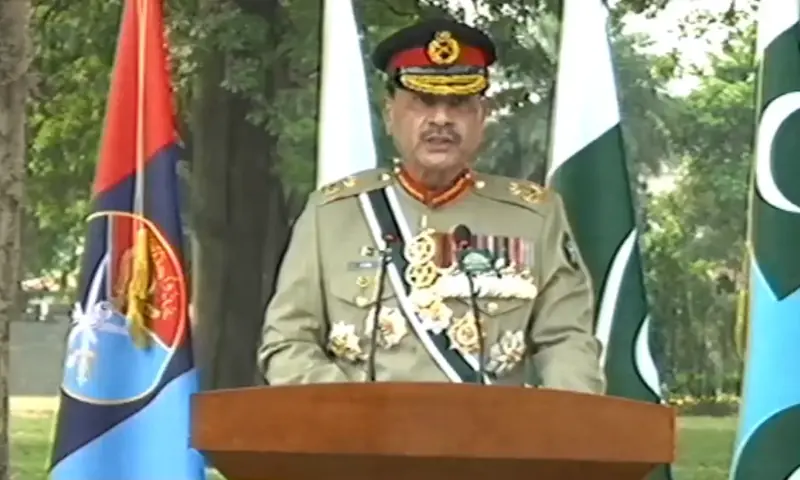
RAWALPINDI: Field Marshal Syed Asim Munir, the chief of defence forces and chief of army staff, warned on Sunday that any future “misadventure” against Pakistan would produce “extremely far-reaching and painful” consequences for the aggressor, delivering the message at a high-profile military ceremony marking the first anniversary of the country’s victory in last year’s brief but intense conflict with India.
Munir spoke as chief guest at General Headquarters in the garrison city of Rawalpindi, where the armed forces commemorated “Marka-i-Haq,” or Battle of Truth — the 2025 confrontation that began with an attack in Pahalgam on April 22 and culminated in Pakistan’s retaliatory Operation Bunyanum Marsoos and a ceasefire on May 10. Chiefs of the air staff and naval staff, Air Chief Marshal Zaheer Ahmed Babar Sidhu and Adm. Naveed Ashraf, attended alongside him.
The army chief described the day as “a source of pride” for Pakistan, its people and its military. He portrayed the conflict not as a conventional clash between armies but as a decisive contest between ideologies in which, he said, truth prevailed over falsehood. Quoting a Quranic verse on the triumph of truth, Munir asserted that the episode was not an isolated incident but part of a longer pattern of Indian “false flag operations” in 2001, 2008, 2016 and 2019. “Each time, not only did Pakistan unveil the wrong assumptions of the enemy, but also served it a decisive defeat,” he said. “In this war as well, India once again was a victim of its obsolete and self-delusional thinking.”
Munir said India had sought to divert attention from its internal problems by manufacturing war hysteria and blaming Pakistan. He argued that New Delhi had miscalculated, believing it could shift the regional balance of power through military aggression and diplomatic isolation. “But in reality, global and defence experts know that India’s ambitions proved to be much larger than its stature and capabilities.”
The objective of Operation Bunyanum Marsoos, he explained, was to expose that behavior. Pakistan responded with “full national unity and military force” after Indian forces violated its sovereignty between the night of May 6-7 and May 10. The operation’s name derives from a Quranic verse describing a solid, unbreachable structure — a phrase recited earlier in the ceremony.
Munir paid tribute to the “martyrs of Marka-i-Haq,” including civilians — women, the elderly and children — killed in Indian strikes. “All martyrs of Marka-i-Haq and their bereaved families are our crown,” he said. “Your sacrifices are the guarantor of our independence and everlasting debts. We consider our martyrs an amanat, our power and responsibility, and our success a favour of God.”
He extended gratitude to the president, prime minister, federal cabinet, national and provincial political leaders, and all political parties for their “everlasting political wisdom, foresight and leadership.” The nation, he said, had spoken with one voice: “any compromise on the country’s sovereignty, territorial integrity and national honour is unacceptable.”
Victory, Munir emphasized, was achieved not only on the battlefield but across society. He praised the Pakistani media, journalists and especially the youth for countering Indian propaganda, cyberwarfare and psychological operations. The public, he recalled, had set aside all other identities in favor of “Pakistaniyat,” forming “an iron wall” in defence of the homeland.
The armed forces, he said, had performed with distinction. He commended the air force for the modern era’s longest and most decisive air battle, in which it downed several modern Indian fighter jets and destroyed military installations. The navy, he added, had kept Indian warships thousands of miles from Pakistani shores through vigilant maritime defence. Troops on the working border and the Line of Control, he said, had inflicted heavy losses on Indian positions.
Pakistan, Munir stated, successfully struck more than 26 military targets inside India. Defeated, New Delhi then sought a ceasefire through American mediation, a request Pakistan accepted “in the interest of wider regional peace.” The chief of defence forces declared Pakistan’s defense “absolutely invincible” against foreign aggression and reaffirmed its commitment to maintaining the regional balance of power and full-spectrum deterrence. Traditional wars, he said, are obsolete; future conflicts will be multi-domain operations involving cyber and electronic warfare, drones, long-range missiles and artificial intelligence.
To prepare for that reality, he said, Pakistan has established a Defence Forces Headquarters, expanded its space program and created an Army Rocket Force Command. Recent acquisitions — Hangor-class submarines for the navy, advanced fighter jets for the air force and the Fatah missile series — represent only part of the effort, he added. Equally important is “new thinking, training and research.”
Munir highlighted diplomatic gains that he said flowed directly from the conflict. “The number of our friends in the world today is much higher compared to the past,” he said, noting that even former critics were now offering praise. He singled out the Strategic Mutual Defence Agreement signed with Saudi Arabia in September 2025 as “a major milestone” and “a historic step toward mutual defense and security.” Under the pact, an attack on one nation is treated as an attack on both.
He also pointed to Pakistan’s role as mediator in recent talks between the United States and Iran, thanking both governments — and specifically US President Donald Trump — for entrusting Islamabad with the task. “Through our continuous and sincere efforts, we will continue making every possible attempt to live up to this trust,” he said. Pakistan has also reaffirmed its commitment to Saudi Arabia’s defense, deploying an air contingent last month to bolster joint readiness and stating that any threat to the kingdom or the Two Holy Mosques is a threat to Pakistan itself.
On Afghanistan, Munir issued a single demand: that Kabul halt Indian-directed support for terrorism on Afghan soil and dismantle the “centres and safe havens” of Fitna al-Khawarij and Fitna al-Hindustan. He praised Pakistani law enforcement, security forces and civilians, particularly in Khyber Pakhtunkhwa and Balochistan, for two decades of counterterrorism efforts and pledged that the state would continue until terrorism is eradicated.
The army chief turned briefly to the unresolved dispute over Kashmir, saying “any story of Pakistan is incomplete without Kashmir.” A resolution in line with United Nations resolutions and the wishes of Kashmiris, he said, is essential to end Indian “state brutality and violence.” Demographic changes in Indian-occupied Kashmir, he added, cannot alter ground realities. Pakistan will keep pressing for Kashmiri self-determination at every international forum while providing political, diplomatic and moral support.
The ceremony itself unfolded with the solemn rituals of military remembrance. Before Munir spoke, the air and naval chiefs laid floral wreaths at the Yadgar-i-Shuhada, the Martyrs’ Monument. Smartly turned-out contingents from all three services presented a salute, followed by the playing of the national anthem. Munir closed by expressing confidence that the nation would confront any future challenge with the same unity, standing “like an iron wall” while continuing the work of national development.
Copyright © 2021 Independent Pakistan | All rights reserved