By Staff Reporter
ISLAMABAD: For Shaukat Mukadam, the years since his daughter was found murdered and beheaded in a wealthy Islamabad neighborhood have been a relentless march through Pakistan’s courts — trial courts, appellate courts, the nation’s highest bench, and now, on Thursday, one final dismissal that left nowhere else to go.
The Supreme Court rejected the last legal appeal filed by Zahir Jaffer, the Pakistani-American heir to an industrial fortune who was convicted of the July 2021 killing of Noor Mukadam, 27, and has now exhausted nearly every avenue of appeal available to him under Pakistani law. The three-member bench, led by Justice Muhammad Hashim Khan Kakar, announced the decision after nearly four hours of oral argument, cementing a death sentence that has survived review at every level of the country’s judiciary.
“Thanks to Allah, a legal and judicial process has been completed today,” Shaukat Mukadam, a former Pakistani diplomat, told reporters gathered outside the Supreme Court building. He urged authorities to carry out the sentence without delay. “This should be implemented,” he said, “and people like him, who kidnap innocent women, keep them hostage and kill them — they must be punished.”
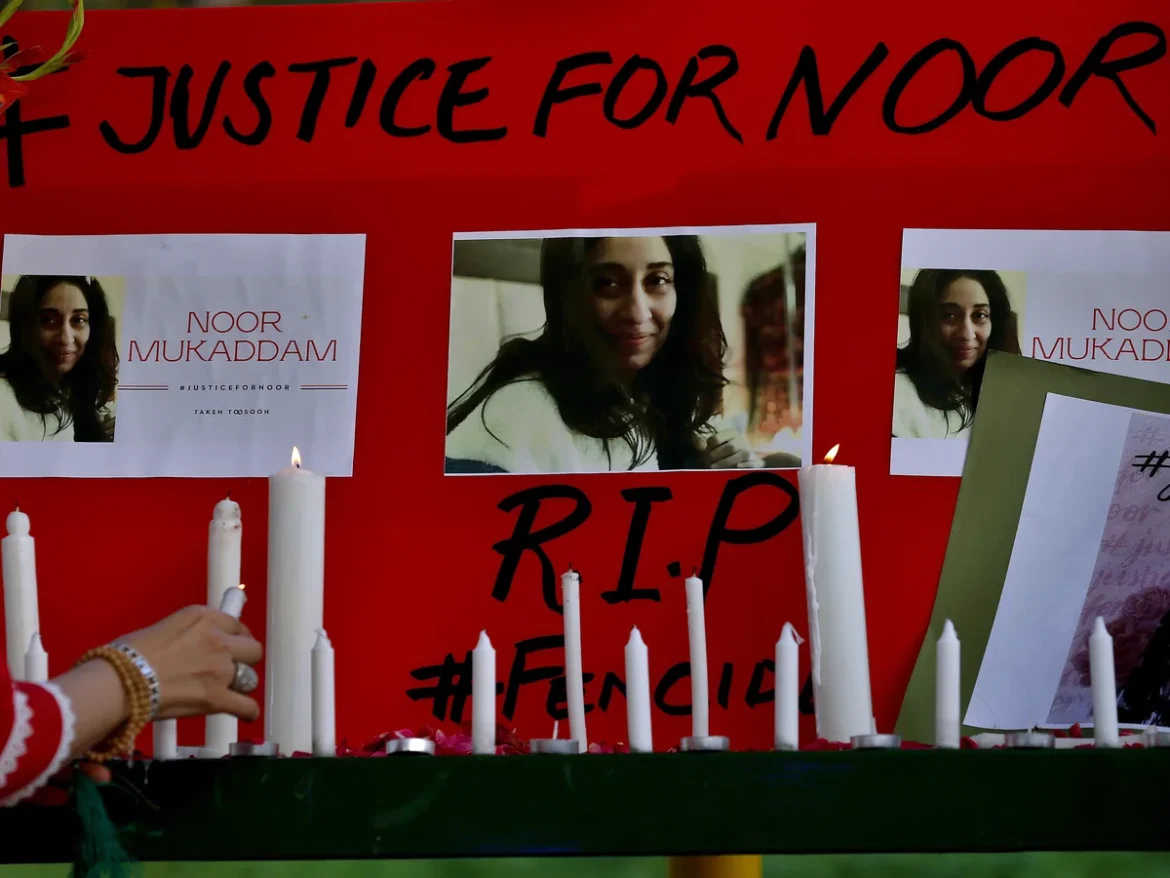
The ruling closes what has become one of Pakistan’s most closely watched criminal cases in recent memory, one that exposed the sense of impunity long associated with the country’s moneyed elite and galvanized a women’s rights movement already grappling with endemic violence. Noor Mukadam’s murder — brutal even by the grim calculus of gender-based killings — provoked an outpouring of public fury that kept the case in newspaper headlines and on social media feeds for years, and helped generate the sustained pressure that observers credit with pushing the case through Pakistan’s notoriously slow courts with unusual speed.
Outside the Supreme Court on Thursday, her father offered a message he said was meant not only for his own family, but for every woman in the country. “I will give this message to daughters and young girls,” he said. “Raise your voice against oppression.”
A killing that defined an era
Noor Mukadam was found dead on the evening of July 20, 2021, at Jaffer’s residence in Islamabad’s upscale Sector F-7/4. Her father received a call from Kohsar police station around 10 p.m. that night, informing him that his daughter had been killed. When police brought him to the house, he found that she had been murdered with a sharp-edged weapon and decapitated. Jaffer was arrested at the scene.
Police said Jaffer confessed to the killing. His DNA and fingerprints placed him at the scene. Investigators later said Noor had been tortured before she was killed. A first information report — the formal complaint that initiates criminal proceedings in Pakistan — was filed the same night.
Jaffer, the son of prominent industrialist Zakir Jaffer and his wife Asmat Adamji, held dual Pakistani and American citizenship. He and Noor were widely understood to have been in a romantic relationship that had ended in the months before her death. The involvement of two families from Pakistan’s privileged upper class gave the case an electric charge from the outset, feeding public anger at a system critics said routinely shielded the wealthy from accountability.
Jaffer’s parents and several household employees were taken into custody in the days after the murder on suspicion of concealing evidence. His parents were indicted the following October but were ultimately acquitted. Six employees of Therapy Works — a clinic whose staff had arrived at the scene before police — were also indicted and later cleared. Two household workers, Mohammad Iftikhar and Jan Mohammad, were convicted alongside Jaffer and sentenced to ten years each; the Supreme Court later ordered their release, finding they had already served sufficient time.
Four courts, one outcome
In February 2022, a district and sessions court in Islamabad convicted Jaffer of murder and sentenced him to death, along with 25 years of rigorous imprisonment on a rape conviction and a fine. He appealed. In March 2023, the Islamabad High Court not only upheld the death sentence but converted the 25-year prison term into a second death penalty on the rape charge. He appealed again.
In May 2025, a Supreme Court bench — the same bench that heard Thursday’s proceeding — rejected that appeal. In a detailed written ruling issued afterward, the court described Jaffer as “a ruthless killer” who was “not worthy of sympathy.” The bench upheld the death sentence for murder but commuted the second capital sentence, for rape, to life imprisonment, and acquitted him of an abduction charge while maintaining a conviction for unlawful confinement.
Two months after that ruling, Jaffer filed the review petition that was dismissed on Thursday.
Mental illness, media pressure, and a letter from London
Jaffer’s attorney, Khawaja Haris, a prominent advocate who had not represented him at earlier stages of the case, opened Thursday’s hearing with an unusual concession. He acknowledged that Noor Mukadam had been subjected to grave injustice and offered an apology to her family. He told the bench he would not contest his client’s presence at the crime scene, nor dispute that the murder had occurred.
His argument turned instead on Jaffer’s mental state. Haris contended that his client suffered from bipolar disorder, schizophrenia and depression; that he had been receiving medication in prison; and that his mental condition had not been adequately examined before the court imposed the death penalty. He told the justices that material presented at trial suggested Jaffer had believed himself to be a spiritual leader and considered the victim a sacrificial offering. “My client is mentally ill,” Haris said. “He cannot even sign properly.”
The defense also faulted prosecutors for failing to administer a narcotics test, arguing that intense media scrutiny during the trial had created a climate in which investigators were discouraged from pursuing lines of inquiry that might have appeared to favor the defendant. “At that time, social media was full of claims that proving the accused was addicted to drugs would be used to save him,” Haris told the court.
That argument drew a sharp response from Justice Kakar. “This court neither decides cases on newspaper reports nor comes under pressure from social media,” he said.
The bench pressed the defense throughout, asking for documentation showing when Jaffer’s psychiatric treatment had begun, whether he was receiving care at the time of the murder, and which physicians had diagnosed him. Justice Salahuddin Panhwar observed that the defense appeared to be reasoning from assumption rather than evidence. The court also questioned a letter from a clinic on London’s Harley Street that Haris submitted in support of his mental-health argument; Justice Panhwar noted that the document was dated 2022, after the murder had taken place. “It is strange that the accused could not obtain counsel of his choice, yet a letter arrived for him from London,” the judge remarked.
The bench further noted that requests to convene a medical board to assess Jaffer’s competency had been rejected during trial proceedings and had not been challenged before the Islamabad High Court — meaning, Justice Ishtiaq Ibrahim observed, that “the matter has already attained finality.”
At one point, Justice Kakar asked the defense counsel directly what relief he was actually seeking. Haris said he was not asking for a retrial, but for a reduction in sentence, arguing that all mitigating circumstances should have been weighed before capital punishment was imposed. The exchange produced one of the morning’s more pointed observations: Justice Kakar noted that had Jaffer been represented by counsel of Haris’ caliber from the beginning of the case, “the accused might not have had to see this day.”
Advocate Shah Khawar, appearing for Noor’s family, opposed the petition and urged the court to let the prior verdicts stand.
What comes next
With Thursday’s dismissal, Jaffer has one remaining avenue: a petition for presidential clemency under Article 45 of Pakistan’s Constitution, which grants the president authority to pardon, reprieve, commute or suspend any sentence. Last year, according to reports, Jaffer was weighing such a petition and prison authorities had sought the formation of a medical board whose findings could be included in any mercy plea to President Asif Ali Zardari.
Whether such a petition succeeds would depend entirely on the discretion of the president.
For Shaukat Mukadam, the prospect of further delay appeared unwelcome. He noted that the trial court, the high court, and the Supreme Court had each reached the same conclusion, leaving the defense with nothing new to offer. He urged the authorities to move toward execution without waiting for appeals that, in his view, had already been exhausted.
His daughter’s case, he suggested, had shown that persistence could move even the slowest of legal systems. “I urge people who suffer under similar circumstances,” he said, “to not give up and keep pursuing legal action.”
Copyright © 2021 Independent Pakistan | All rights reserved