By Staff Reporter
ISLAMABAD: The Foreign Office on Thursday issued a sharp denial of reports that Deputy Prime Minister and Foreign Minister Ishaq Dar had passed sensitive intelligence to US Secretary of State Marco Rubio about Iran’s nuclear program, calling the claims fabricated and potentially designed to sabotage fragile diplomatic efforts across a region already bristling with tensions.
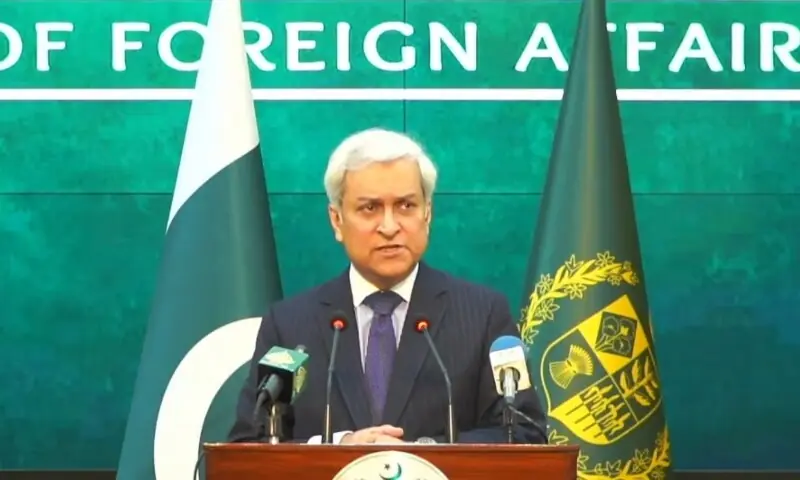
The denial came at a weekly press briefing, where Foreign Office spokesman Tahir Andrabi faced pointed questions about a claim made by Larry Johnson, a former CIA analyst, who alleged that Dar’s May 29 meeting with Rubio in Washington had included a revelation about what Iran “is prepared to do to preserve its independence” — language Johnson suggested had alarmed the secretary of state.
“We categorically and unequivocally reject the assertion that the deputy prime minister and foreign minister shared any intelligence regarding Iran with the US secretary of state,” Andrabi said. “Such claims are entirely baseless, speculative, and appear to be aimed at undermining ongoing diplomatic efforts and the broader process of dialogue and engagement.”
Rubio himself appeared to pour cold water on the story. At a congressional hearing on Wednesday, Rep. Scott Perry of Pennsylvania asked the secretary directly whether Dar had relayed a message that Iran was “prepared to demonstrate a nuclear weapon should the current escalation continue.” Rubio said he had not seen the reporting and was unaware of any such message.
When Perry pressed further, Rubio was unequivocal. “I would be surprised if that message had been relayed,” he said. “I would be aware of it if it was.”
Johnson, whose claim ignited the controversy, cited an unnamed source and offered no documentation. His allegation — that Dar’s conversation with Rubio had included signals of Iran’s possible withdrawal from the Nuclear Non-Proliferation Treaty and the development of a nuclear weapon — spread rapidly through online forums and some regional media outlets before drawing official responses from both governments.
The Pakistani foreign minister’s May 29 visit to Washington was brief but substantive by official accounts. Rubio had praised Islamabad’s role in “advancing peace in the Middle East,” a reference widely understood to include Pakistan’s role in hosting direct US-Iran talks — a historic development that followed a brittle ceasefire struck in April.
Andrabi said the Dar-Rubio conversation was devoted entirely to “regional peace, stability, and the importance of pursuing diplomatic solutions to ongoing challenges” and that “no intelligence was shared during the course of this dialogue.”
The episode unfolded against the backdrop of a region in combustion. Though daily strikes on targets across Iran and the Gulf subsided after the April ceasefire, armed exchanges have resumed. On Monday, the US military struck targets near the Strait of Hormuz. Iran retaliated Wednesday with a missile barrage that struck Kuwait’s international airport, killing at least one person, wounding dozens, and forcing a temporary suspension of flights. Tehran also claimed strikes on Bahrain, including what it described as an attack on the headquarters of the US Fifth Fleet.
At Thursday’s briefing, Andrabi condemned the attacks on Kuwait and Bahrain unambiguously.
“Pakistan condemns this drone and missile attack that targeted the state of Kuwait and the Kingdom of Bahrain,” he said, noting that Islamabad had similarly condemned recent Iranian strikes on nuclear facilities in the United Arab Emirates and earlier attacks on Saudi Arabia. “We condemn attacks on all sides. Such hostilities shrink the space for dialogue and diplomacy.”
He called the latest escalations “major obstacles toward reaching a settlement” and urged all parties to honor the April ceasefire. He also welcomed news that Israel and Lebanon had agreed to implement a ceasefire brokered by the United States, calling it “a welcome development.”
President Trump has been pressing hard for an agreement that would lift competing US and Iranian blockades around the Strait of Hormuz — a chokepoint for roughly a fifth of the world’s seaborne oil supply, whose disruption has sent energy prices climbing and stoked fears of a broader economic shock. Israel’s expanding military campaign in Lebanon, however, has repeatedly complicated those efforts, prompting Trump himself to press Prime Minister Benjamin Netanyahu to pull back.
Pakistani Sailors in Pirate Hands for Weeks
Seven weeks after Somali pirates seized an oil tanker in the Gulf of Aden, ten Pakistani sailors remain in captivity, their government warning Thursday that the vessel’s highly explosive cargo has all but ruled out any forcible rescue and that resolutions in such cases rarely come quickly.
The MT Honour 25, a Palau-flagged product tanker, was boarded on April 21 roughly 30 nautical miles off Somalia’s Puntland coast. Of the 17 crew members taken hostage, ten are Pakistani; the remainder include Indonesian, Indian and Myanmar nationals.
“Unfortunately, the situation remains grave,” Andrabi said.
Families of the Pakistani crew members have painted a desperate picture of conditions aboard the vessel. A video that circulated last month showed crew members with discolored drinking water. Relatives have said the men are surviving on scarce food supplies and have appealed to the government to intervene more forcefully.
Andrabi acknowledged the distress but said the nature of the ship’s cargo — he described it as “very highly explosive” — had made any law enforcement operation to free the hostages extraordinarily dangerous. “There is the safety of the people,” he said, in effect ruling out the kind of armed intervention that naval forces have occasionally mounted in the waters off East Africa.
The Pakistani government has placed the responsibility for negotiations squarely with the ship’s owner, the party that pirates in these cases typically treat as the principal interlocutor. Andrabi said those talks were proceeding “with the knowledge of the Somali government” and that all channels of communication remained open.
A delegation from Pakistan’s embassy in Djibouti, which is cross-accredited to Somalia, traveled to Mogadishu to gather firsthand information on the case, Andrabi said. Pakistan’s interior and maritime affairs ministries have also been drawn into the effort.
The foreign office urged both the ship’s owner and Somali authorities to ensure that the hostages received adequate food, clean water and other basic necessities while negotiations continued. Without elaborating, Andrabi warned that piracy cases in the region historically drag on for months.
“Our hearts go out to the families of those being held captive,” he said, asking for patience and promising that the matter remained under constant review at senior levels of the government.
Pakistan Warns India That Plan to Divert Chenab Waters Violates Treaty
Andrabi said India is preparing to weaponize water, warned that a proposed project to divert flow from the Chenab River — one of three rivers allocated to Pakistan under a 65-year-old treaty — constituted a serious violation of international law and carried implications that could extend well beyond the subcontinent.
He confirmed that Pakistan had reviewed both media reports and official Indian tender documents showing that New Delhi has solicited bids for a project known as the Chenab-Beas Link Tunnel, which would redirect 1.9 million acre-feet of water annually from the Chenab into the Beas river system. Work is reportedly set to begin August 1, with the project estimated to cost approximately 26.2 billion Indian rupees.
“Such an inter-basin diversion of water of the Chenab into the Beas system constitutes a grave violation of not just the Indus Waters Treaty but also of the laws of treaty, particularly the Vienna Convention on the Law of Treaties, as well as the broader framework of international water law,” Andrabi said.
The Indus Waters Treaty, brokered by the World Bank and signed in 1960, divides the rivers of the Indus basin between the two countries along lines that have survived three wars and decades of hostility. Under its terms, the three western rivers — the Indus, Jhelum, and Chenab — belong to Pakistan. The three eastern rivers — the Ravi, Beas, and Sutlej — flow to India. The treaty has long been regarded as one of the more durable instruments in South Asian statecraft.
Andrabi said India had neither notified Pakistan of the project nor sought consultations, as the treaty requires. He raised a second concern alongside the diversion plan: India’s reported intention to conduct “silt flushing” at the Salal Dam in the Reasi district of Indian-administered Kashmir, a procedure he said would grant New Delhi water-control capability impermissible under both the Indus Waters Treaty and a 1978 bilateral agreement governing the dam.
“These projects confirm that India seeks to weaponize water,” Andrabi said. “This carries dangerous implications not only for Pakistan’s economy but also for regional stability and international peace and security.”
Pakistan, he emphasized, had exercised restraint. But he left little ambiguity about the limits of that restraint.
“Any illegal action, any illegal measure to endanger Pakistan’s water, food and economic security, as well as the survival and well-being of its 250 million people, is unacceptable,” he said. “Let me emphasize — we retain all options in this regard.”
The foreign office called on the international community, and specifically the World Bank in its role as treaty custodian, to press India to halt the projects and restore what Islamabad described as “full and faithful implementation” of the Indus Waters Treaty.
Pakistan Seeks Afghan Assurances on Cross-Border Terror
The foreign ministry mounted a robust defense of its right to strike militant targets inside Afghanistan, pushing back against calls for restraint from the European Union and insisting that Islamabad’s patience with cross-border terrorist attacks had reached its limit.
Andrabi was responding to remarks by EU foreign policy chief Kaja Kallas, who cited the “grave humanitarian consequences” of recent fighting between Pakistan and Afghanistan and urged both governments to exercise restraint.
“No responsible state can remain passive when its civilians and security forces are repeatedly targeted,” Andrabi said. “Therefore, we reserve the right to take all necessary measures to safeguard the lives and property of our nationals, based on the principles of necessity and as a measure of last resort.”
He insisted that any Pakistani action in Afghan territory was governed by the principles of distinction and proportionality under international law, and was directed exclusively at “sanctuaries and bases used for planning terrorism and launching terrorist attacks against Pakistan.”
Pakistan’s relations with the Taliban government in Kabul have deteriorated sharply over the past year, driven by what Islamabad describes as a surge in attacks by the Tehrik-i-Taliban Pakistan, a militant group that has long used Afghan soil as a staging ground. Pakistani officials have accused elements within the Afghan government of complicity in some of those attacks, a charge Kabul denies.
Andrabi said Pakistan had made its central demand clear: an unequivocal commitment from Afghan authorities that their territory will not be used to target Pakistan. Absent that assurance, he said, border closures and military operations in frontier areas would remain available tools.
He noted, however, that Islamabad had not closed the door on diplomacy. “There is no bar on Pakistan pursuing dialogue and diplomacy with Afghanistan,” he said. “Indeed, this is what we were doing until very recently.”
On the sidelines of the standoff, China has stepped in as a mediator. Andrabi said Chinese Special Representative on Afghanistan, Ambassador Yue Xiaoyong, held “productive discussions on regional security” during a recent visit to Islamabad. Pakistan and China agreed to strengthen coordination and synchronize counterterrorism efforts, he said, praising Beijing’s “constructive role” in the region.
Asked about a recently signed military cooperation agreement between Russia and Afghanistan, Andrabi demurred, saying the details were still being assessed and that it would be “premature” to comment.
Copyright © 2021 Independent Pakistan | All rights reserved