By Staff Reporter
ISLAMABAD: The government unveiled a flat-rate tax scheme for small retailers on Friday, offering shopkeepers a simplified one-page filing process and exemption from audit in an effort to drag millions of informal traders into a revenue base long derided as narrow, inequitable and politically resistant to reform.
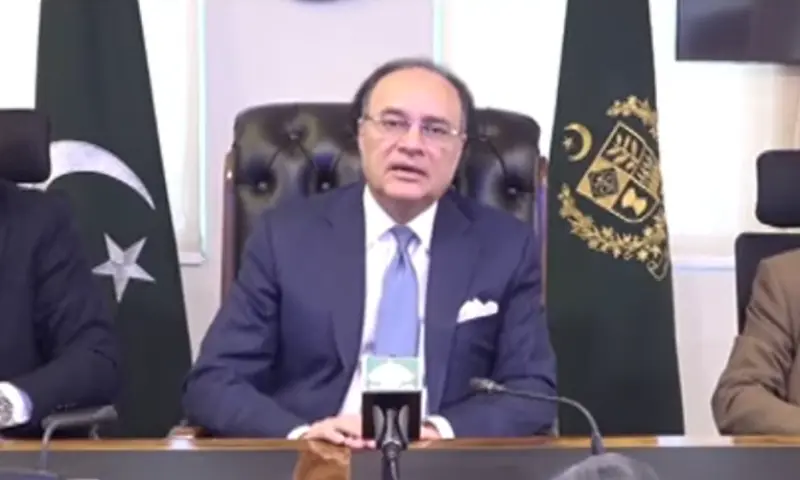
Finance Minister Muhammad Aurangzeb announced the initiative — dubbed the “Asaan Scheme,” or Easy Scheme — at a joint press conference in Islamabad alongside State Minister for Finance Bilal Azhar Kiani and Federal Board of Revenue member Hamid Ateeq Sarwar. The scheme targets an estimated three to four million small shop owners with annual turnover of up to Rs200 million, imposing a fixed tax of 1% on gross sales.
“Our tax system needs to become more transparent and move on a sustainable footing,” Aurangzeb said. “It is an important milestone in terms of expanding our tax net.”
The announcement comes less than a week before the government is due to present its federal budget for fiscal year 2026-27 on June 10, a document being assembled under close supervision from the International Monetary Fund as Islamabad presses ahead with a stabilisation program that has made broadening the tax base a central condition of continued support.
How the Scheme Works
Under the voluntary program, both registered filers and non-filers can enroll by submitting a single form available in multiple local languages. Businesses that have filed previously are eligible provided their turnover did not exceed Rs200 million in any of the past three years.
The minimum tax payable under the scheme is Rs25,000, with larger businesses paying 1% of their actual annual turnover. Any withholding tax already deducted through the existing tax machinery will be offset against the amount owed, Kiani said.
In exchange for enrollment, traders receive a physical plaque issued by the FBR bearing their name, shop name and a unique QR code to be displayed at their premises. The QR code allows tax inspectors patrolling markets to pull up compliance records on the spot. Traders also receive a point-of-sale terminal inside the shop, though Kiani noted that enrollment in the scheme simultaneously exempts participants from the FBR’s standard POS requirement — an obligation many small traders have resisted.
Enrolled businesses will also be exempt from routine audits, with any irregularities instead handled in consultation with local traders’ associations, a concession likely designed to ease the suspicion with which many informal traders regard the tax authority. Street vendors and kiosk operators are excluded from the scheme entirely.
A System Under Strain
Aurangzeb did not shy away from acknowledging the structural distortions the scheme is meant to correct. Pakistan’s documented corporate sector and its salaried workers — groups from which tax is withheld automatically — have long borne a disproportionate share of the revenue burden, he said, while vast swaths of the retail and services economy operate in the informal sector with little contribution to the exchequer.
“Everyone says that instead of increasing tax rates at this time, there is a need to reduce them,” the minister said, framing the scheme as a step toward a more “equitable, balanced and sustainable” tax architecture.
The FBR’s Sarwar was careful to distance the initiative from the politically fraught history of tax amnesties, which have repeatedly drawn criticism from the IMF and domestic reformers alike. “This is not a tax amnesty scheme but rather a tax facilitation scheme,” he said. “We are trying to simplify the system for all taxpayers, and we started from small shop owners as they are in huge numbers.”
Traders who neither enroll in the Asaan Scheme nor register under the standard tax regime will face penalties, Kiani warned, a stick designed to backstop the voluntary character of the program.
Regional Stability, Domestic Ambitions
Aurangzeb also sought to reassure investors and trading partners rattled by recent regional turbulence, saying Pakistan’s economy had remained stable despite tensions in the Middle East. “We overcome our challenges via our own resources, and didn’t take assistance from anyone,” he said, without elaborating.
The scheme was developed after consultations with national traders’ associations, according to officials, an unusual degree of stakeholder engagement for a country where tax reform efforts have historically stalled in the face of organized commercial resistance. Whether the compliance incentives on offer — administrative simplicity, audit protection and the reputational endorsement of an FBR plaque — prove sufficient to move the needle on enrollment will become clearer once the scheme goes live.
Pakistan’s tax-to-GDP ratio has persistently ranked among the lowest in the developing world, with near 11 percent, a structural weakness that has constrained public investment and made the country chronically dependent on external financing. The IMF has pushed Islamabad to widen the net rather than squeeze existing taxpayers further, and the Asaan Scheme appears calibrated to show progress on that front before budget negotiations reach their final stage.
Copyright © 2021 Independent Pakistan | All rights reserved