By Staff Reporter
MUZAFFARABAD: The government of Azad Jammu and Kashmir formally banned the region’s most prominent protest movement on Friday, designating it a terrorist organisation and deploying thousands of paramilitary and police reinforcements as tensions mounted ahead of a planned mass demonstration and the region’s first general elections in years.
The Home Department’s notification added the Joint Awami Action Committee — known variously as JAAC, JK-JAAC and the Awami Action Committee — to the First Schedule of the Azad Jammu and Kashmir Anti-Terrorism Act of 2014, a designation that renders the group’s activities illegal. The government said it had “reasonable grounds to believe” the organisation was engaged in terrorism, promoting hatred and “creating anarchy in the state by intimidating the public” and generating “a sense of insecurity in society and the public at large.”
The JAAC dismissed the designation with characteristic defiance. The ban, the group said, amounted to little more than a “confusion.” It had “nothing to lose,” its statement read, and “the whole world left to gain.”
The confrontation between the AJK government and the JAAC has been building for months, rooted in a dispute that goes back to the bloody partition of the subcontinent in 1947 — and it is now threatening to upend elections scheduled for July 27.
A Strike Timed to Disrupt Nominations
The immediate flashpoint is a wheel-jam strike the JAAC has called for June 9 — the same day the AJK Election Commission has designated for candidates to begin filing nomination papers for the upcoming legislative elections. Critics of the group, including federal Defence Minister Khawaja Asif, have characterised the timing as a deliberate effort to sabotage the democratic process.
“Democratic thinking requires that those making this demand should present it before the public on July 27,” Asif wrote on X, arguing that raising electoral grievances before polling amounted to “blackmail.” Voters, he said, should be allowed to “shape the form of representation” themselves.
The JAAC’s core demand centres on abolishing 12 seats in the 53-member AJK Legislative Assembly that are reserved for Kashmiri refugees — people who fled Indian-administered Kashmir in 1947 and 1965 and resettled across Pakistan. The group contends those seats, which are contested by voters living in mainland Pakistan rather than in AJK itself, have long been exploited by major Pakistani political parties to install pliant governments in Muzaffarabad. With six seats representing an estimated 434,000 refugees from the Jammu division and six representing roughly 30,000 from the Kashmir Valley, even the allocation within the reserved-seat system has struck many observers as deeply uneven.
The AJK Legislative Assembly on Thursday rejected any change to the arrangement, backing the refugee seats and calling for elections to proceed on schedule.
Reinforcements Pour In
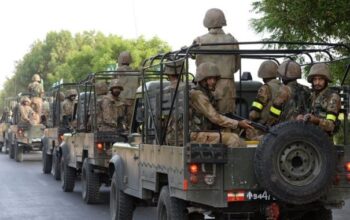
Video footage circulating on Friday showed convoys of security personnel entering Muzaffarabad. The images confirmed what officials had already announced: a large-scale mobilisation to contain any unrest the strike might produce.
A total of 1,505 Islamabad Police personnel were dispatched to AJK on Friday under a deployment authorised by Islamabad Inspector General Nasir Rizvi. The contingent — which included one deputy inspector general, two senior superintendents of police, four superintendents of police, and more than 1,380 constables — arrived equipped with full anti-riot gear, alongside units from the counter-terrorism department and the capital’s Safe City and Operations divisions.
The reinforcements augmented a request the AJK inspector general, retired Capt. Liaqat Ali Malik, had placed with the federal government on Thursday for 14,000 additional personnel to secure the territory between June 7 and June 21. “Our foremost responsibility is to protect public and private life and property, and the police will act in accordance with their mandate,” Malik told the newspaper Dawn.
The AJK government also urged outsiders to avoid traveling to the region and asked visitors already present to leave immediately. Speculation mounted on social media that internet and mobile data services could be suspended — as they were during a weeklong JAAC strike in September and October of last year.
The JAAC preemptively condemned any such move. “The shutdown of mobile and internet services is the economic murder of the people of the state,” the group posted on X, saying it would sever 2.2 million Kashmiris from their homes and represented “the worst form of governmental terrorism.”
A History Written in Blood
The current impasse follows some of the most violent episodes in AJK’s recent history. In May 2024, protests led by the JAAC over demands for economic relief and political rights turned deadly. The unrest grew worse in the autumn of last year, when demonstrations erupted over a broader set of governance and constitutional demands. At least nine people were killed — including three police officers — during confrontations between security forces and protesters in October.
Two days after that violence, the government and the JAAC reached a written agreement covering 12 core demands and 13 additional points. Among other things, both sides committed to forming a high-level committee to examine the refugee-seat issue. But that committee, critics say, became another casualty of the region’s chronic dysfunction: the JAAC has repeatedly refused to engage with it, and the government has accused the group of pursuing confrontation over negotiation.
The unrest also had immediate political consequences. The Pakistan Peoples Party moved a no-confidence motion against then-Prime Minister Chaudhry Anwarul Haq, whom the PML-N joined in ousting. On Nov. 17, Raja Faisal Mumtaz Rathore was elected the 16th prime minister of Azad Jammu and Kashmir, winning 36 votes in the legislative assembly.
An All-Parties Conference That Resolved Nothing
With elections approaching and the refugee-seat dispute still unresolved, the AJK government convened an All Parties Conference in Muzaffarabad to seek consensus. Nearly every major party attended. The JAAC and Pakistan Tehreek-e-Insaf boycotted it.
The JAAC said its written proposals, submitted May 30, had already been rejected by the government, rendering its participation pointless. The group had proposed two alternatives: retaining nominal refugee representation until the broader Kashmir dispute is resolved, or replacing the 12 assembly seats with 4 seats in the AJK Council — a body chaired by Pakistan’s prime minister, which the JAAC argued would better preserve the political dimension of the Kashmir cause at the national level.
The APC rejected any modifications outside the existing constitutional and legislative framework, concluding that only the elected assembly could alter the refugee-seat arrangement. The JAAC responded with contempt, calling the conference resolution “a page and a half of utterly trivial lines” and accusing participants of gathering to serve their own interests rather than the public’s.
Defence Minister Asif, for his part, appealed to history in defending the refugee seats. Sialkot alone, he noted, had absorbed more than 200,000 Kashmiri migrants in October 1947 following the partition’s violence. “How can you deprive these migrants of their rights?” he wrote. “They paid a very heavy price for freedom.”
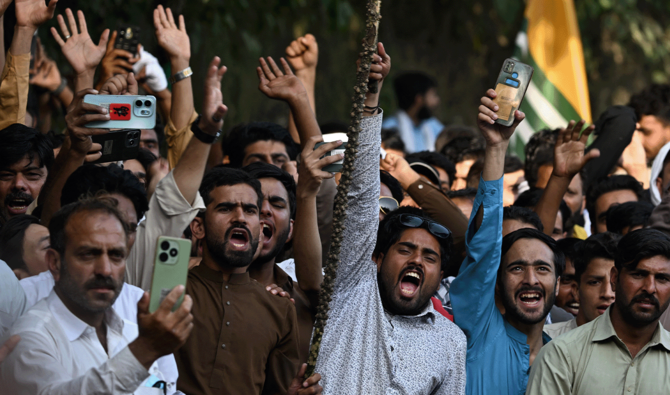
The JAAC has called for mass caravans to converge on Muzaffarabad from across the region on June 9. Whether the security deployment will deter them — or whether it will produce the kind of confrontation both sides claim to want to avoid — remained an open question as night fell Friday over the Kashmir valley.
Copyright © 2021 Independent Pakistan | All rights reserved