By Staff Reporter
ISLAMABAD: Pakistan said on Thursday it was doing its “utmost” to bring the United States and Iran back into talks under a peace framework brokered in Islamabad last month, even as fresh American strikes on Iranian targets underscored how far the two sides remain from any lasting truce.
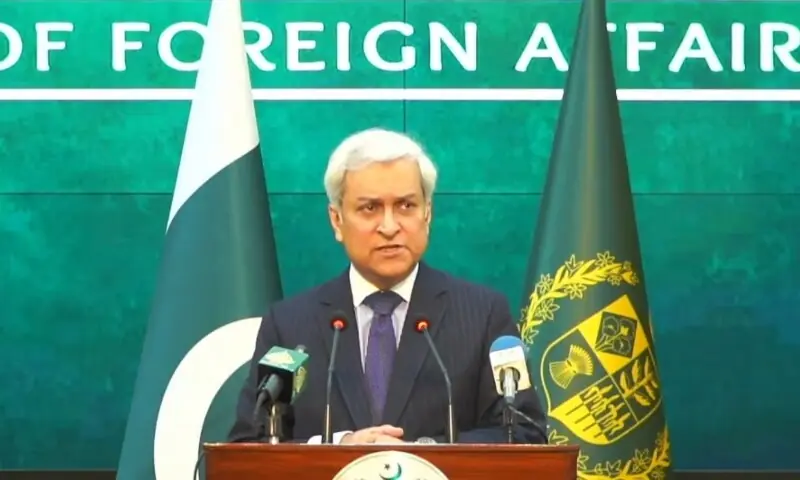
Speaking at the Foreign Office’s weekly briefing in Islamabad, spokesperson Tahir Andrabi said negotiations aimed at normalising the situation in the Strait of Hormuz and de-escalating the wider conflict were continuing behind the scenes, despite a week that has seen the war widen across multiple fronts in the Middle East.
“Let me add that the negotiations between parties are ongoing to normalise the situation, particularly the situation in the Strait of Hormuz, as well as to de-escalate,” Andrabi told reporters.
He said Pakistan noted with concern that the security situation in the region “remains precarious despite the relative calm of the past few days, which had rekindled hopes that this positive development, this calm, would consolidate into a durable and fully respected ceasefire and pave the way for dialogue”.
Islamabad has positioned itself as a key mediator between Washington and Tehran since the conflict erupted on 28 February, when American and Israeli strikes on Iran triggered retaliatory attacks on Israel and on Gulf states hosting US forces. That mediation produced the Islamabad Memorandum of Understanding, signed on 18 June after weeks of intensive shuttle diplomacy, under which both sides committed to a further 60 days of negotiations aimed at reopening the Strait of Hormuz and winding down hostilities.
The agreement held for less than three weeks. Fighting resumed on 7 July when Iran struck commercial shipping in the strait, including a Qatari liquefied natural gas tanker, with Tehran accusing Washington of having violated the understanding first. The US responded with successive waves of strikes on Iranian military positions, and the conflict has since escalated on several fronts simultaneously — from Iraq to the Red Sea to the Gulf of Aden.
Andrabi said Pakistan was working to remove “all irritants” preventing a return to the Islamabad framework, in keeping with what he called the spirit of the agreement and a subsequent Pakistan-Qatar joint statement issued on 22 June. He called on both Washington and Tehran to exercise “maximum restraint” and to honour their earlier commitment to resume technical-level talks.
Dialogue and diplomacy, he said, remained “the only viable path forward” — a message he said Pakistan had consistently pressed on both parties, alongside its own stake in the conflict’s resolution. Pakistan imports the bulk of its fuel from the Middle East and has been grappling with higher energy costs, inflationary pressure and fuel conservation measures as the war has dragged on.
Fresh US strikes follow Iranian attack on Jordan
The Foreign Office’s appeal for restraint came only hours after US Central Command announced it had carried out what it described as a “heavy wave of strikes” against Iranian targets, breaking a lull in direct fighting that had lasted almost a week.
The American strikes were launched in retaliation for an Iranian missile attack on a US base in Jordan a day earlier. President Donald Trump had vowed to hit Iran “very hard” in response, and Centcom said American forces struck “dozens” of sites belonging to Iran’s Revolutionary Guard Corps, including military command centres, missile and drone facilities, and coastal surveillance and defence positions. The command said the operation was intended to “further diminish threats posed by Iran and its proxies to American forces, commercial shipping, and neighbouring Gulf countries”.
Iran’s state news agency IRNA reported strikes on several towns in the south-western province of Khuzestan, including areas around Abadan, Shadegan, Arvandkenar and Ahvaz, as well as on Qeshm island in the Gulf. The Fars news agency reported that a strike on a residential property in Qeshm’s Chah Tangu neighbourhood killed three members of one family — a father, mother and their two-year-old child — and injured two other children. The report cited the Hormozgan University of Medical Sciences.
Jordan’s armed forces said separately that its air defences had intercepted five missiles fired from Iran, with no casualties reported, according to the state-run Petra news agency. Iran’s Revolutionary Guards confirmed they had targeted US bases in the country, warning that “as long as the threats against the Islamic Republic of Iran continue… the resistance will continue”.
Strikes on Iraqi militias and a widening front
The renewed hostilities followed a joint US-Saudi operation on Wednesday against Iran-aligned militia targets in Iraq, launched after Riyadh accused armed groups loyal to Tehran of a fresh wave of drone attacks on its oil facilities.
Iraq’s Hashed al-Shaabi alliance said at least 20 of its members were killed in the strikes, including, according to two of its officials, five Iranian military advisers. News agency correspondents reported seeing coffins draped with Iranian flags at the scene. The alliance condemned what it called a “dangerous escalation” against an “official security institution”, and the Iraqi government criticised the strikes, saying it rejected “all acts of aggression, regardless of the party responsible or the justifications presented”. Baghdad’s Ministerial Council for National Security said it would “confront any violation of Iraq’s sovereignty” and prevent Iraqi territory being used to threaten neighbouring states.
Trump, however, said the operation had been “coordinated with the Iraqi government” — a claim made as Washington has stepped up pressure on Baghdad in recent weeks to disarm pro-Iran militias. Iraqi prime minister Ali al-Zaidi visited both Washington and Tehran earlier this month.
Saudi Arabia’s defence minister, Prince Khalid bin Salman, held separate meetings with Trump and Vice President JD Vance on Wednesday. According to two people familiar with the discussions, who were not authorised to speak publicly, the prince told both men that Riyadh’s decision to join the strikes on the Iraqi militias was intended to signal that Saudi Arabia would not tolerate attacks on its oil industry — while also stressing that the kingdom wanted to see de-escalation and a return to US-Iran negotiations.
The war also reached Kuwait on Thursday morning, when an Iranian strike hit a building belonging to a Chinese firm in the north of the country, severely damaging the structure and killing a worker, according to Kuwait’s military.
In Egypt, the British maritime security firm Ambrey reported that drone strikes had ignited fires on two natural gas vessels at the port of Damietta on Wednesday — a US-owned floating storage facility and a Greek-owned tanker. The office of the Egyptian prime minister said initial investigations indicated the fires had been caused by a drone, though responsibility was not immediately established. Asked whether Iran was behind the attack, Trump told reporters in the Oval Office: “It’s a little more of the same… in the meantime, we’re going to be hitting them very hard because it’s our turn to hit them.” No injuries were reported. Egypt, a close US ally and regional mediator, has largely been spared direct military action during the war, and confirmation of an Iranian-linked strike would mark a significant widening of the conflict.
Separately, Israel accused Hezbollah of flying a drone against an Israeli vehicle inside Lebanon overnight, calling it “a blatant violation of the ceasefire”. Israel fought alongside the US in the early weeks of the war against Iran and has continued operations against Hezbollah in Lebanon, but has not yet joined the latest round of American strikes on Iran itself.
Two chokepoints, one energy crisis
The Strait of Hormuz remains at the centre of the diplomatic impasse. Iran’s Revolutionary Guards said on Wednesday they had attacked and boarded three tankers in the strait, asserting Iran now had “full control” of a waterway that was previously open to free transit. Tehran has said it intends to retain control of the passage and has announced plans to charge fees for ships passing through it — a move Washington has rejected. The United States has responded with new sanctions targeting entities linked to the Revolutionary Guards accused of extorting vessels transiting the strait.
Iran-aligned Houthi rebels in Yemen have since opened a second front, imposing what they have called a blockade on Saudi shipping through the Bab el-Mandeb strait, the entrance to the Red Sea from the Gulf of Aden. On Monday, the Houthis said they had launched drones at oil infrastructure used to move Saudi crude to the Red Sea port of Yanbu — a route that has taken on added importance as Iran’s grip on the Strait of Hormuz has cut off other export options. The group said the strike was retaliation for a Saudi drone it said had entered Yemeni airspace. Satellite imagery from Monday, analysed by the Associated Press, showed damage to Saudi Aramco’s Abqaiq processing facility, which is capable of handling around seven million barrels of crude a day.
Crude prices eased on Thursday after climbing sharply the previous day, though the widening conflict — now touching Iran, Iraq, Jordan, Kuwait, Egypt, Lebanon, Saudi Arabia and Yemen — has left mediators warning of the difficulty of containing a war that has already killed thousands, displaced millions and unsettled global energy markets. A regional official said mediators were “still trying with both sides” to restore calm and revive the collapsed ceasefire, though he offered no indication of whether that effort
Copyright © 2021 Independent Pakistan | All rights reserved