By Staff Reporter
ISLAMABAD: Finance minister Muhammad Aurangzeb on Saturday mounted a vigorous defence of his Rs18.77 trillion federal budget for fiscal year 2026-27, saying the government had exhausted the fiscal space available to it in pursuing an ambitious pivot from economic stabilisation toward export-driven growth.
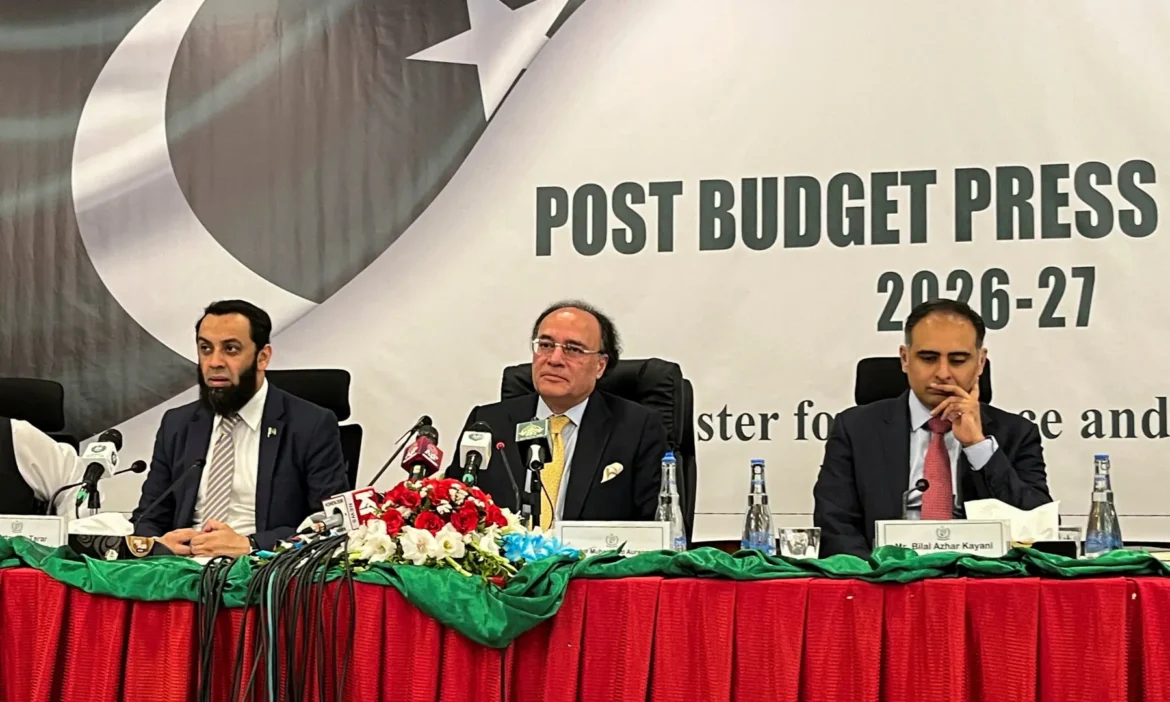
Speaking at a post-budget press conference in Islamabad flanked by the minister of state for finance, Bilal Azhar Kayani, information minister Attaullah Tarar and Federal Board of Revenue chairman Rashid Mahmood Langrial, Aurangzeb said the measures unveiled before the National Assembly on Friday represented the most comprehensive effort yet to construct an enabling environment for exporters and formal industry.
“When we were sitting here at this time last year, I said that, God willing, we would move from economic stability toward growth,” he told reporters. “We have made significant progress in that direction.”
The budget, Pakistan’s third under Aurangzeb and the fifth presented by the ruling coalition, proposes an ambitious revenue target of Rs15.264 trillion — a 17.6 percent increase on the revised estimate for the outgoing year — despite an estimated shortfall of roughly Rs1 trillion in fiscal year 2025-26. The government has set a GDP growth target of 4 percent and projects average inflation of 8.2 percent for the coming year, with the fiscal deficit expected to narrow to 3.6 percent of GDP and a primary surplus of 2 percent.
Super tax and advance levy
The headline corporate measure is the abolition of the super tax across six income brackets, together with a reduction in the levy from 10 percent to 8 percent for businesses posting annual income in excess of Rs500 million. The advance tax on exporters has also been scrapped. Aurangzeb said Prime Minister Shehbaz Sharif had specifically directed him to extend the super tax abolition to all exporters — a commitment he said he would enshrine in his concluding budget speech.
“The abolition of the advance tax and the six slabs of super tax were the primary demands of the exporters and the formal industry,” said Kayani. “We heard the concerns of all chambers of commerce and we addressed them.”
An additional Rs70 billion in subsidies has been earmarked to allow exporters to access financing through the Export Refinance Scheme at a rate of 4.5 percent, a measure Aurangzeb described as taking the facility “to a different level”. He was at pains to stress that the budget’s approach to exports was as much a question of financing as it was of taxation.
Langrial, the FBR chairman, was characteristically blunt about the strategic logic. “The entire budget is a budget for export-led growth,” he said. “There is a limited market within Pakistan to sell locally-manufactured goods. Unless you sell those goods abroad, poverty will not decline.”
Salaried class relief
The government has simultaneously sought to burnish its credentials with lower-income earners. The 5 percent income tax slab for the lowest bracket has been cut to 1 percent, while the 15 percent slab has been reduced to 13 percent. Those earning up to Rs600,000 annually pay nothing; those earning between Rs600,000 and Rs1.2 million are taxed at 1 percent. A person earning Rs100,000 per month will now pay Rs500 in monthly tax; someone earning Rs200,000 will pay Rs13,500. Tax rates for higher-income individuals have also been trimmed across several brackets.
Kayani described the budget as one that “reduces the economic burden on the people”, and said measures had been designed in consultation with the business community. He was careful to note that export-oriented growth was not purely a corporate project — workers, machine operators, drivers and labourers throughout the industrial value chain would also benefit from the expansion in activity it was intended to generate.
Tariffs and agriculture
Customs duty, additional customs duty and regulatory duty on the import of agricultural machinery — including combined harvesters, tractors and centrifugal pumps — have all been reduced to zero. Agricultural credit has risen approximately 15 percent year-on-year and now exceeds Rs2 trillion, the minister said. The government’s collateral-free Zarkhez-e-Asaan financing scheme for small farmers was, he said, progressing well, and was designed specifically to loosen the grip of commission agents who had exploited the sector’s historical lack of access to formal credit.
The Prime Minister’s Youth Business and Agriculture Loan Scheme has been allocated Rs262 billion in total, of which Rs125 billion is earmarked for agriculture.
On tariffs more broadly, Aurangzeb noted that the government was two years into a five-year plan to reduce the cost of imported intermediate goods and raw materials — a programme he described as central to the effort to improve export competitiveness and reduce the trade deficit on goods. Information technology exports, he said, were expected to reach $4.5 billion and were “becoming more and more important as we go forward”. The Final Tax Regime for the IT sector and freelancers — fixed at 0.25 percent following consultations with PASHA and the broader industry — would be maintained.
Tax modernisation
Aurangzeb sketched out an ambitious programme to overhaul the architecture of tax collection, describing a new model based on automation, artificial intelligence and sharply reduced human intervention. “We want to move towards a technology-driven, faceless system in income tax and sales tax, similar to what has been introduced in customs,” he said, adding that digital monitoring had already begun to generate additional revenues.
On the retailers’ scheme, Kayani clarified that the Rs25,000 figure widely reported before the budget was not a flat tax but rather a minimum cash payment, with the actual liability set at 1 percent of turnover for retailers with annual sales below Rs200 million. Retailers could offset withholding taxes against the liability, but were required to make a minimum cash payment of Rs25,000 when filing.
When pressed on pre-budget speculation — reports had circulated variously of increases in sales tax, levies on solar panels and other measures that did not materialise — Aurangzeb turned the tables on the room, quipping that journalists should hold their sources “accountable” for the inaccurate briefings they had received. “This,” he said of solar equipment taxes, “was never part of the discussion.”
Provinces, defence and energy
The budget extends a freeze on provincial development allocations, a measure Aurangzeb framed as a collective effort in the national interest rather than a constraint imposed from the centre. He expressed gratitude to the provinces for stepping up and said their contributions were reflected partly in the defence budget. The arrangement, he indicated, was expected to remain in place for the next three years following consultations with provincial governments.
On energy, the minister acknowledged that the conflict in the Middle East had already disrupted Pakistan’s oil import bill — which rose by $1 billion in April before coordinated government interventions through the National Command and Monitoring Centre helped reduce the additional burden to approximately $500 million in May. He said the damage to regional energy infrastructure would have spillover effects into the next fiscal year but insisted the government had built sufficient fiscal buffers to absorb the impact. The petroleum levy, he confirmed, was not being increased; any adjustments would involve only the allocation between petrol and diesel within an unchanged overall structure.
Public-private partnership and development
On development spending, Aurangzeb told reporters the government had $12 billion available for projects in the current year alone — more, he suggested, than could be deployed effectively through traditional public channels. “We do not have a shortage of resources,” he said. The relevant constraint was not fiscal but structural. The government intended to redirect the bulk of future development financing through public-private partnership structures, limiting direct budget commitments to projects where commercial viability was genuinely absent. He cited the Sindh government’s work in Thar as a model of effective PPP execution.
A merger of the Board of Investment and the Special Investment Facilitation Council — foreshadowed in earlier reporting — was confirmed to be under active consideration. “Both have similar objectives of investment and facilitation,” Aurangzeb said, adding that Prime Minister Sharif had taken the principal decision to proceed, though the mechanics of integration had yet to be determined. “It is best if foreign investors use and work with a one-window system,” he said.
Population and the NFC
In remarks that veered toward the existential, Aurangzeb used the press conference to sound a stark warning about Pakistan’s population growth trajectory. The abolition of taxes on contraceptives — quietly included in the budget — reflected, he said, a broader government concern that the country’s developmental challenges would become unmanageable if the population trajectory was not addressed. “If today, with a population of 250 million, you are highlighting child stunting and learning poverty — primarily girls out of school — then can you imagine what will happen if we reach 300 to 400 million?” he said. He called it “an existential issue” and indicated that population metrics should be incorporated as a driver in the next National Finance Commission award.
IMF and macrostability
Throughout the briefing, Aurangzeb framed macroeconomic discipline as a prerequisite rather than an end in itself. “Macrostability is basic hygiene,” he said. “If there are forex reserves, stable interest rates, a functioning foreign exchange market and consistent policies, then local investors will come first, followed by foreign investors.” Pakistan, he noted, remained in continuous consultation with the IMF as a requirement of its programme, and all budget discussions had been conducted with the Fund’s input. The government has set a markup payment provision of Rs8,045 billion within the overall budget outlay, reflecting the continued weight of debt servicing on public finances.
The budget’s credibility will ultimately be tested by whether the revenue target — optimistic by the standards of the outgoing year — can be achieved, and whether the incentive architecture for exporters translates into the kind of measurable growth in foreign exchange earnings the minister has promised. Aurangzeb acknowledged there was “more to do”. The feedback received so far, he said, was that the country had set out on the right path.
Copyright © 2021 Independent Pakistan | All rights reserved