By Staff Reporter
ISLAMABAD: Pakistan has ordered the development of a sovereign, airgapped mobile communications network for at least 10,000 government officials, citing critical information leakages identified after its recent conflict with India and drawing lessons from military engagements across the Middle East.
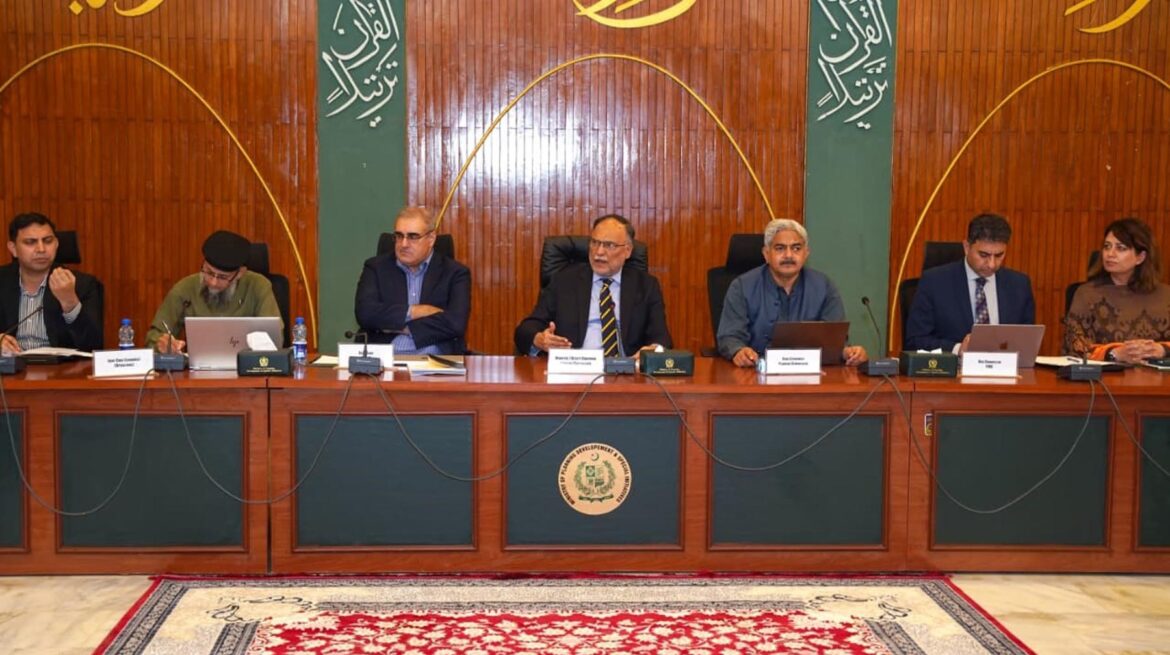
The directive was among 24 development projects worth a combined 465.76 billion rupees approved on Thursday at a meeting of the Central Development Working Party (CDWP), chaired by Planning Minister Ahsan Iqbal.
The 709 million rupee scheme, dubbed the PAKAWAZ Secure Mobile Communication Ecosystem, would place government communications on an isolated private 4G LTE core network physically or logically airgapped from the public internet — a configuration officials described as “below-internet.” The platform would support encrypted voice and video calls, secure messaging, file sharing and centrally managed contact directories, and would incorporate a kill-switch mechanism to remotely disable handsets.
The Planning Commission, however, expressed reservations about the technical robustness of the proposal submitted by the National Telecommunication Company (NTC), according to government sources. NTC was directed to hold further consultations with stakeholders and redesign the security architecture to deliver what officials described as an unbreakable system meeting requirements for confidentiality, integrity, availability and national data sovereignty before the project advances.
SATELLITE SLOT AT STAKE
The CDWP recommended a second major technology initiative for sign-off by the Executive Committee of the National Economic Council (ECNEC) — a 37.19 billion rupee project to construct and deploy Pakistan Communication Satellite-2 (PakSat-2) in geostationary orbit. The satellite would replace PakSat-IR, which is due to complete its 15-year operational lifespan later this year.
Officials said the launch carried urgency beyond technical succession: under international allocations, Pakistan risks permanently forfeiting its geostationary orbital slot — a position in space that cannot be recovered — if it remains vacant for three years.
PakSat-2 would also upgrade ground control and operations facilities at Lahore and Karachi, expanding satellite command, tracking and operational capabilities through existing infrastructure run by the national space agency, SUPARCO.
INFRASTRUCTURE SPENDING
Of the 24 projects cleared, the CDWP directly approved 15 schemes worth a combined 34.7 billion rupees, while nine projects totalling 431.02 billion rupees were forwarded to ECNEC for final authorisation.
The largest single commitment was a 278.62 billion rupee scheme to overhaul the ML-3 railway corridor, a 996-kilometre artery running from Rohri through Sibi and Quetta to Koh-i-Taftan on the Iranian border. The project covers track renewal, rehabilitation of embankments and bridges, replacement of turnouts and construction of 11 new stations between Spezand and Taftan.
Financing is to be arranged through the Public Sector Development Programme, with bridging funds provided by Reko Diq Mining Company and the government. Work will be carried out in two phases — critical infrastructure between 2026 and 2030, with remaining priority works completed by 2033.
A second major transport allocation, a 43.65 billion rupee road project linking Mashkel and Chedgi across 108.5 kilometres of Balochistan terrain, was also recommended for ECNEC approval. The scheme includes a 4.1-kilometre mountain tunnel and associated bridges, culverts, retaining walls and erosion-control works. Ninety percent of financing is to be provided by the Saudi Development Fund.
Other cleared projects included a 20.35 billion rupee bypass at Lalamusa on the N-5 national highway; a 10.87 billion rupee bridge over a reservoir channel on the Mirpur-Islamgarh road in Azad Jammu and Kashmir; and a 10 billion rupee scheme to strengthen the electricity supply network in AJK through reconductoring, load bifurcation, transformer upgrades and the creation of a dedicated repair facility.
ARTIFICIAL INTELLIGENCE PUSH
On digital infrastructure, a 7.93 billion rupee emerging technologies data centre was approved to establish sovereign, government-owned artificial intelligence and high-performance computing capacity for Pakistani state institutions, universities, research bodies and the private sector. The facility is intended to reduce dependence on foreign cloud providers, bolster data security and stimulate domestic AI development.
A 13 billion rupee National Artificial Intelligence Ecosystem Development Programme was also cleared in principle, allocating resources for a comprehensive feasibility study by an external consultancy. The study will assess Pakistan’s AI landscape, infrastructure requirements, market viability, financing options and governance and legal frameworks as a precursor to a full implementation plan.
The CDWP additionally cleared a 9.42 billion rupee project to acquire 26.76 kanal of land in Islamabad’s H-11 sector and engage consultants to design a dedicated Special Protection Unit facility for the capital’s police force.
Copyright © 2021 Independent Pakistan | All rights reserved