By Staff Reporter
QUETTA: Security forces killed ten suspected militants and wounded several more during a gun battle in the mountains of Balochistan on Saturday, in the latest of a string of operations against a group the state accuses India of sponsoring.
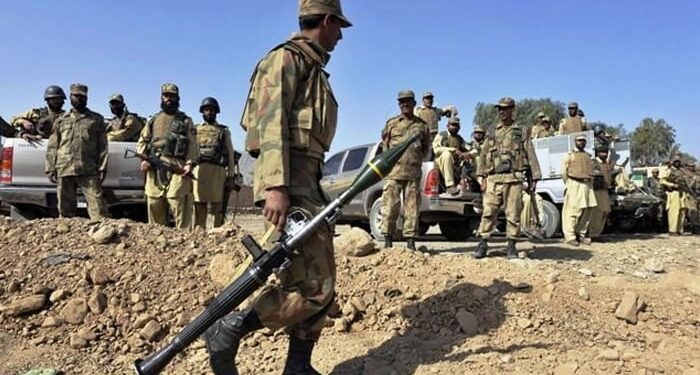
The clash unfolded in the Shor Parod range, a remote and rugged stretch of Khuzdar district, after security sources said they had received credible intelligence that fighters linked to Fitna al-Hindustan were sheltering in the area. Officials said troops moved to encircle several suspected hideouts once they had located them, only to find militants dug in across three separate small groups scattered through the terrain.
What followed, according to the sources, was a sustained firefight as soldiers pressed in on the surrounded positions. By the time the shooting stopped, ten militants lay dead and a further unspecified number had been wounded.
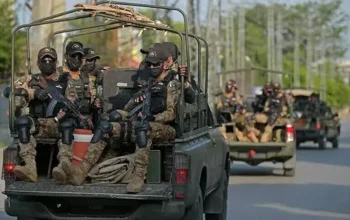
Security forces did not withdraw once the immediate clash ended. Sources said troops fanned out across the mountainous terrain in a search-and-clearance operation aimed at hunting down fighters who had slipped away during the fighting, with pursuit efforts continuing into the search phase. Officials reiterated that operations would carry on “until the complete elimination of terrorism” from the region.
Fitna al-Hindustan is the label Pakistani authorities use for a cluster of separatist and militant groups active in Balochistan, chief among them the banned Balochistan Liberation Army. Islamabad maintains that India funds, arms and directs the network as part of a proxy campaign against the Pakistani state.
Saturday’s raid came just three days after security forces reported killing at least eight Fitna al-Hindustan terrorists in Surab district, when a vehicle-borne improvised explosive device they were assembling detonated prematurely. That blast, and the secondary explosions it triggered among other stored explosives at the site, also killed three civilians who happened to be nearby. In the hours that followed, troops moving through the area reportedly tracked the movement of militants fleeing the scene and killed a further ten of them during a follow-up clearance operation, bringing the toll from that single episode to eighteen.
The frequency and scale of such incidents point to a security landscape that has deteriorated sharply since 2021, when the Taliban’s return to power in neighbouring Afghanistan is widely seen as having emboldened militant networks operating along Pakistan’s western frontier. Khyber Pakhtunkhwa and Balochistan have borne the brunt of the fallout, with both provinces now functioning as the country’s principal theatres of violence.
Figures compiled by the Centre for Research and Security Studies paint a stark picture of just how concentrated that violence has become. The think tank’s assessment of the second quarter of 2026 found that Khyber Pakhtunkhwa and Balochistan together accounted for close to 96 percent of all conflict-related deaths recorded nationwide during the period. Khyber Pakhtunkhwa alone absorbed the heaviest losses, with 475 fatalities amounting to more than 61 per cent of the total, while Balochistan recorded 265 deaths, or roughly 34 percent.
The pattern held for the number of attacks as well as their lethality. Khyber Pakhtunkhwa logged 151 separate violent incidents over the quarter, 57 percent of the national count, while Balochistan registered 94, or 35 percent — together confirming the two provinces as the epicentre of Pakistan’s ongoing militant crisis, even as security officials continue to insist that sustained operations are steadily eroding the militants’ capacity to strike.
Copyright © 2021 Independent Pakistan | All rights reserved