By Staff Reporter
ISLAMABAD: Pakistan recorded a broad decline in militant violence and security force casualties in June even as a string of high-profile suicide bombings underscored the persistent threat facing the country, according to data published on Wednesday by an Islamabad-based research group that tracks conflict trends.
The Pakistan Institute for Conflict and Security Studies (PICSS) said 262 people were killed nationwide in June, including 184 suspected militants slain in operations by security forces, 52 civilians and 26 members of the security forces. A further 134 people were wounded, among them 63 civilians, 50 security personnel, 18 members of pro-government peace committees and three militants.
The figures mark a sharp improvement from May across nearly every category PICSS tracks. Security force deaths fell 62% month-on-month, civilian deaths dropped 27% and militant fatalities declined 32%. Casualties followed a similar pattern, with injuries among security forces down 43%, civilian injuries down 57% and militant injuries down 67%.
Kidnappings roughly halved, to 27 in June from 54 in May, PICSS said, while security forces detained at least 27 suspected militants during the month. The overall number of attacks fell to 108 from 128 in May, a decline of about 16%.
Despite the improvement, PICSS said Pakistan continued to face “high-impact attacks, including at least four suicide attacks” in June, three of them vehicle-borne bombings. The most prominent struck a convoy of the Sindh Rangers, a paramilitary force, in the port city of Karachi on June 27, killing three security personnel. May had been markedly more violent by this measure, with six suicide bombings, four of them vehicle-borne.
REGIONAL PICTURE MIXED
The security gains were not uniform across the country. Balochistan, the site of a long-running separatist insurgency, saw the steepest improvement, with attacks falling 31% to 49 in June from 71 in May. The tribal districts bordering Afghanistan, formerly known as the Federally Administered Tribal Areas (FATA) and now merged into Khyber Pakhtunkhwa province, recorded 17 attacks, down 23% from 22 in May.
The rest of Khyber Pakhtunkhwa moved in the opposite direction, with attacks rising 16% to 37 from 32 the previous month. The province has for years been a focal point of Pakistan’s fight against the Pakistani Taliban, a group separate from but ideologically aligned with the Afghan Taliban.
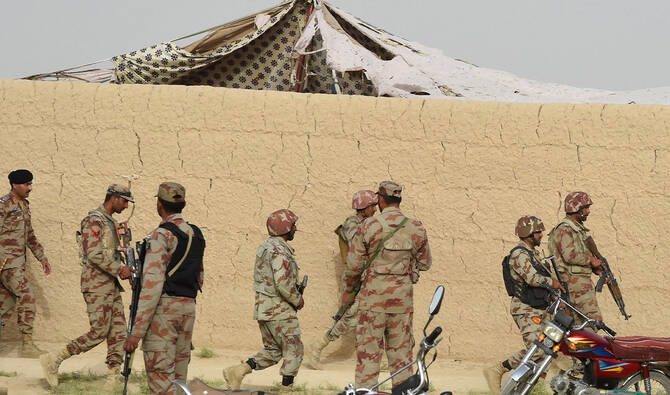
Among the deadliest single episodes of the month, six Frontier Corps paramilitary personnel were killed and four wounded on June 9 when militants attempted to seize a security post in the Hassan Khel area of Peshawar, according to security sources. Security forces killed eight militants in the ensuing response.
Sindh province, home to Karachi, recorded four attacks in June compared with one in May. Punjab, Pakistan’s most populous province, recorded a single attack. No militant violence was reported in the capital, Islamabad, or in the northern regions of Azad Kashmir and Gilgit-Baltistan, PICSS said.
FIRST-HALF TOLL
PICSS put the nationwide death toll for the first six months of 2026 at 2,166, including 1,442 militants, 404 civilians, 307 security personnel and 13 members of peace committees. A further 1,137 people were wounded over the same period: 692 civilians, 281 security personnel, 136 militants and 28 peace committee members.
The figures follow a year in which Pakistan ranked first on the Global Terrorism Index for the first time, with terrorism-related deaths rising 6% to 1,139 in 2025, as militant groups based in Balochistan and along the Afghan border stepped up attacks on security forces and infrastructure.
Copyright © 2021 Independent Pakistan | All rights reserved