By Staff Reporter
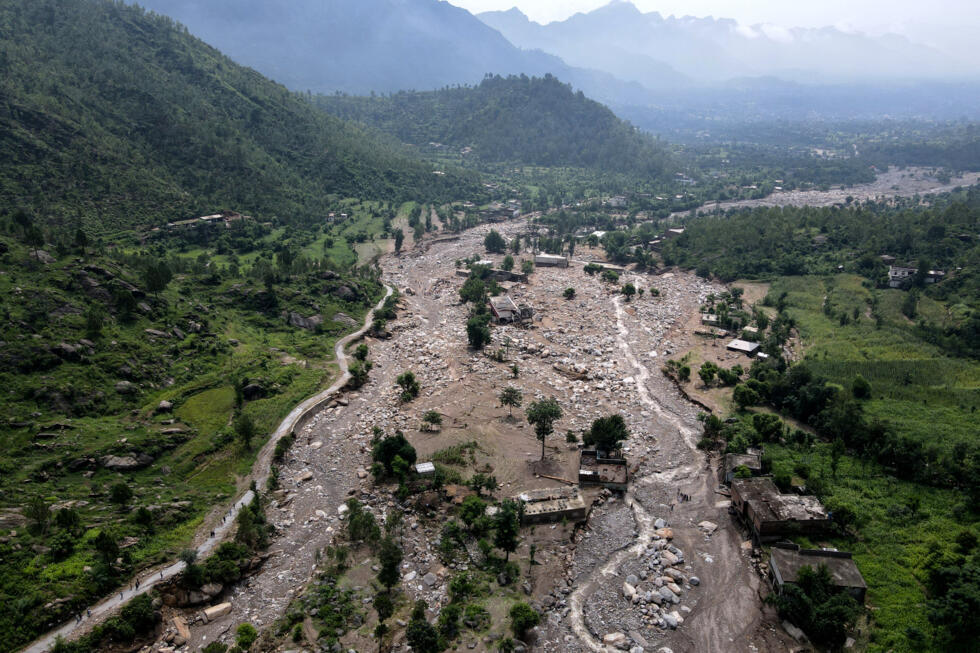
ISLAMABAD: The disaster management authority warned on Wednesday of an elevated risk of glacial lake outburst floods, flash floods, landslides and urban flooding across the country’s northern and central regions over the next four days, as rising temperatures and an active monsoon system combine to accelerate glacier melt and trigger heavy rain.
The National Disaster Management Authority (NDMA) said in an advisory that the threat would run from July 1 to July 4, with its National Emergencies Operation Centre (NEOC) attributing the risk to a combination of soaring temperatures, westerly weather systems and monsoon rains moving in from the south.
The warning covers a broad swath of the country, from the glacier-fed valleys of the north to river plains and hill torrent zones stretching across Khyber Pakhtunkhwa, Punjab, Balochistan, Azad Jammu and Kashmir and Gilgit-Baltistan.
Pakistan is highly vulnerable to glacial lake outburst floods, or GLOFs, which occur when meltwater breaches natural ice or debris dams and sends walls of water and debris rushing downstream with little warning. The country is home to more glaciers than almost anywhere outside the polar regions, and scientists have linked the growing frequency of such floods to warming temperatures.
GLACIER REGIONS ON HIGH ALERT
The NDMA said glacier-adjacent districts of Gilgit-Baltistan, Khyber Pakhtunkhwa and Azad Kashmir faced a heightened threat of GLOFs, with accelerated melting raising the likelihood of sudden flash floods, debris flows, landslides and rockfalls in mountain communities.
It named Hunza, Nagar, Ghizer, Skardu, Shigar, Ghanche, Kharmang, Astore, Diamer, Upper and Lower Chitral, and Swat among the districts where residents and local authorities should exercise extreme caution.
The agency said water flows in the Hispar-Hopper Nullah, a glacial torrent in Gilgit-Baltistan, were expected to rise significantly, increasing the danger of flash floods, debris flows and riverbank erosion in nearby areas.
FLASH FLOOD ALERT ACROSS FOUR PROVINCES
In a separate alert also covering July 1 to 4, the NEOC said the combined effect of the monsoon and westerly weather systems could send water levels surging in hill torrents and seasonal streams in Khyber Pakhtunkhwa, Punjab, Balochistan, Azad Kashmir and Gilgit-Baltistan.
In Khyber Pakhtunkhwa, the authority said hill torrents and streams were likely to swell in Charsadda, Nowshera, Peshawar, Mardan, Swabi, Kohat, Bannu, Lakki Marwat, Dera Ismail Khan, Mansehra, Abbottabad, Haripur, Swat, Upper and Lower Dir, Chitral, Shangla, Buner, Battagram, Torghar and Kohistan.
Seasonal streams were expected to flood parts of Punjab, including Rawalpindi, Attock, Jhelum, Chakwal, Mianwali, Bhakkar, Khushab, Sargodha, Faisalabad, Jhang, Sialkot, Narowal, Gujrat, Gujranwala, Lahore, Sheikhupura, Hafizabad and Mandi Bahauddin.
In Balochistan, the NDMA forecast localized flash flooding in Zhob, Sherani, Musa Khel, Barkhan, Sibi, Kohlu, Dera Bugti, Loralai and surrounding areas, while mountainous parts of Azad Kashmir and Gilgit-Baltistan were also at risk of overflowing streams and localized flooding.
URBAN AREAS BRACE FOR DISRUPTION
The advisory further warned that low-lying areas of major cities could see urban flooding, with heavy rain likely to disrupt traffic and inundate roads and residential neighborhoods. Roads, bridges, irrigation networks and other public infrastructure were also at risk of damage from flooding and landslides, it said.
The NDMA has directed relevant government departments to put precautionary measures in place, including drainage arrangements, emergency response preparedness, and continuous monitoring of river flows and glacial lakes.
The authority said it was carrying out ongoing monitoring and early risk assessment to ensure warnings reach relevant authorities in time, and it urged the public to strictly follow official safety guidance.
Residents in low-lying areas and along riverbanks were advised to avoid unnecessary travel and remain vigilant through the four-day forecast window.
Pakistan suffered its worst flooding in decades in 2022, when monsoon rains and glacial melt submerged a third of the country, killed more than 1,700 people and caused an estimated $30 billion in damage. The disaster prompted the government to step up early-warning systems in glacier-fed regions, though officials and climate researchers have continued to warn that the country’s exposure to extreme weather is rising as global temperatures climb.
Copyright © 2021 Independent Pakistan | All rights reserved