By Staff Reporter
Buried inside the 927-page financial disclosure that President Trump’s office filed this week with the U.S. Office of Government Ethics is a number that says a great deal about how his second term has reshaped his business, and perhaps his diplomacy along with it: $515 million. That is roughly what Trump earned last year from the sale of tokens issued by World Liberty Financial, the cryptocurrency venture launched by his sons and the sons of his Middle East envoy, Steve Witkoff. It is one piece of a crypto windfall that, once meme-coin royalties and other digital-asset income are added in, helped push Trump’s total reported earnings for 2025 above $2 billion.
The disclosure does not explain how that money came in the door. But a look at just one of World Liberty’s foreign partnerships offers a fairly direct answer, and raises a question that has followed Trump’s crypto ventures since he returned to office: whether foreign governments are buying a financial product, or buying access to the man profiting from it.
Pakistan’s government provides as clean a test case as exists anywhere. In January, its finance ministry signed a memorandum of understanding with SC Financial Technologies, a World Liberty affiliate, to study whether the firm’s dollar-pegged token, USD1, might be adapted for the country’s cross-border payments. Nearly six months on, Pakistani officials confirm there is no pilot program, no license issued, and no transaction on record. There is, in other words, no product to show for it.
There is, however, a great deal else to show for it. In the past year, Pakistan’s army chief has been received at the White House in a manner without recent precedent, the country has stepped into a mediating role between Washington and Tehran during a live regional war, and a Pakistani official who once advised World Liberty directly now chairs the agency regulating crypto in Islamabad. Several analysts argue that this — not a functioning stablecoin — was the actual return on Pakistan’s investment.
A CEREMONY, THEN SILENCE
The January signing was not a low-key affair. Prime Minister Shehbaz Sharif and army chief Field Marshal Asim Munir both appeared alongside a World Liberty delegation led by Zach Witkoff, who signed on the company’s behalf across the table from Pakistan’s finance minister, Muhammad Aurangzeb. The optics suggested the start of something substantial: a sitting head of government and his top military officer turning out to greet the business partners of an American president’s family.
What followed that ceremony was quiet. Pakistani officials now acknowledge that the stablecoin has not moved past the conceptual stage. A senior banking executive in Pakistan, who described the agreement to Al Jazeera on the condition of anonymity, characterized it in narrower terms than the signing ceremony implied: “exploratory, technical dialogue and knowledge-sharing, with no commitment to deploy any particular stablecoin.” He added that any firm meeting the licensing standards Pakistan is now writing could ultimately fill the same role — “the architecture matters more than the counterparty,” he said — and that a genuine pilot, if one ever launches, would likely take months to reach any scale.
SOLVING A PROBLEM THAT MAY NOT EXIST
Part of what makes the stalled timeline unsurprising, analysts say, is that Pakistan’s actual remittance system was not obviously broken to begin with. The State Bank of Pakistan reported $38.3 billion in remittances for the last financial year, a record, and a 27 percent increase over the year before; May alone brought in $4.25 billion, and the bank expects the annual figure to top $42 billion. Those transfers increasingly settle instantly through ordinary banking channels — which raises the question of what a Trump-linked stablecoin would actually improve.
“Why are people using USDT in the first place, considering Pakistan is receiving record remittances through the banking channel, and transfers now happen instantaneously in many cases?” asked Ibrahim Khalil, a Canada-based banking and finance professional, in comments to Al Jazeera, referring to Tether’s dominant stablecoin. “Whatever the reason, [these] people are avoiding the banking channel. USD1 will not solve that issue if banking channels are involved.”
Pakistan is, by some measures, exactly the kind of market a stablecoin company would want: it ranked third worldwide last year on Chainalysis’s crypto-adoption index, trailing only India and the United States. But the activity driving that ranking appears to run almost entirely through Tether, not through anything World Liberty has built. No one interviewed could point to a single Pakistani transaction involving USD1, and even the scale of informal crypto use generally is difficult to pin down — a senior banking executive said no reliable estimate exists, since the numbers that circulate are typically inferred from formal financial flows rather than measured directly. Industry estimates put informal channels, of which stablecoins are one small slice, at roughly a tenth of total remittances.
Khalil also raised a more mechanical concern: Pakistan’s central bank held just $16.5 billion in reserves as of late June, enough to cover roughly two months of imports. Unless the country’s trading partners agreed to accept USD1 directly — which none currently do — the central bank would still need to convert any tokens back into dollars before using them, adding a step rather than removing one.
WRITING THE RULES AFTER THE RIBBON-CUTTING
Islamabad has, at least, moved quickly on the regulatory side. Parliament passed the Virtual Assets Act in March, creating a permanent regulator — the Pakistan Virtual Assets Regulatory Authority — empowered to license crypto firms and to jail unlicensed operators for up to five years. The State Bank cleared licensed crypto companies to open bank accounts the following month. But the new authority is still processing preliminary applications, and its full licensing rules have yet to be published; two international exchanges, Binance and HTX, have received no-objection letters but remain unauthorized to operate.
The person now chairing that regulator has his own ties to World Liberty. Bilal Bin Saqib was named an adviser to the company in April of last year and stepped down from that role only after joining the Pakistani government. In March, he told Bloomberg News that the country’s crypto outreach had opened doors in Washington and helped repair trust between the two governments — a fairly direct acknowledgment, from a sitting official, that the value of the arrangement ran through diplomacy rather than finance. The White House has said the relationship presents no conflict of interest. Bin Saqib, the regulatory authority, and Pakistan’s finance ministry did not respond to requests for comment sent by Al Jazeera.
FROM THE MARGINS TO THE INNER CIRCLE
To understand what Pakistan actually gained, it helps to see where the relationship started. As recently as early last year, Pakistan occupied an awkward position in Washington’s view of South Asia: a country the U.S. had leaned on for two decades during the Afghan war, then largely set aside once American troops left. World Liberty’s delegation arrived in Islamabad that April, within days of a deadly militant attack in Indian-administered Kashmir’s Pahalgam region that pushed India and Pakistan to the brink of open conflict. By May, Pakistan and India had fought a short, sharp military confrontation. By June, that confrontation was over, and Pakistan’s standing in Washington looked entirely different.
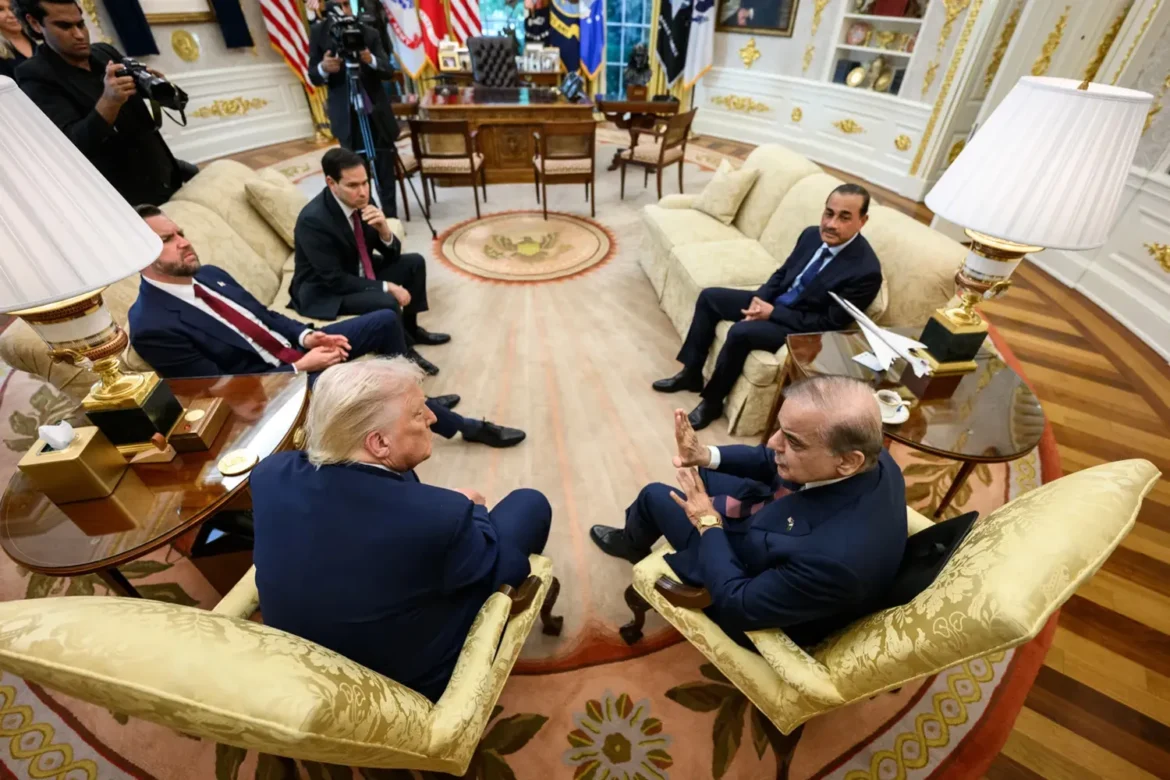
The clearest signal came on June 18, when Trump hosted Field Marshal Munir for lunch at the White House — the first time in years, and by some accounts ever, that a sitting American president had hosted a Pakistani army chief who did not also hold his country’s top civilian office. The meeting took place one day after Trump had publicly demanded Iran’s “unconditional surrender,” as Israeli strikes on Iranian nuclear and military sites entered their second week, and Munir arrived having just been promoted to Field Marshal, only the second officer in Pakistan’s history to hold that rank. Trump told reporters afterward that he had wanted to thank Munir personally for, as he put it, “ending the war” with India, crediting the general alongside Indian Prime Minister Narendra Modi. Pakistan, notably, had also just credited Trump’s intervention by nominating him for the Nobel Peace Prize.
Analysts who track the U.S.-Pakistan relationship said the optics of the lunch mattered as much as anything discussed inside it. “Trump’s lunch invite to Pakistan’s army chief isn’t just protocol-breaking, it’s protocol-redefining,” Raza Ahmad Rumi, a lecturer at the City University of New York, told Al Jazeera at the time. “It signals, quite visibly, that Pakistan is not just on Washington’s radar, it’s in the inner circle, at least for now.” The timing was delicate in its own right: Munir had publicly voiced solidarity with Iran and called for rapid de-escalation even as he sat down with a president openly weighing military action against Tehran — a balancing act Pakistan would be asked to repeat, more visibly, within the year.
That test came quickly. When the United States and Israel struck Iran outright weeks later, Pakistan positioned itself as a channel between Washington and Tehran, a role with real diplomatic weight given that Islamabad, unlike Washington, maintains standing relations with Iran’s government. By last month, according to the original Al Jazeera reporting on the relationship, Vice President JD Vance was crediting Munir in Switzerland with helping broker a framework for de-escalation between the two countries, calling him a “statesman” — a remarkable endorsement, coming from a sitting U.S. vice president, of a military officer who a year earlier would have drawn little notice in Washington at all.
Pakistani officials do not describe this trajectory as coincidental to the crypto relationship, so much as intertwined with it. Bilal Bin Saqib, the World Liberty adviser who now chairs Pakistan’s crypto regulator, told Bloomberg News in March that the country’s digital-asset outreach had “opened doors” in Washington and helped rebuild trust between the two governments — crediting the financial relationship, in his own words, with producing a diplomatic result.
Economists who study the arrangement describe the financial and diplomatic tracks as, in effect, the same transaction viewed from two angles. “The MoU was nothing more than an instrument of access. It had no real policy basis,” Khurram Husain, a Karachi-based economist, told Al Jazeera. “Access was the calculation, and it paid off spectacularly. The tangible gains for Islamabad were getting good access to the Trump White House, which was then added to by the diplomacy in the context of the Iran war.” Khalil, the banking professional, put it more bluntly still: “My bottom line would be that this whole exercise was pay for access.”
None of that shows up in a financial disclosure form. What does is the $515 million. Whether the two figures are as connected as they appear is, at this point, a question Washington has shown little appetite for asking.
Copyright © 2021 Independent Pakistan | All rights reserved