By Staff Reporter
ISLAMABAD: Prime Minister Shehbaz Sharif called on all parties to exercise restraint in the escalating conflict between Iran and the United States on Tuesday, as Pakistan sought to shore up a ceasefire agreement it brokered that has come under renewed strain from fighting in the Gulf.
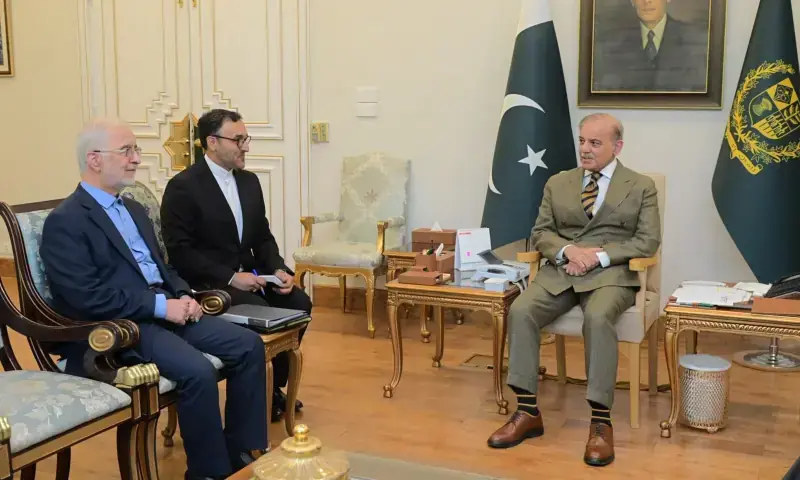
Sharif made the appeal during a meeting with Iran’s interior minister, Eskandar Momeni, who arrived in Islamabad on Monday night at the head of a high-level delegation. The visit, ostensibly focused on expanding bilateral trade, has taken on added significance as the interim ceasefire Pakistan helped negotiate between Washington and Tehran shows signs of collapse.
According to a statement from the Prime Minister’s Office, Sharif “shared his deep concern over the recent escalation in the Gulf region and urged all sides to exercise restraint and refrain from actions that could further destabilise the region”. He reiterated that Pakistan would continue to act as “an honest and sincere mediator and facilitator” in the dispute, the statement said.
The meeting at the PM House was attended by Deputy Prime Minister Ishaq Dar, Interior Minister Mohsin Naqvi, Information Minister Attaullah Tarar and other senior officials. Sharif welcomed the Iranian delegation and recalled his own visit to Tehran earlier this month for the funeral of the late Supreme Leader, Ayatollah Sayyid Ali Khamenei, conveying his regards to the current Supreme Leader, Sayyid Mojtaba Hosseini Khamenei, and to President Masoud Pezeshkian.
Momeni, for his part, thanked the prime minister for the reception extended to his delegation and praised the “untiring mediation efforts” of Sharif, Dar and the army chief, Field Marshal Syed Asim Munir, which led to last month’s Islamabad Memorandum of Understanding.
Meeting at GHQ
Later on Tuesday, Momeni travelled to Rawalpindi for talks with Field Marshal Munir at the General Headquarters. The two discussed regional and bilateral security along with border management, according to a statement from the military’s media wing, the Inter-Services Public Relations. Momeni praised Pakistan’s “diplomatic role in easing regional tensions”, the ISPR said, describing the country as “an anchor for peace” in the region. Both sides pledged to maintain close coordination going forward.
The visit began on Monday evening with a formal welcome. Momeni was received in Islamabad by Interior Minister Mohsin Naqvi and, ahead of his meeting with the prime minister on Tuesday, was honoured with a police parade, accompanied by Minister of State for Interior Talal Chaudhry. He also visited the Pakistan Monument, where a Federal Constabulary contingent presented a guard of honour.
A ceasefire under pressure
The diplomatic courtesies have unfolded against a broken ceasefire. The 14-point Islamabad Memorandum of Understanding, signed by American and Iranian officials on 17 June, called for an immediate halt to military operations, the reopening of the Strait of Hormuz to commercial shipping, and negotiations towards a final settlement covering sanctions and Iran’s nuclear programme, with a 60-day deadline. The agreement led to further talks at Bürgenstock in Switzerland on 21 June, attended by Pakistani and Qatari mediators, which established a high-level committee and working groups on nuclear issues, sanctions and monitoring.
That framework has since come under severe pressure. The United States carried out strikes inside Iran for a tenth consecutive day late on Monday, and Iran responded on Tuesday by targeting American radar and air defence installations in the Gulf. President Donald Trump declared earlier this month that the ceasefire was “over” and accused Tehran of failing to honour its commitments, while Iran has accused Washington of breaching the agreement. President Pezeshkian said on Monday that the two countries were now engaged in a “full-scale war”. No date has been set for a further round of talks, though Iran’s foreign ministry spokesman, Esmaeil Baqaei, said diplomatic exchanges through mediators were continuing.
The collapse of the truce has had immediate practical consequences. Iran has reimposed its blockade of the Strait of Hormuz, a vital corridor for global oil shipments, and the United States has responded by again blockading Iranian ports. The conflict widened further on Monday when Yemen’s Houthi rebels announced an immediate maritime embargo on Saudi Arabia, prompting Riyadh’s foreign ministry to condemn the move and reaffirm its support for Yemen’s Aden-based government.
Trade ambitions amid the turmoil
Beyond the security discussions, Momeni’s visit has a substantial economic dimension. Speaking to reporters in Persian shortly after his arrival on Monday, remarks later translated and carried by Iran’s Mehr news agency, the interior minister said Pakistan and Iran were aiming to more than triple annual bilateral trade, from roughly $3 billion to $10 billion.
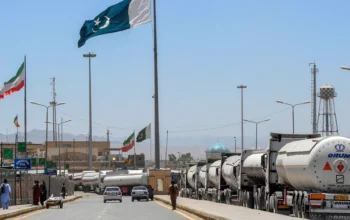
Reaching that target, he said, would require around 2,000 trucks or containers crossing the border each day — a substantial increase from the roughly 20 percent of that capacity currently in use. “Creating the necessary conditions on both sides of the border will be a main focus of discussions on this trip,” he said, adding that regional developments would also feature prominently in his talks.
Momeni’s delegation includes the governor-general of Iran’s Sistan and Baluchestan province, Iran’s deputy interior minister, its deputy minister of urban development and transport, and the head of the National Iranian Oil Company — a line-up that underscores the trade and infrastructure focus running alongside the security talks. Discussions are also expected to touch on long-standing plans for the Iran-Pakistan gas pipeline, connectivity between Pakistani ports and Iran, and wider transport links.
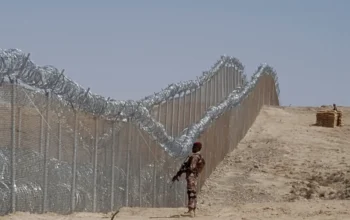
Pakistan and Iran share a border stretching roughly 900 kilometres, along with deep historical, cultural and religious ties. That relationship has nonetheless been repeatedly strained by cross-border militant activity, smuggling and security concerns that have long constrained trade despite repeated pledges from both governments to deepen economic cooperation.
Islamabad’s growing diplomatic profile in the crisis — hosting talks, relaying messages between Washington and Tehran, and helping broker the now-fraying understanding — reflects an increasingly active role for Pakistan in a conflict that shows little sign of abating.
Copyright © 2021 Independent Pakistan | All rights reserved