By Staff Reporter
ISLAMABAD: Fears that the war between the United States and Iran could widen into a broader regional conflagration intensified this weekend, after Yemen’s Houthi rebels struck Saudi Arabian oil facilities on the Red Sea coast and Tehran accused Ukraine of attacking one of its vessels in the Caspian Sea.
The escalation came even as Washington’s own campaign against Iran appeared to pause, with US forces halting a run of 13 consecutive nights of strikes without any official explanation.
The US military insisted on Saturday that its naval blockade of Iran “remains in full effect”, but offered no account of why the bombing campaign had stopped. A senior official in Donald Trump’s administration, asked about the lull, said the president “has always been clear that his preference is diplomacy, but he has shown Iran what will happen if they fail to come to the table in a serious way”.
There were no reports on Saturday of Iranian strikes against its Gulf neighbours, of the kind that have become a near-daily occurrence since the American bombing campaign began.
According to The New York Times, which cited two people briefed on internal discussions, Trump has for now shelved earlier plans to intensify the assault on Iran. The newspaper reported that the president and his advisers are wary of expanding the conflict further, citing concerns over depleting US defence stockpiles, alienating Gulf allies, and the knock-on effects for global energy markets and the wider economy.
Houthis strike Aramco sites in Jizan and Yanbu
Even as the confrontation between Washington and Tehran appeared to cool, fighting between Iran’s Houthi allies in Yemen and Saudi Arabia suggested the war was capable of spreading to a second critical shipping corridor — and of reigniting Yemen’s own devastating civil conflict.
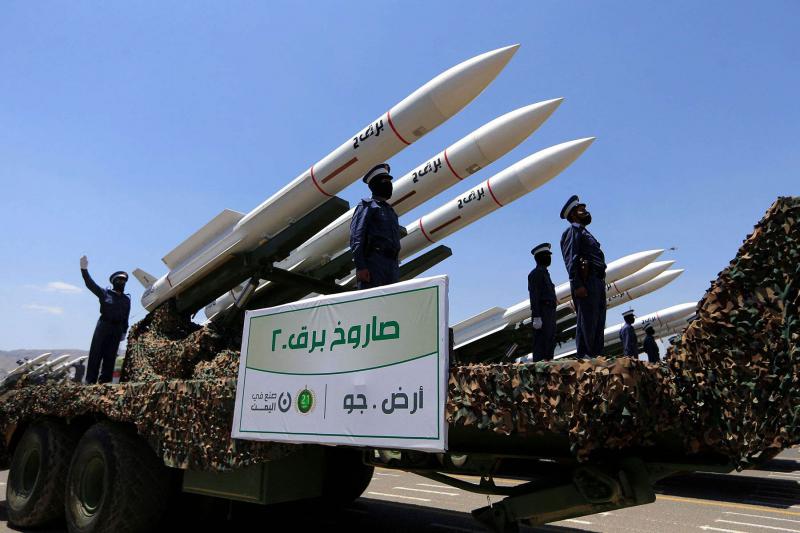
A Houthi military spokesman, Yahya Saree, said the group had struck sites belonging to the Saudi state oil company Aramco in the cities of Jizan and Yanbu. Footage circulated on social media and verified by Reuters showed a heavy plume of smoke rising near the Aramco refinery at Jizan.
Two trading sources based in Asia said they had been told of possible damage to fuel and oil storage facilities at the site. Aramco did not respond to requests for comment.
In Yanbu, two ballistic missiles aimed at oil installations were intercepted by a Patriot missile battery of US manufacture, operated in Saudi Arabia by Greek forces under an agreement with Riyadh, according to Greek security sources.
Yanbu is Saudi Arabia’s principal Red Sea export terminal, handling millions of barrels of crude daily, and has become the kingdom’s main route for shipping oil that would otherwise pass through the Strait of Hormuz — now effectively blockaded by Iran. Jizan, close to the Yemeni border, is home to a refinery capable of processing up to 400,000 barrels a day.
Yemen’s war reignites as both sides mobilise
In Yemen itself, the air force of the internationally recognised, Saudi-backed government struck Houthi missile and drone launch sites, along with arms depots, in the provinces of Marib and al-Jawf, according to Yemeni officials.
The Saudi-led coalition had separately said it bombed Houthi military positions on Friday in the Red Sea port city of Hodeidah, though it maintained that port facilities themselves were not targeted. Yemeni officials said forces on both sides of the conflict were mobilising along the front lines.
Saudi Arabia has led a coalition of Arab states against the Houthis for more than a decade, since the Iran-backed group seized the Yemeni capital, Sanaa. The ensuing civil war, in which hundreds of thousands died from violence and famine, had been held in check by a ceasefire since 2022 — a truce that collapsed this month as the Houthis moved to join the wider conflict being waged by their Iranian backers since the US and Israel launched their offensive five months ago.
Over the past week, the Houthis have declared a naval blockade of Saudi Arabia, with the group’s leader, Abdul Malik al-Houthi, warning that all Saudi oil facilities could now be considered targets. On Thursday, Houthi forces struck two Saudi oil tankers in the Red Sea.
The renewed hostilities have already driven global oil prices sharply higher, with Brent crude surging past $100 a barrel this week for the first time since May. Mr Trump responded to Thursday’s tanker strikes by vowing “major military punishment” for both Tehran and the Houthis.
Pakistan and Saudi Arabia reaffirm diplomatic ties amid tension
Amid the escalating violence, Pakistan and Saudi Arabia used a call between their foreign ministers on Saturday to reaffirm their commitment to diplomacy and regional stability. Pakistan’s deputy prime minister and foreign minister, Ishaq Dar, spoke with his Saudi counterpart, Prince Faisal bin Farhan, with Islamabad’s foreign office saying the pair had “exchanged views on the latest regional developments and reaffirmed the close and brotherly ties between Pakistan and Saudi Arabia”.
The statement added that both sides had “underscored the importance of continued diplomacy” and their shared commitment to “constructive engagement, peace and stability” in the region. The call followed a bilateral defence pact signed by the two countries last September, under which an armed attack on either nation would be treated as an attack on both.
Pakistan has taken an increasingly firm public position as the confrontation has widened, warning on Thursday that any Houthi attack on Pakistani-flagged vessels would be “swiftly retaliated” against. The country relies heavily on imported oil and has grown more dependent on the Red Sea route for crude shipments since the outbreak of the war with Iran — a route now itself under threat from the Houthi blockade of the Bab al-Mandab Strait, the narrow passage linking the Red Sea to the Gulf of Aden.
Washington cites depleted missile stocks behind pause
According to The New York Times, Trump’s decision to hold back from further escalation followed a meeting on Friday with senior advisers and cabinet officials, at which military leaders warned that renewed large-scale operations risked dangerously depleting stocks of Patriot interceptors and other air defence munitions needed to protect American troops and bases across the Middle East.
General Dan Caine, chairman of the joint chiefs of staff, is reported to have privately warned that resuming major combat operations remained feasible but would significantly reduce the interceptor stockpiles available to US Central Command, which oversees military operations in the region.
The newspaper reported that the administration is also concerned further escalation could provoke heavier Iranian retaliation, strain relations with Gulf allies, and worsen both the global energy crisis and refugee flows stemming from the conflict.
White House communications director Steven Cheung said Trump “has always been consistent in saying he prefers a diplomatic solution, but he continues to retain all options if Iran continues terrorist activities in the Strait of Hormuz or against allies”. He added: “It would be wise for Iran to work towards a negotiated deal; otherwise, they know what will happen.”
The Times reported that diplomatic efforts had stalled, and that recent strikes did not appear to have deterred Iran militarily. Some senior US officials are said to doubt that renewed large-scale operations would push Tehran back to the negotiating table at all — arguing instead that further strikes could strengthen cohesion around the country’s leadership.
Diplomatic efforts continue behind the scenes
The conflict, which will reach its five-month mark on Tuesday, appears to be at a delicate juncture. A regional official involved in mediation efforts told Reuters that concerted diplomacy was under way, and that the pause in US strikes — together with a halt in Iranian counterstrikes on countries hosting American forces — was “a positive signal that helps their efforts to de-escalate”.
According to the official, who was not authorised to discuss the matter publicly and spoke on condition of anonymity, both Washington and Tehran want to return to the interim ceasefire agreed in June. A compromise now under negotiation would reportedly see Iran manage vessel transit through the Strait of Hormuz with fewer restrictions on shipping.
That interim deal had briefly eased tensions before collapsing roughly two weeks ago, when US forces struck targets in southern Iran in response to Tehran’s disruption of shipping through the strait. Iran had demanded that vessels use a route closer to its coastline — with the possibility of levying transit fees — while ships had increasingly used a southern route along the Omani coast under US oversight, before Iran began attacking vessels there too.
The US responded by striking Iranian coastal defences in an effort to blunt Tehran’s capacity to threaten shipping, before expanding its target list to include bridges and infrastructure in the south, and strikes reaching deeper into the Iranian interior.
Michael Singh, managing director at the Washington Institute for Near East Policy and a former senior Middle East director on the National Security Council under George W Bush, said the strikes appeared designed to push Iran back towards negotiations. “The question would be: what kind of messages, if any, is the Iranian regime sending through diplomatic channels? Have those messages changed? Do they seem more eager to return to talks?” he said.
Singh noted that Washington faces particular difficulty in negotiating with a fractured Iranian leadership, with rival factions competing for control — a dynamic that Trump administration officials have also acknowledged. He suggested Iran’s leadership may fear that any compromise with the US would be perceived as weakness, potentially loosening their hold on power.
Both countries, he said, have strong economic incentives to see the Strait of Hormuz reopened — but remain far apart on the terms. “They have very different conceptions of under what conditions, under whose control,” he said. “So we have to get to some kind of stable equilibrium on those questions before you’re going to see a longer period of quiet. I think this effort to negotiate with words and also to negotiate with force is going to continue until we reach that equilibrium.”
Netanyahu visit adds to uncertainty
Further uncertainty surrounds a planned visit to Washington next week by Israeli prime minister Benjamin Netanyahu. Israel, which launched the war alongside the US on 28 February, has been notably absent from the recent American strikes carried out in response to Iran’s effective closure of the Strait of Hormuz — a corridor through which roughly 20 per cent of the world’s oil normally passes.
“The Iranians understand that perhaps it could get worse because Israel could come into the conflict,” Singh said, though he added that Israel’s absence from the fighting so far “may signal to the Iranians that we’re looking to limit the conflict”. He cautioned against reading too much into the current lull: “If it turns into a multi-day pause, that’ll be something significant. But it’s hard to know. Is it an operational pause? Is it a pause to allow for some kind of behind-the-scenes diplomacy?”
Trump has continued to combine threats of further military action with an emphasis on diplomacy. Speaking to reporters in the Oval Office on Friday, he was asked about his exit strategy and said there were two paths available. “You can just keep doing exactly what we’re doing and take them apart piece by piece. We could do it in a more rapid fashion, which we might do,” he said. “Or we can negotiate with them, which we’re also doing right now.”
While Mr Trump said he did not believe Iran was “ready yet” to reach a deal, he added that he believed Tehran was “getting more and more serious as the days go by, for maybe the obvious reason”. He met with senior national security aides on Friday to discuss whether to maintain the current approach or escalate further, according to a US official who spoke on condition of anonymity to discuss internal deliberations.
The US president has continued to brush aside concerns that rising petrol prices linked to the conflict could damage Republican prospects in November’s midterm elections. “Despite what everyone says about the election, I’m not in a hurry,” he said on Friday. “We have to do it right. Elections take care of themselves.”
The US military is continuing to enforce its naval blockade of Iranian ports. US Central Command said it disabled a Mozambique-flagged vessel in the Gulf of Oman on Friday after its crew attempted to breach the blockade despite repeated warnings.
Copyright © 2021 Independent Pakistan | All rights reserved