By Staff Reporter
ISLAMABAD: Pakistan’s fragile coalition government was plunged into open conflict on Tuesday, as the first phase of elections in Azad Jammu and Kashmir left a trail of disputed casualties and a bitter public feud between the two parties that are supposed to be governing the country together.
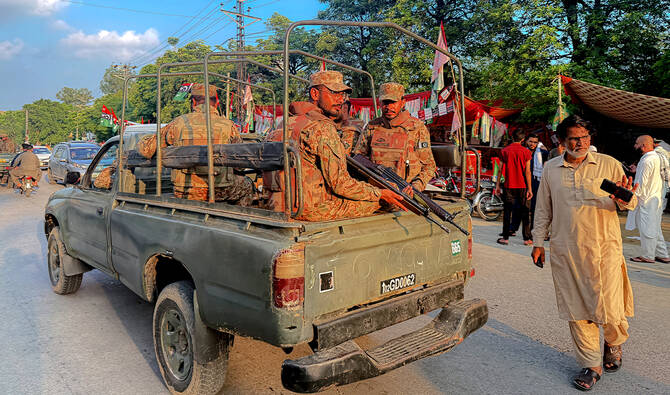
The Pakistan Peoples Party and the Pakistan Muslim League-Nawaz, uneasy partners at the federal level, spent the day hurling accusations at one another after preliminary results from Monday’s vote in AJK’s Mirpur division handed nine of 13 assembly seats to the PML-N, against four for the PPP. But the political row was only part of the story. Overnight and into Tuesday, the region also saw the deadliest unrest of its election season so far, after supporters of a banned civil rights group clashed with security forces in the town of Rawalakot.
Police said two of their personnel, including a member of the paramilitary Rangers, were killed. The group at the centre of the unrest, the Joint Awami Action Committee, claimed a far higher toll on its own side — alleging that at least 25 of its supporters had died over two days of violence. Neither figure could be independently verified.
A vote marred by violence before the count was even finished
AJK’s elections are being staggered across three phases, officially for security reasons, with Monday’s vote in Mirpur the first leg of a process that continues on 2 and 10 August in Poonch and Muzaffarabad. Even before polls closed, the process had been disrupted by scuffles and mutual accusations of malpractice between the two main parties.
Rana Sanaullah, adviser to the prime minister on political affairs, told reporters in Islamabad that polling had concluded successfully and was largely peaceful, notwithstanding what he called isolated pockets of violence. Voting hours, he said, had been extended to accommodate a late surge in turnout.
That account sat uneasily beside what followed. Azad Kashmir’s police chief, Inspector General Captain (retired) Liaqat Ali Malik, said protesters opened fire on security forces through the night after polling ended, torching police and military vehicles and attacking a security post. He accused JAAC supporters of attempting to march into Rawalakot despite repeated warnings to disperse.
JAAC’s account is starkly different. Abid Shaheen, a member of the group’s core committee, said 19 of its supporters were killed in Rawalakot on Monday alone, with more than 50 wounded, and alleged a further six died on Tuesday when security forces opened fire on demonstrators in Mirpur who were protesting the previous day’s bloodshed. He said the group could supply names and photographs of the dead, and denied police claims that protesters were armed.
Malik said police were unable to verify JAAC’s figures, as no bodies or medical documentation had been submitted to authorities. Complicating matters further, a journalist who has covered the region for years, Haris Qadeer, said verifying civilian deaths in AJK is unusually difficult, as hospitals and local authorities do not routinely release the kind of medico-legal data that would be standard practice elsewhere in Pakistan.
Officials allege militant infiltration
AJK’s information secretary, Muhammad Rashid Hanif, went further on Tuesday, claiming that a significant number of those involved in the JAAC demonstrations were affiliated with what officials refer to as Fitna al Khawarij — the state’s term for militants belonging to the banned Tehreek-i-Taliban Pakistan. He played video footage he said showed masked gunmen on a rooftop, and argued that ordinary citizens, including women and children, were being used as human shields by “anti-state elements”.
A police spokesman, Deputy Inspector General Irfan Kashfi, said the weaponry recovered — including automatic rifles, M-4s, AK-47s and, according to initial information, sniper equipment — indicated the state was dealing with militants rather than peaceful demonstrators. One suspect arrested in Rawalakot, he said, was a foreign national alleged to have acted as a sniper. Kashfi insisted security forces were acting in self-defence and ruled out any prospect of the militants seizing control of Rawalakot or any other town.
AJK’s prime minister, Faisal Mumtaz Rathore, described the unrest as a “conniving plan to trigger mass unrest” that had been weeks in the planning, and accused organisers of exploiting civilians as human shields. Defence Minister Khawaja Asif ruled out any negotiation with those responsible for attacking security forces. “I count them among those whom we see as being in the enemy camp of Pakistan,” he said.
The tension has been building for weeks. JAAC, formed last year initially over grievances including electricity tariffs and governance, shifted its focus to demanding the abolition of 12 assembly seats reserved for refugees from Indian-occupied Kashmir — seats the group argues let mainland Pakistani parties dictate the composition of the regional government. Authorities counter that the seats are constitutionally protected and cannot be scrapped without a constitutional amendment. The group was formally banned last month under anti-terrorism legislation, a move followed by a crackdown that saw dozens of its leaders arrested and 147 activists placed on a fourth-schedule terrorism watchlist.
Maryam Nawaz tells PPP to accept defeat
Against that backdrop, the row between Pakistan’s coalition partners played out largely detached from the violence — a parallel dispute over who actually won Mirpur.
In a televised address, Punjab Chief Minister Maryam Nawaz declared what she called an outstanding victory for the PML-N and told the PPP, in blunt terms, to accept the result. “Crying will not help,” she said. “The PPP should have accepted its defeat with an open heart.”
She rejected the rigging allegations outright, arguing that no evidence had been produced against PML-N candidates, and suggested those making the claims were themselves implicated in electoral malpractice elsewhere. “The state does not decide election results; only the people make this decision,” she said, adding pointedly that the PML-N had not disputed the PPP’s win in Gilgit-Baltistan and had congratulated the party at the time. “When you won the GB election, there was no rigging there, but as you have lost the AJK election badly, you are now levelling rigging allegations.”
Maryam used much of her address to attack the PPP’s record in Sindh, the province it has governed for close to two decades, arguing the party had no comparable achievements to point to in AJK. “How could you build AJK’s roads when the roads in your own province are wrecked?” she asked, adding that people arriving in Punjab from Sindh routinely wished for infrastructure and governance to match what they found in Lahore. She noted, too, that the PPP had governed AJK itself for the past year under no interim administration, and could not credibly blame Islamabad for the territory’s problems.
Bilawal accuses the state of favouring its coalition partner
Bilawal had set the tone for the day hours earlier, addressing a workers’ convention in Muzaffarabad with a quotation from Tacitus — “to robbery, butchery and rapine, they give the lying name of government” — which he said captured what was unfolding “from Mirpur to Poonch”. He questioned whether the process could be described as democratic at all.
His central charge was that the state had allowed the interests of its coalition partner to override the national interest. “It seems to me that every decision made by the state prioritises the PML-N and not the national interest, which is harming Kashmir, and we can no longer remain silent,” he said, calling on authorities to “open their eyes”.
He singled out the defeat of PPP candidate Chaudhry Yasin, who had contested from two constituencies, questioning how he could have lost even in his own village, and alleged that PML-N workers had seized 30 polling stations in Yasin’s constituency and ten in that of another candidate, Chaudhry Ikhlaq. He named a party worker, Mukhtar Younis, whom he said had been martyred amid the violence, and accused the ruling partner of firing bullets and spreading fear among voters. “Every child in Kashmir knows that PPP has the mandate and we will not give up on the stolen votes,” he said.
Bilawal also questioned the logic of holding the election across three phases at all. “You did not conduct the election in phases to maintain transparency but to ensure rigging and steal PPP’s mandate,” he said, warning that his party would “reclaim every single one” of its votes in Mirpur and Kotli. He invoked his family’s political lineage as he issued the warning. “I am the son of President Zardari, I am also Mir Shahnawaz Bhutto and Mir Murtaza Bhutto’s nephew, and I want to follow Shaheed Benazir Bhutto’s politics but do not tempt me,” he said.
A call for reconciliation, not just recrimination
Beyond the dispute over the count, Bilawal used his Muzaffarabad address to renew a call the PPP has been making for roughly a month: the formation of a truth and reconciliation commission to examine the unrest surrounding JAAC’s protests, which he argued could have prevented the violence altogether.
“All the state had to do was form a truth and reconciliation commission and task it with discerning the truth, and the protesters would have been asked to halt their protests until the commission presented its findings,” he said, arguing that neither the government nor JAAC had been willing to back down because the dispute had hardened into a matter of ego. He said he did not believe the protesters should be judged on the street. “If you want to take action, investigate and form a commission, which will then tell you who is the murderer and who is whose agent; this issue cannot be resolved on the street.”
He was careful to distance the PPP from JAAC’s specific demands, noting his party had never called for the reserved seats to be abolished, while arguing a negotiated settlement had always been possible had the state been willing to pursue one.
Sindh minister brings the political row to a head
The sharpest response to Maryam Nawaz came from Senior Sindh Minister Sharjeel Inam Memon, who accused the PML-N of stealing the mandate of the AJK electorate outright. He said weapons had been used openly during the vote and that a PPP worker had been killed, a development he said Maryam ought to have condemned rather than respond to with what he called arrogance.
Memon went further, telling the Punjab chief minister that her own government sat in office on what he called a fake mandate, and compared the PML-N administration in Punjab to a tenant who had come to believe it owned the property. He drew a sharper contrast still between the two parties’ histories. “The PPP leadership had made sacrifices for the nation, while the PML-N’s leadership has signed deals to flee the country,” he said, an allusion to past exile arrangements involving senior PML-N figures. He also suggested the PML-N’s interest in the region had been a late one. “The PML-N did not even remember Kashmir until three days before the polls,” he said, calling on Maryam Nawaz to explain why her party had been willing, in his words, to sacrifice lives and steal a mandate simply to secure victory.
Election officials confirmed the remaining two phases of AJK’s assembly election will go ahead as scheduled, in Poonch on 2 August and Muzaffarabad on 10 August, despite the unresolved violence in Rawalakot and Mirpur. Whether the disputed casualty figures from this week’s clashes can be independently confirmed before then remains unclear — both sides say that verification depends on documentation neither has yet produced.
Copyright © 2021 Independent Pakistan | All rights reserved