By Staff Reporter
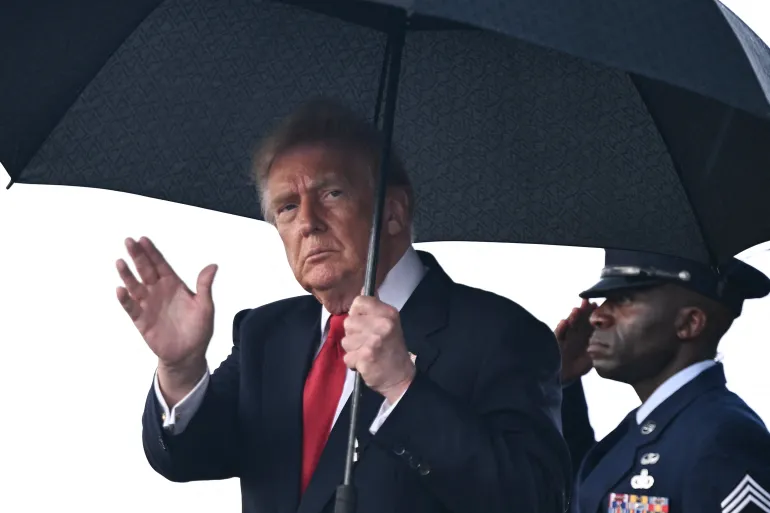
ISLAMABAD: US President Donald Trump said on Tuesday that talks between Washington and Tehran were “going well”, even as he repeated a threat to destroy Iran’s power stations and bridges within hours if the two sides fail to reach a lasting agreement, hours before sitting down with Benjamin Netanyahu at the White House for the first time since the war between Israel, the US and Iran began.
In an interview with Fox News’ “Fox & Friends” ahead of the meeting, the US president said Washington’s negotiating position was strong enough that Iran understood the consequences of walking away from the table. “It’s a very, very delicate balance,” he said. “I think we have a very strong position right now. They know I’m going to do that if they don’t make a deal.”
Trump has previously said he could disable Iran’s electricity network in a single day, cutting power to some 91 million people, and put most of the country’s major bridges out of action within two hours. He has repeated the warning at intervals throughout the conflict, generally alongside the insistence that he would rather not carry it out. Asked again on Tuesday, he suggested Iran had already been given enough chances. “We cannot have them break deals any more,” he said.
The remarks came as the Iranian foreign ministry continued to deny that direct talks with Washington were under way, though its spokesman, Esmaeil Baghaei, has acknowledged that intermediaries have been passing messages between the two sides. Oman is understood to be leading the mediation, with Qatar, Egypt and Pakistan also involved alongside the US president’s envoys Steve Witkoff and Jared Kushner.
Pickaxe Mountain
Much of the interview turned on Pickaxe Mountain, the fortified site Iran calls Kuh-e Kolang Gaz La, buried deep in a ridge beside the Natanz nuclear complex around 140 miles south of Tehran. The facility survived last year’s American and Israeli strikes on Iran’s nuclear programme and has continued to be dug out since, according to satellite imagery reviewed by the Institute for Science and International Security, which has warned the site is large enough to house both a centrifuge plant and weapons-related work. UN inspectors have not been allowed near it.
Trump was asked whether Netanyahu intended to raise the site’s progress when the two men met later that day. “Bibi doesn’t need to tell me about this,” the president said. “He brings it up because he wants me to stay involved in this matter.” He went on to question why intelligence on the facility kept becoming public: “Why shouldn’t he just tell me? Why does the whole world have to know about it?”
He maintained that he already had a full picture of what was happening underground. “It’s not a big deal,” he said. “We knocked out their nuclear facilities, and if a deal isn’t reached, we’ll target Pickaxe Mountain too. If they don’t reach an agreement, we’ll destroy it very easily.” He credited the earlier strikes on Iran’s nuclear sites with protecting Israel, telling the programme: “If I weren’t president today, Israel would no longer exist.”
Eighth meeting, first since the war
Netanyahu arrived in Washington on Monday evening, attending a private memorial dinner for the late senator Lindsey Graham before the two leaders sat down at the White House on Tuesday morning for what the Israeli prime minister’s office confirmed was their eighth meeting since Trump returned to office, and their first face to face since Israeli and American strikes on Iran began in February. Before leaving Israel, Netanyahu said the talks would range widely but that Iran would come first: “We will discuss all the issues on the agenda, first and foremost Iran. Naturally, our goal is to safeguard our security and also to expand the circle of peace around us.”
A White House official said the two men would also cover the framework agreement Israel and Lebanon signed last month, whose implementation on the ground has proved difficult, along with efforts to widen the Abraham Accords. The meeting ran for roughly ninety minutes and was described by the White House press secretary, Karoline Leavitt, as “positive and productive”. Trump held a separate meeting with Ukraine’s president, Volodymyr Zelensky, the same day, with the Ukrainian leader saying afterwards that the two had discussed access to Patriot missile interceptors and reviving diplomacy over the war with Russia.
The sit-down comes five months into a conflict that has strained the two leaders’ relationship at points, most notably in April, when disagreements over the terms of a ceasefire with Iran prompted Trump to vent his frustration at his Israeli counterpart in profane terms and later describe him in an interview as “a very difficult guy”. Mr Netanyahu has since characterised the friction as no more than “tactical disagreements”, insisting the two governments remain united on the war’s aims.
Strait of Hormuz talks continue
The immediate backdrop to Tuesday’s meeting was a fragile pause in hostilities that has held since Friday, after nearly two weeks of American strikes on Iranian coastal and infrastructure targets and Iranian retaliation against US allies across the region. Both sides have said they have stopped attacking for now, though ship traffic through the Strait of Hormuz remains a fraction of what it was before the war, and the US ambassador to the UN, Mike Waltz, has said American forces remain “locked and loaded” should talks collapse.
At the centre of the dispute is who controls transit through the strait. A memorandum of understanding signed in June committed Iran to allowing commercial shipping through for an initial sixty-day window, but Tehran and Washington have since disagreed over whether that gives Iran the right to dictate the route ships take and to charge for it. Oman has proposed an alternative corridor, understood to have the backing of other Gulf states, under which vessels would pay voluntary fees rather than mandatory tolls set by Tehran — a model similar to one already in use in the Strait of Malacca.
Iran’s foreign minister, Abbas Araghchi, held separate calls this week with his Saudi and Omani counterparts on what the ministry described as efforts to eliminate the insecurity imposed on the strait by American actions. Iran’s military said separately on Tuesday that ships belonging to countries or companies making use of frozen Iranian assets would be barred from the waterway.
The wider region has continued to see sporadic violence even as the main pause has held. Saudi Arabia said it intercepted a number of drones overnight targeting its oil facilities, which it blamed on Iran-backed militias in Iraq, though those groups have not claimed the attack; Yemen’s Houthis said separately that they had struck Saudi oil infrastructure. Jordan’s military said it shot down a drone that entered its airspace. Markets, meanwhile, have taken the pause as a modestly positive sign, with oil prices easing and stocks rallying at the start of the week on hopes a durable agreement might yet be reached.
Copyright © 2021 Independent Pakistan | All rights reserved