By Staff Reporter
ISLAMABAD: Pakistan and Kuwait agreed on Wednesday to broaden cooperation across trade, investment, energy, labour and defence, as the two governments moved to institutionalise a relationship that has deepened rapidly against the backdrop of an escalating conflict in the Middle East.
The commitment came at the end of a day of high-level engagements in Islamabad involving Kuwait’s visiting foreign minister, Sheikh Jarrah Jaber Al-Ahmad Al-Sabah, who held talks with Prime Minister Shehbaz Sharif, Deputy Prime Minister and Foreign Minister Ishaq Dar, and the country’s most senior military officer, Field Marshal Asim Munir.
In a statement issued after delegation-level talks between Dar and his Kuwaiti counterpart, Pakistan’s foreign ministry said the two sides had “reviewed the entire spectrum of Pakistan-Kuwait bilateral relations” and discussed ways to strengthen cooperation in trade, investment, energy, labour, agriculture, information technology, health, mining and minerals, and defence.
“They agreed to further institutionalise bilateral cooperation through enhanced institutional linkages and regular high-level exchanges,” the ministry said.
The visit, Sheikh Jarrah’s first official trip to Pakistan, comes only days after Kuwait ratified a five-year defence cooperation agreement with Islamabad, first signed in 2023, that sets out a framework for joint military training, intelligence sharing, logistics, defence technology and joint exercises. Pakistan’s foreign office confirmed it had welcomed the ratification, calling it “another important milestone” in a defence partnership stretching back to the early 1980s.
Defence pact reflects “shared resolve”
Foreign office spokesperson Dr Tahir Andrabi said the ratified agreement would “further enhance institutional linkages between the armed forces of both countries and consolidate the longstanding defence ties between Pakistan and Kuwait”. The pact, he added, reflected “the shared resolve of both sides to further strengthen bilateral defence cooperation and elevate their security partnership”.
The agreement was originally signed on June 11, 2023, at Kuwait’s Ministry of Defence, with Pakistan’s ambassador Malik Muhammad Farooq signing on behalf of Islamabad and Brigadier General Fawaz Khudair Muhammad Al-Harbi, the ministry’s joint planning director, representing Kuwait. It also provides for cooperation in military manufacturing and establishes a joint committee to oversee implementation.
Reuters reported earlier this month, citing five sources familiar with the discussions, that Pakistan has been negotiating an expanded defence pact with Kuwait in exchange for energy cooperation and investment — a dynamic that appears to be playing out in the sequence of announcements this week.
The ratification also follows months of contacts between civilian and military officials from both countries, and comes at a moment of heightened anxiety in the Gulf, where Kuwait has been struck by Iranian missiles and drones during the recent widening of hostilities in the region.
Munir meets Kuwaiti minister at GHQ
Sheikh Jarrah, who arrived in Islamabad on Tuesday night, travelled to General Headquarters in Rawalpindi on Wednesday for talks with Field Marshal Asim Munir, Pakistan’s Chief of Defence Forces and Chief of the Army Staff. According to a statement from the military’s media wing, the Inter-Services Public Relations, the two discussed regional security and “steps to further strengthen bilateral cooperation”.
Munir reiterated Pakistan’s commitment to Kuwait, telling the visiting minister that the two countries shared a “common vision for regional peace and prosperity”, the ISPR said. Sheikh Jarrah, for his part, praised Pakistan’s “steadfast support” and its contribution to regional stability, as well as what the statement described as the deep fraternal ties between the two nations.
Sharif reaffirms solidarity, condemns attacks on Gulf states
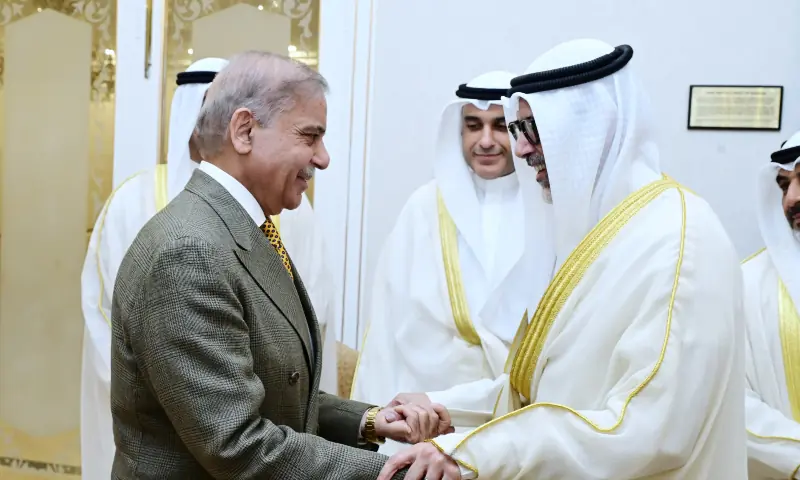
Earlier in the day, the Kuwaiti minister was received by Prime Minister Shehbaz Sharif, in a meeting also attended by Ishaq Dar and federal ministers for defence, commerce, food security, communications, maritime affairs and petroleum, according to the Prime Minister’s Office.
Sharif reaffirmed Pakistan’s commitment to deepening cooperation with Kuwait across trade, investment, energy, agriculture, information technology, maritime affairs and human resource development, the PMO said, adding that the prime minister expressed satisfaction with the “positive trajectory” of relations between the two countries.
The two leaders also discussed the regional situation, with Sharif reaffirming Pakistan’s solidarity with Kuwait’s leadership and people and strongly condemning attacks on Kuwait and other Gulf states during the ongoing conflict in the Middle East. He described Pakistan’s role in regional diplomacy as that of an “honest and sincere mediator and facilitator”, thanking Kuwait for its support of those efforts.
Sheikh Jarrah reaffirmed Kuwait’s commitment to expanding cooperation and praised what the PMO statement called the “valuable contributions” of Sharif, Dar and Munir in “advancing dialogue and diplomacy to resolve the current crisis and restore peace to the region”. Both sides agreed to exchange delegations in the near future, and Sharif renewed an invitation to Kuwait’s Crown Prince to visit Pakistan at a mutually convenient time.
Pakistan’s mediation role under strain
The flurry of engagement reflects Pakistan’s expanding, if increasingly fraught, diplomatic role in the Middle East. Islamabad hosted unprecedented talks between the United States and Iran in April, which led to the signing of the Islamabad Memorandum of Understanding in June — an interim agreement providing for a ceasefire, the reopening of the Strait of Hormuz to commercial shipping, and a framework for broader negotiations.
Follow-up talks in Bürgenstock, Switzerland, with Pakistan and Qatar acting as mediators, produced a 60-day roadmap intended to lead to a final settlement covering sanctions, Iran’s nuclear programme and maritime security in the Gulf. That progress has since been jeopardised. The United States and Iran resumed military strikes on each other this month, unravelling much of what had been achieved under the Islamabad accord. The renewed fighting has drawn in Iran-backed Houthi forces, who have intensified attacks on shipping in the Red Sea and recently declared a maritime blockade targeting Saudi vessels, widening the conflict further across the region.
Despite the setback, Islamabad has continued engaging regional and international partners — including Saudi Arabia, Oman, Kuwait, China and Qatar — in an effort to keep dialogue alive between Washington and Tehran. Pakistan has also maintained its own contacts with Iranian officials as it attempts to revive the mediation process following the breakdown of the earlier ceasefire.
In their talks on Wednesday, Dar and Sheikh Jarrah “exchanged views on regional and international developments of mutual interest, including the situation in the Middle East and Palestine”, the foreign ministry said, adding that the Kuwaiti minister “appreciated Pakistan’s constructive role in promoting regional peace and stability”.
Ties rooted in “shared history and mutual trust”
In a separate meeting at the Ministry of Foreign Affairs, described by the foreign office as “warm and productive”, Dar and Sheikh Jarrah reviewed the “full spectrum” of bilateral relations and reaffirmed what the ministry called their “shared commitment to further strengthening the longstanding brotherly partnership”. The two also held what the foreign office described as in-depth discussions focused on the evolving Middle East situation.
Both sides pledged to maintain close coordination at multilateral forums on issues of shared concern, the foreign office added.
Sheikh Jarrah thanked the government and people of Pakistan for their hospitality, and separately expressed appreciation for the support Pakistan extended to Kuwait during the Covid-19 pandemic, when Islamabad agreed to send hundreds of medical workers to the Gulf state at its request.
The foreign office said the minister’s visit reflected relations “anchored in shared history, mutual trust and close cooperation”, first announced on Monday when it confirmed Kuwait’s top diplomat would pay a courtesy call on Pakistan’s leadership.
Sheikh Jarrah departed Islamabad following the conclusion of his visit, seen off at Islamabad International Airport by Additional Secretary for the Middle East, Zahid Hussain — who had also received him on arrival two days earlier.
Copyright © 2021 Independent Pakistan | All rights reserved