By Staff Reporter
ISLAMABAD: The United States and Saudi Arabia carried out joint air strikes against Iran-backed militias in Iraq on Wednesday, hours after Iran fired missiles at American forces in the region, shattering a fragile lull in a conflict that has unsettled the Middle East and rattled global oil markets for months.
US Central Command said the strikes had hit “multiple terrorist logistics and weapons sites” in eastern Iraq, describing the operation as a response to more than 30 drone attacks it blamed on militias directed by Iran’s Islamic Revolutionary Guard Corps over the preceding three days. The IRGC, it said, “must cease these attacks to avoid further US military response.”
Iraq’s Popular Mobilisation Forces, an umbrella network of mostly Shia militias formally attached to the Iraqi armed forces, said at least 20 of its fighters had been killed and 32 wounded in strikes on bases across seven provinces, including Baghdad, Nineveh, Basra and Diyala. Two Iraqi militia officials, speaking on condition of anonymity, told the Associated Press that six Iranian military advisers were also killed, though it remained unclear whether they were counted among the dead fighters already reported.
Footage broadcast by Iraq’s Al-Ahad television showed mourners in Mosul chanting sectarian slogans and “Death to America!” as they carried the bodies of slain fighters from a hospital in body bags.
The strikes marked a significant widening of the conflict. It was the first time Saudi Arabia had publicly confirmed taking part in combined military action alongside the United States since the war with Iran began in February, raising the prospect of Sunni-led Saudi Arabia being drawn directly into confrontation with Shia proxies loyal to Tehran. A spokesman for the Saudi defence ministry, Major General Turki al-Maliki, said the militias had launched drones from Iraqi territory against oil facilities in the kingdom’s Eastern and Riyadh regions on Monday and Tuesday, and that Saudi Arabia had acted under its “right to self-defence.”
“The Kingdom of Saudi Arabia reiterates that it does not seek escalation but will respond decisively to any aggression directed against it,” he said.
Iran strikes first, hours before the retaliation
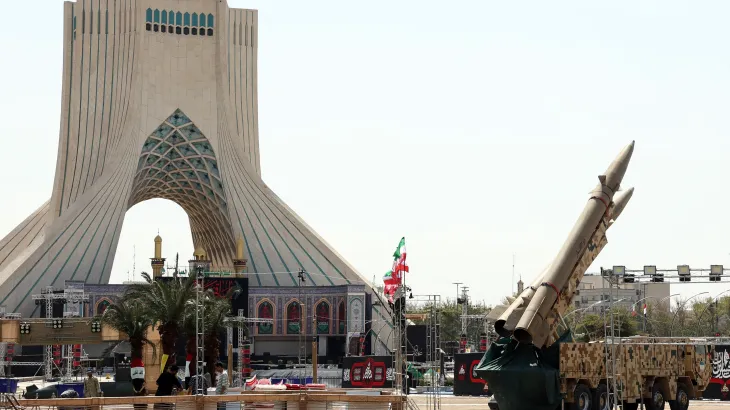
The joint strikes came only hours after Centcom said Iran had attempted a “surprise attack” on US forces at 5.45pm eastern time on Tuesday, launching missiles that were “successfully intercepted.” Iran’s Revolutionary Guard said separately that it had targeted a US air base and command centre in Jordan “in response to the acts of aggression of the American child-killing army,” and that its naval forces had struck three oil tankers in the Strait of Hormuz after they sailed what it called an “unsafe and illegal route” through the waterway.
Jordan’s military said it had shot down five incoming Iranian missiles aimed at the Muwaffaq Salti air base, a key American hub in the country, with no immediate reports of casualties or damage. Three US service members were killed in Jordan earlier this month, in what had been the worst American losses of the conflict since March.
Asked about the attack on Jordan by a Fox News correspondent, Donald Trump responded with a string of expletives, warning that US forces would be “hitting them hard” and that Iran was “going to get a beating.” On the prospect of renewed negotiations, the president struck a more measured note, saying only: “We’re going to let them keep talking.”
Iran’s foreign ministry condemned the retaliatory strikes on Iraq as a “gross violation” of international law, accusing Washington and Israel of seeking to “expand the war” across the region, and warning that the US and its “accomplices” would bear responsibility for “dangerous consequences.” One of the Iran-aligned groups named in Iraq, Harakat Hezbollah al-Nujaba, said American and Saudi forces would pay a “heavy price.”
Baghdad furious, Washington insists it was consulted
The response from Baghdad was one of open anger. The Iraqi presidency denounced the bombing of Popular Mobilisation Forces bases as “an unacceptable attack and a blatant violation of Iraq’s sovereignty, targeting its official security institutions,” while also calling on armed groups to halt attacks against Iraq’s neighbours. Iraq’s National Security Council said the strikes had come even as Baghdad was in direct contact with Saudi and American officials to investigate the drone allegations, adding that “a number of innocent people” had been killed and wounded. An emergency meeting was convened in the capital.
Trump, however, told Fox News the strikes had been “co-ordinated with the Iraqi government,” a claim starkly at odds with Baghdad’s public condemnation.
A visit to Riyadh by the Iraqi prime minister, originally scheduled for Thursday, was postponed indefinitely, according to two Iraqi government officials who were not authorised to speak publicly.
The Popular Mobilisation Forces was formed to fight Islamic State after it overran large parts of Iraq in 2014, and has since been formally designated an “independent military formation” within the Iraqi armed forces. In practice, analysts note, many of its constituent militias operate with considerable autonomy from Baghdad and retain close ties to Tehran — a duality that has long complicated Washington’s relationship with the Iraqi state, which maintains military and diplomatic links with both the US and Iran.
The timing has added to regional tension: this week hundreds of thousands of Iranian pilgrims are travelling to shrines in Iraq for an annual day of mourning, with some reported to be carrying portraits of Iran’s late Supreme Leader, Ayatollah Ali Khamenei.
A second front in the Red Sea
Saudi Arabia is simultaneously contending with a renewed threat from Yemen’s Houthi movement, which last week declared a blockade of Saudi shipping in the Red Sea and has since fired on vessels and energy infrastructure. On Monday the group said it had launched drones at facilities used to move Saudi crude to the export terminal at Yanbu, in what it described as retaliation for a Saudi drone incursion into Yemeni airspace.
Satellite imagery from Monday, reviewed by the Associated Press, showed damage at Saudi Aramco’s Abqaiq processing facility, which can handle roughly seven million barrels of crude a day. The plant was the target of a major Houthi-claimed attack in 2019 that knocked out 5.7 million barrels of daily production and sent global oil prices sharply higher — the first clear demonstration of how exposed Saudi energy infrastructure could be to missile and drone strikes.
A separate refinery at Jazan, on Saudi Arabia’s Red Sea coast, has also been shut down after what a regional official described as “relatively significant” damage from a Houthi attack on Saturday. The plant, which produces around 400,000 barrels a day, is expected to remain offline for several days; the Texas-based consultancy IIR Energy said it was tentatively pencilled in to restart by 15 August.
Diplomacy stalls as the Strait of Hormuz remains the key obstacle
The renewed violence came just two days after Trump had spoken of “very friendly negotiations” aimed at resolving the standoff over the Strait of Hormuz — talks Iranian officials have publicly denied are even taking place. A regional official briefed on the mediation, speaking anonymously, said intermediaries were “still trying with both sides” to restore calm, though gave no indication of whether that effort was making progress.
Any such progress suffered a further setback this week when Iran rejected a proposal from Oman, which sits on the opposite shore of the strait, to jointly manage shipping traffic through the waterway. Iran’s deputy foreign minister, Kazem Gharibabadi, said in an interview broadcast on state television that Oman’s plan would have split the strait into two lanes, each carrying half of the transit traffic. Tehran had offered a counter-proposal allowing only temporary passage through its own territorial waters, he said, adding that Iranian policy was for the strait “never to return to its prewar situation,” when vessels moved through freely.
The strait has been effectively closed since fighting between the US, Israel and Iran erupted at the end of February, following 13 consecutive nights of American air strikes that Washington said were intended to degrade Iran’s ability to threaten commercial shipping. Iran responded with missile and drone strikes on US assets in neighbouring states, killing four American service personnel in Jordan and Iraq. A brief lull, in which the two sides had not exchanged fire for three days, ended abruptly with Wednesday’s escalation.
Brent crude, the international benchmark, jumped as concerns mounted that the conflict could further choke off energy shipments through one of the world’s most critical maritime corridors.
The latest violence unfolded as Israeli Prime Minister Benjamin Netanyahu was in Washington, where he met Trump at the White House and attended the funeral of Senator Lindsey Graham, one of the most prominent Iran hawks in Congress.
Copyright © 2021 Independent Pakistan | All rights reserved