By Staff Reporter
ISLAMABAD: The United Arab Emirates has resumed issuing visit visas to Pakistani nationals who apply through registered travel agents, according to industry representatives and an embassy official, bringing relief after months of delays that had unsettled one of Pakistan’s most important travel and remittance corridors.
The shift, confirmed on Saturday, marks a tangible easing for a relationship both governments had insisted, throughout the disruption, was never formally suspended. Roughly 1.8 million Pakistanis live in the UAE, and the country ranks among Pakistan’s largest sources of remittances, meaning even a partial slowdown in visa processing carries weight far beyond individual travel plans.
Travel executives say the clearest improvement has been for families. Applications that once languished for weeks are now moving with far less friction.
“The UAE embassy in Pakistan has started issuing visas to Pakistani tourists travelling with families, which is a positive development,” said Muhammad Nadeem Sharif, chief executive of Aroma Travels and a former chairman of the Travel Agents Association of Pakistan.
Sharif said travellers heading out with relatives, or joining family members already settled in the UAE, are now receiving decisions within a reasonable timeframe. Tourism promotion campaigns, paused during the uncertainty, have also resumed, and passenger numbers — which dipped amid recent regional tensions — are climbing back.
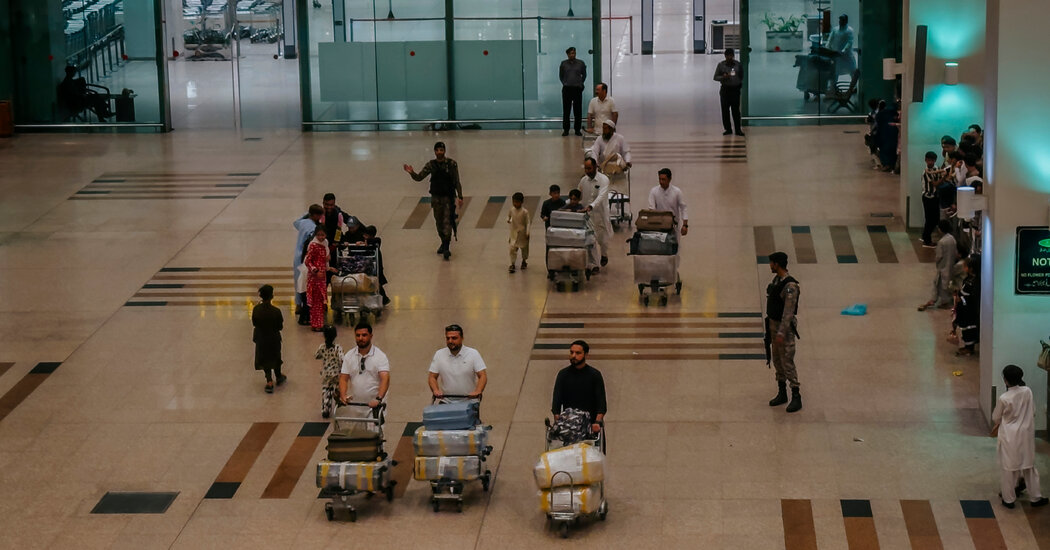
That recovery shows up in the immigration figures. A senior Pakistani immigration official, speaking on condition of anonymity, said daily passenger traffic from Pakistan to Dubai had risen from around 170 a day earlier in the summer to close to 400 by the last week of July. Even so, he cautioned, that figure sits well short of the roughly 1,000 passengers a day recorded two years ago — a reminder that any recovery, however welcome, is starting from a low base.
Muhammad Hanif Rinch, an office-bearer with the Travel Agents Association of Pakistan, offered a similar assessment, noting that family applications are now succeeding at markedly higher rates after a stretch in which individual applicants faced steep rejection rates.
“The situation has improved since last week, and more Pakistanis travelling with families are getting visas,” Rinch said. He put family travellers at roughly a tenth of all Pakistani visitors to the UAE.
An official at the UAE embassy in Islamabad, speaking on condition of anonymity, confirmed that visit visas are once again being issued to ordinary passport holders who apply through registered travel agencies. “I don’t have the complete information, but visas are open through travel agents for ordinary passports,” the official said, adding that while some processing had been delayed earlier for security reasons, applicants submitting complete documentation can now expect their cases to move without difficulty.
Months of friction
The easing follows a prolonged period of concern over how Pakistani applications were being handled. In April last year, Pakistan’s interior ministry said Islamabad and Abu Dhabi had agreed to take what it called “necessary steps” to facilitate visa issuance, following talks between Interior Minister Mohsin Naqvi and his Emirati counterpart.
Pakistan’s foreign ministry later told parliament that the tightened scrutiny had followed specific abuses: some applicants had submitted forged academic degrees, diplomas or employment contracts, while others had run into legal trouble in the UAE over unauthorised political activity, criminal offences or misuse of social media. That prompted the UAE to introduce stricter background checks and tighter documentation requirements — measures that, applicants and agents say, slowed processing considerably even for those with no connection to the underlying cases.
A costly stretch for business
The disruption was not confined to family travel. Pakistani businessmen have said the extended difficulty in securing UAE visas took a real toll on the country’s exports and its standing in international trade.
Ismail Suttar, founder chairman of the Salt Manufacturers Association of Pakistan, described a period in which the UAE was effectively not issuing visas to Pakistani citizens in any category — a freeze, he said, that created serious problems for exporters, traders and business delegations trying to maintain commercial ties with one of Pakistan’s key trading partners. He said no official explanation for the restrictions was ever given, leaving the business community to plan blind.
That uncertainty, Suttar said, was already shaping decisions around next year’s Gulfood exhibition in Dubai, one of the region’s major food-industry showcases. He said a number of Pakistani food companies were holding back from committing to the event, worried their sales teams and representatives would not be able to secure visas in time.
“When sales representatives are unable to obtain visas, companies cannot showcase their products, meet international buyers or explore new export opportunities,” Suttar said, warning that continued restrictions could set back Pakistan’s efforts to grow its footprint in regional and global markets.
He called on the Pakistani government to press the issue with UAE counterparts through diplomatic channels without delay, arguing the matter required urgent attention to protect trade interests, keep exporters and business professionals moving, and head off further losses to the export sector. Left unresolved, he warned, the restrictions risked costing Pakistan valuable business opportunities and its place at international trade exhibitions — openings that competitors from other countries would be quick to fill.
Copyright © 2021 Independent Pakistan | All rights reserved