By Staff Reporter
ISLAMABAD: Pakistan has called on Arab and Muslim-majority countries to present a united front against Israeli actions in Jerusalem, warning that repeated incursions into the Al-Aqsa Mosque compound by settlers risk dragging the wider region, and adherents of multiple faiths, into a broader conflict.
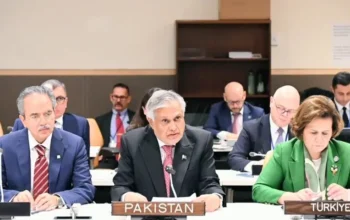
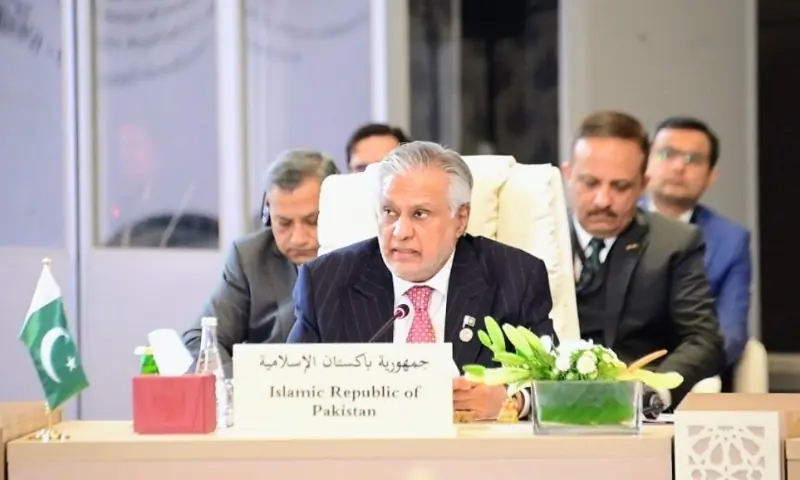
Ishaq Dar, Pakistan’s deputy prime minister and foreign minister, delivered the warning at a ministerial conference on Jerusalem convened by the Jordanian government in Amman on Wednesday, as concern mounts over the future of one of Islam’s holiest sites and the fragile aftermath of the Gaza war.
“Let there be no ambiguity. Israel has no sovereignty over occupied East Jerusalem or its Islamic and Christian holy sites,” Dar told the gathering in televised remarks. “All measures seeking to alter their character or status are null and void and without any legal effect.”
The meeting, bringing together foreign ministers from Arab League states and a wider group of Islamic countries, was called amid Jordanian warnings that attempts to disturb the long-standing arrangements governing Al-Aqsa could inflame tensions across an already volatile region. Jordan serves as custodian of Jerusalem’s Islamic and Christian holy sites, with the compound administered day-to-day by the Jerusalem Islamic Waqf while Israel retains overall security control — an arrangement Jordan says is now under sustained pressure.
Dar condemned “the continued incursions into Al-Aqsa Mosque by extremist Israeli settlers”, saying these were being encouraged by senior Israeli ministers and carried out under the protection of occupying forces. Such actions, he said, were undermining international law, disregarding United Nations resolutions and eroding the prospects for a just and lasting peace.
“This appears not only an attempt to undermine regional peace, security and stability but also to drag followers of various religions into a wider conflict,” he said. “We cannot and must not allow that.”
Reaffirming Islamabad’s backing for Jordan’s custodial role, Dar said Pakistan recognised the Jerusalem Endowment and Al-Aqsa Mosque Affairs Department, which operates under Jordan’s Ministry of Awqaf and Islamic Affairs, as the sole legal authority over the site’s administration. He described the entire 144-dunam, 35-acre compound as an exclusive Muslim place of worship, and said any attempt to alter that status “must be rejected unequivocally”.
Al-Aqsa, regarded as Islam’s third-holiest site, sits in east Jerusalem, territory Israel captured in the 1967 war and later annexed in a move not recognised internationally. Under the arrangements Jordan oversees, Jewish visitors may enter the compound but are barred from praying there. Israel maintains it remains committed to that status quo, though Palestinians and Jordanian officials say it is being steadily eroded by an increasing frequency of visits from Israeli ministers and settlers.
Settlement expansion and West Bank violence
Dar also used his address to voice alarm over developments in the occupied West Bank, saying Pakistan remained “deeply concerned” by the continued expansion of illegal Israeli settlements, the establishment of new outposts, rising settler violence and what he described as the ongoing oppression of Palestinians across the occupied territories.
“These policies violate international humanitarian law, defy the advisory opinion of the International Court of Justice, and further entrench an unlawful occupation,” he said.
Turning to Gaza, Dar said the humanitarian situation there remained dire notwithstanding some improvements delivered by the ceasefire and the broader peace initiative underpinning it.
“The ceasefire and the implementation of elements of the peace plan have yielded some improvements. However, 59 per cent of the population still faces crisis-level food insecurity,” he said, adding that nearly two million people remained confined to roughly 30 per cent of Gaza’s territory, living in what he called miserable conditions.
He went further, telling delegates that more than 1,100 Palestinians had been killed since the ceasefire took effect — a toll he said called into question whether the Gaza peace plan was being implemented fully and faithfully.
Pakistan nonetheless welcomed progress under the plan, including steps towards disarmament in Gaza, and praised the mediation efforts of the United States, Egypt, Qatar and Turkey in sustaining it.
He urged Arab and Muslim states to treat the current moment as a narrow window for peace that must be protected through collective action. Countries should demand an immediate end to all violations at Al-Aqsa, reject Israeli settlement activity, annexation attempts, forced displacement and demographic change in the occupied territories, and back full implementation of the Gaza peace plan alongside UN Security Council Resolution 2803, he said.
“Pakistan’s support for the Palestinian people remains steadfast and unwavering,” Dar said. “We reaffirm their inalienable right to self-determination and their right to establish an independent, sovereign, viable, and contiguous state of Palestine based on the pre-June 1967 borders with Al-Quds Al-Sharif as its capital.”
A flurry of bilateral talks
On the margins of the summit, Dar held a series of one-to-one meetings with counterparts from across the region, according to Pakistan’s Foreign Office.
He met Turkey’s foreign minister, Hakan Fidan, for what officials described as an exchange of views on regional and international issues of mutual interest, and held separate talks with Egypt’s Badr Abdelatty, covering Pakistan-Egypt relations and wider regional developments. In a meeting with Algeria’s Ahmad Attaf, discussion centred on bilateral ties and ways to deepen cooperation in trade, investment, information technology and agriculture.
Foreign ministers from the R4 group — Egypt, Pakistan, Saudi Arabia and Turkey — also convened separately in Amman. In a joint statement issued afterwards, the group reiterated its support for Palestinian self-determination and the establishment of an independent, sovereign Palestinian state based on the pre-1967 borders with East Jerusalem as its capital, in line with relevant Security Council resolutions. The four countries described a comprehensive settlement of the Palestinian question as indispensable to lasting peace and stability in the Middle East, and pledged continued coordination in the face of an evolving regional picture.
Separately, Dar held bilateral talks with his Jordanian counterpart, Ayman Safadi, focused chiefly on the deteriorating situation in the occupied West Bank. According to the Foreign Office, Dar praised Jordan’s role in safeguarding Jerusalem’s holy sites and its support for the Palestinian cause, while the two men welcomed what they called growing momentum in Pakistan-Jordan relations and agreed to deepen cooperation across political, defence, economic, educational and cultural lines.
The two ministers also touched on wider regional developments, including the recent conflict between the United States and Iran, and stressed the importance of dialogue and diplomacy in de-escalating tensions, pledging closer coordination at the United Nations and the Organisation of Islamic Cooperation.
In a further bilateral meeting, Dar met Somalia’s foreign minister, Abdisalam Abdi Ali, with the two discussing longstanding ties between their countries and ways to strengthen cooperation in political, economic, defence, education and capacity-building fields, alongside continued coordination in multilateral forums.
Wednesday’s remarks add to a running series of protests from Islamabad and other Muslim-majority governments over access to Al-Aqsa. In June, foreign ministers from Pakistan and eight other Muslim countries issued a joint statement expressing what they termed their categorical rejection of any attempt to alter the historical and legal status quo governing Jerusalem’s Islamic and Christian holy sites.
The Amman meeting comes against the backdrop of a war in Gaza now approaching its third year, one that has left the Palestinian territory devastated and stoked tensions well beyond its borders. Violence has climbed in parallel across the West Bank, where Israel has widened both military operations and settlement construction — developments Jordan and its allies say are testing the fragile arrangements that have long governed one of the region’s most contested religious sites.
Copyright © 2021 Independent Pakistan | All rights reserved