By Staff Reporter
GILGIT: Pakistani military helicopters on Thursday airlifted the bodies of five more climbers off the slopes of Broad Peak, nearly a week and a half after an avalanche tore through a ten-member international expedition led by the celebrated mountaineer Nirmal Purja, in what the Alpine Club of Pakistan has called one of the country’s deadliest mountaineering disasters.
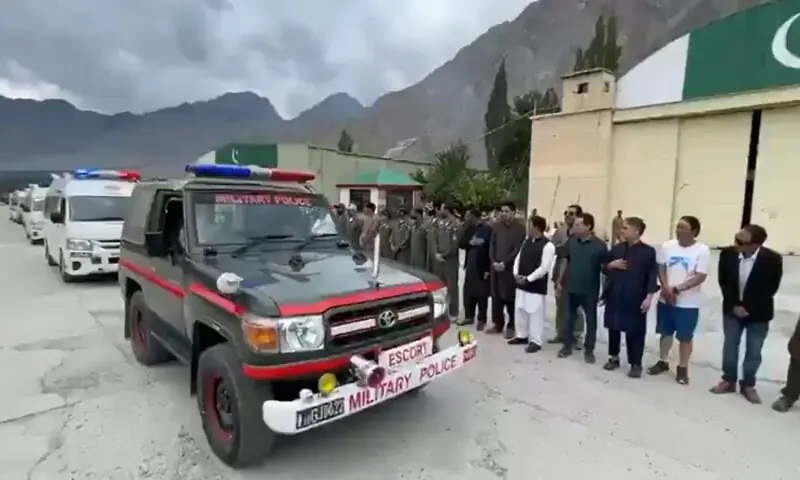
The five — Purja himself, Chinese climber Wang Zhong, and Nepali climbers Nima Sherpa, Gyalu Sherpa and Killi Pemba “Kilu” Sherpa — were flown by Pakistan Army helicopter from Broad Peak’s base camp to Skardu, where they were received by representatives of the Alpine Club of Pakistan, Baltistan Commissioner Kamal Khan, army officers, civil administration officials, and local tourism and district representatives, who paid tribute to the climbers before the bodies were transferred to the Combined Military Hospital.
Thursday’s recovery brings the total number of bodies retrieved to eight. Two members of the expedition remain unaccounted for: Pakistani mountaineer Sohail Sakhi and American climber Sarah Mallory Geis. Remains believed to be Geis’s were airlifted at the weekend along with two other climbers’ bodies, but her body itself has yet to be recovered, according to Alpine Club of Pakistan secretary general Ayaz Shigri. The body of a further climber, Nawang Thindu Sherpa, has been located but could not be brought down owing to its position in a high-altitude, avalanche-prone stretch of the mountain, the club’s Naila Kiani said.
At Skardu, the eight bodies recovered so far underwent legal formalities, documentation and identification procedures at the military hospital before being placed in coffins, each draped in the national flag of the climber’s home country, and given an official farewell with state honours.
One of the deadliest disasters in Pakistani mountaineering
The avalanche struck Broad Peak, one of the world’s highest mountains, on 30 July, severing contact with Purja’s expedition. Purja’s company later confirmed there had been no survivors. The climbers had travelled from Nepal, Oman, Pakistan, China, Britain and the United States, and their remains are due to be flown on to Islamabad, where onward repatriation will be coordinated with the embassies of their respective home countries.
Pakistan’s foreign minister, Ishaq Dar, said this week he was deeply saddened by the tragedy, and that Pakistan remained committed to working with the Nepali, Omani, British and American embassies to complete the recovery operation.
The Alpine Club of Pakistan has credited the “technically demanding” recovery to Pakistani mountaineers Sirbaz Khan, Abid Beg and Sherzad, and Nepali climbers Dipen Gurung and Pemba Chhewang Sherpa, alongside army personnel and local high-altitude porters, whose efforts under what officials described as extremely challenging conditions have been widely praised. The bodies of two further climbers — Oman’s Nadhira Ahmed Abdullah Al Harthy and Nepal’s Pur Bahadur Gurung — were recovered and airlifted to Skardu earlier in the operation.
Mountaineering accidents are a recurring hazard in northern Pakistan, where climbers contend with avalanches, falling rock and ice, extreme altitude and weather that can turn without warning; a Chinese climber died last year after being struck by falling rocks while descending K2, the world’s second-highest peak. The bodies of foreign climbers who die attempting Pakistan’s mountains are typically recovered only when families and governments request it; where relatives decline, remains are usually left on the mountain.
The search for Sakhi and Geis was continuing on Thursday, with the Alpine Club of Pakistan saying the army, local rescue teams and other agencies were drawing on all available resources to locate the two remaining climbers.
Copyright © 2021 Independent Pakistan | All rights reserved