By Staff Reporter
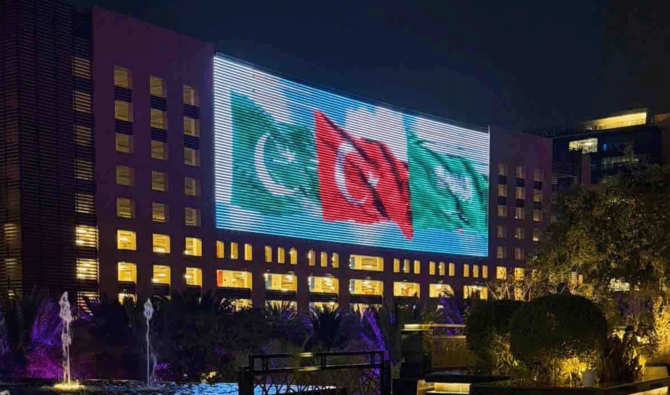
ISLAMABAD: Landmarks across Saudi Arabia were lit up with the flags of Pakistan, Türkiye and the kingdom over the weekend, as reaction continued to pour in to a new trilateral defence pact binding the three nations to treat an attack on any one of them as an attack on all.
The Makkah Joint Defence Agreement, signed on Friday at the Makkah Al-Mukarramah Summit for Joint Defence, has drawn a wave of endorsements from regional governments, the Organisation of Islamic Cooperation and political figures across Pakistan, alongside close scrutiny from analysts over what the pact does — and does not — represent.
The agreement was signed at Al-Safa Palace by Pakistan’s prime minister, Shehbaz Sharif, Saudi Arabia’s crown prince, Mohammed bin Salman, and Türkiye’s president, Recep Tayyip Erdogan, and witnessed by Pakistan’s chief of defence forces and army chief, Field Marshal Asim Munir, along with deputy prime minister and foreign minister Ishaq Dar and defence minister Khawaja Asif.
The pact commits the three states to strengthening collective deterrence against aggression and deepening cooperation across every aspect of defence, from military coordination and intelligence sharing to joint projects within the defence industry. Pakistan’s foreign office said the agreement was “intended to strengthen collective deterrence against any act of aggression” and would provide for “the enhancement of all aspects of defence cooperation among the three states”.
The flag displays lighting up towers and landmarks throughout the kingdom were, according to the Saudi Press Agency, a reflection of “widespread public jubilation over the historic pact”.
Sharif described the agreement as a “historic pact” that he hoped would serve as a lasting guarantor of peace. “May this historic pact, signed in the shadow of the Haramain, remain a shield of peace for generations to come and may it bring prosperity for our three brotherly countries as well as for the Ummah,” he wrote on X, invoking the Arabic term for Islam’s holiest sites in Makkah and Madinah.
President Erdogan struck a similar note, saying the agreement rested on the principle of collective deterrence and would help advance security cooperation, joint defence industry ventures and the fight against terrorism between the three states. He was careful to stress that the pact was not aimed at any other nation. The agreement, he said, reaffirmed the right to self-defence enshrined in Article 51 of the United Nations Charter, targeted no country, and remained open to any “brotherly countries” seeking peace, prosperity and stability in the region.
Saudi Arabia’s deputy minister for public diplomacy, Rayed Krimly, also clarify that the pact’s scope, stating that the new tripartite arrangement “does not supersede or replace any existing bilateral or multilateral agreements between these countries”.
The agreement builds on ties already in place. Pakistan and Saudi Arabia signed a Strategic Mutual Defence Agreement in Riyadh last September, under which an attack on either country would be treated as aggression against both. Friday’s pact extends that mutual defence framework to include Türkiye, a Nato member with one of the region’s most substantial militaries. Pakistan and Türkiye already share deep defence ties, including cooperation on naval shipbuilding and military training, while Pakistan has been steadily expanding its defence exports and Türkiye has built a formidable domestic arms industry producing drones, warships and missiles.
Regional and international reaction
The Organisation of Islamic Cooperation, the world’s second-largest intergovernmental body after the United Nations, has welcomed the agreement as an “important strategic step”. Its secretary general, Hissein Brahim Taha, said in a statement that the pact constituted “a fundamental pillar for supporting security and stability in the region and across the Muslim world”, reflecting what he called “a shared resolve to address growing security challenges and strengthen solidarity and constructive partnerships” among its 57 member states. He praised the “tireless efforts and wise leadership” behind what he termed a “historic agreement”, and voiced hope it would contribute to peace and prosperity both regionally and internationally.
Bahrain’s foreign ministry has called the pact a “key addition to the broader regional defence architecture”, describing it as “a strategic partnership between equal partners” driven by a shared commitment to safeguarding stability and bolstering credible deterrence. The ministry said the arrangement would complement and strengthen the collective defence systems of the Gulf Cooperation Council, and reaffirmed that Saudi Arabia’s security remained integral to Bahrain’s own.
Somalia’s defence ministry, whose minister had visited Pakistan earlier in the week, has called the signing “a historic milestone in strengthening collective security, advancing defence cooperation, and building a strategic partnership capable of addressing shared security challenges”.
Within Pakistan, reaction has been similarly enthusiastic. Bilawal Bhutto-Zardari, chairman of the Pakistan Peoples Party and a former foreign minister, called the pact a “significant milestone” in the country’s history. “This agreement is not only a guarantee of a stable and secure future for Saudi Arabia, Pakistan and Türkiye, but also a historic document for regional and global peace,” he wrote on X, crediting Mr Sharif and Field Marshal Munir with making the agreement possible.
Maulana Fazl-ur-Rehman, chief of the Jamiat Ulema-e-Islam (Fazal), called the pact an important step toward forging unity within the Muslim Ummah, adding that “the establishment of a joint defence capability for the Muslim world has always been our aspiration” and urging other Muslim-majority countries to join the framework. Former senator Mushahid Hussain Syed described it as “the first Pan-Islamic military institutional initiative among three key Muslim countries, independent of the West”, framing it as a welcome development for Pakistan’s security amid what he characterised as an emerging “India-Israel nexus” with backing from other regional states.
International analysts have been watching closely, too. Michael Kugelman, senior South Asia fellow at the Atlantic Council, called the pact a “logical outgrowth” of deepening defence ties between the three countries, noting it followed Pakistan’s earlier agreement with Saudi Arabia and Islamabad’s recent efforts to strengthen security relationships with Egypt and Jordan. “Pakistan’s strategic cachet is on the rise in the Mideast,” he said. Former Pakistani diplomat Asif Durrani described the agreement as “the first concrete building block of an emerging regional security architecture for South and West Asia”, suggesting that, if the momentum continued, it could eventually open the door to progress on long-standing disputes including the Palestinian issue.
Middle East analyst Abdullah Al-Rifai told AFP that the involvement of three regionally significant states could make the pact attractive to others considering joining. “This agreement includes parties with significant weight in the region — Pakistan, Saudi Arabia and Turkiye,” he said, adding that he expected it to draw further interest “because it is a common interest and serves everyone”. He argued the pact should not be read through a sectarian or religious lens, pointing instead to the differing international postures of its signatories — Türkiye’s Nato membership, Pakistan’s relationship with Iran, and Saudi Arabia’s recent outreach to Tehran — as factors that could allow the grouping to play a genuinely stabilising regional role.
What the pact is — and isn’t
The signing has inevitably prompted comparisons with Nato, but security analysts caution against reading too much into the parallel. Rather than creating a new military bloc, they argue, the agreement formalises decades of existing strategic cooperation between the three states. Pakistan’s relationship with Türkiye traces back to the Khilafat Movement of the early twentieth century, while its ties with Saudi Arabia span decades of defence, political and economic cooperation built on mutual trust.
Analysts point to a rapidly shifting regional security picture — ongoing conflicts, evolving threats and changes in the character of modern warfare — as the driving force behind closer coordination. The pact’s core logic, they say, is straightforward: aggression against one member is treated as a threat to all three, raising the potential cost of any hostile action and reinforcing deterrence. Beyond that, the framework envisages closer military coordination, intelligence sharing, strategic consultation and joint defence planning.
Each partner is understood to bring distinct strengths to the arrangement. Pakistan offers battle-tested armed forces and operational expertise honed over decades of counterterrorism operations. Saudi Arabia contributes economic weight, regional influence and political leadership. Türkiye brings an advanced domestic defence industry and substantial military-technology capacity. Analysts describe the combination as a balanced security architecture designed to respond to emerging regional challenges.
Pakistan’s own diplomatic standing has also been cited as a factor. Islamabad played a central mediating role in the recent conflict between the United States and Iran, while maintaining working relationships with Saudi Arabia, Türkiye, Iran, China and the US — a positioning analysts say leaves it well placed to act as a bridge between regional and global powers.
Analysts have been equally clear about what the pact is not. They reject characterisations of it as an offensive alliance, a “Muslim Nato”, a nuclear security arrangement, or a religion-based political or military bloc. It is not, they stress, directed against any specific country. Instead, they describe it as a defensive framework intended to deter aggression, deepen military cooperation and reinforce self-reliance among its three partners — one that codifies an existing relationship through a formal institutional mechanism rather than inventing a new geopolitical grouping.
Its long-term credibility, analysts suggest, will rest on continued political coordination between the three governments, who have so far paired military preparedness with diplomatic engagement and strategic restraint.
The wider backdrop
The timing of the signing has drawn attention, coming amid heightened tensions across the Middle East stemming from months of conflict between the United States and Iran — though officials and analysts note the pact had been under discussion long before that war began. Pakistan, Saudi Arabia, Türkiye and Egypt have all been closely engaged in efforts to contain the fallout from the conflict and stabilise the wider region.
Pakistan in particular has played a prominent mediating role between Washington and Tehran, hosting the first round of direct US-Iran talks in April and helping broker an interim agreement between the two sides in June, known as the Islamabad Memorandum of Understanding. Fighting later resumed after the US accused Iran of attacking shipping in the Strait of Hormuz, a waterway Tehran has effectively closed to commercial traffic since February.
Copyright © 2021 Independent Pakistan | All rights reserved