By Staff Reporter
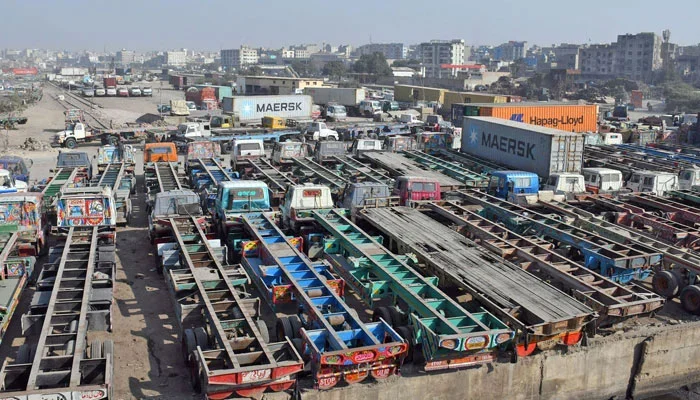
KARACHI: Pakistan’s goods transport industry ground to a halt Saturday as thousands of truckers began an indefinite nationwide strike, escalating a dispute with the government over daily diesel price adjustments, toll charges and tax policy that threatens to disrupt supply chains across the South Asian nation.
The All Pakistan Goods Transport Alliance said freight operators suspended services in every province, with drivers parking cargo trucks, containers and oil tankers rather than reporting for duty. The action, which the alliance has framed as indefinite, comes after talks between transporters and Communications Minister Abdul Aleem Khan failed to produce a breakthrough on Friday.
Malik Shehzad Awan, the alliance’s president, said the federal government has invited transporter representatives to a fresh round of negotiations on Monday. He said a negotiating committee has been formed to represent the industry, and that the strike’s fate hinges on the outcome of that meeting.
“We have kept the doors for negotiations open, but the wheel-jam strike will not end until our demands are accepted,” said Muhammad Owais Chaudhry, another alliance leader who heads the All Pakistan Goods Transport Owners Association, in comments to Arab News. “Every day the situation will get worse as tens of thousands of vehicles will be stranded across the country.”
Diesel Pricing at Center of Dispute
The transporters’ central grievance concerns Pakistan’s shift to daily fuel-price adjustments. The Oil and Gas Regulatory Authority now publishes diesel rates daily on its website, calculated using a seven-day rolling average of international benchmark prices, according to Petroleum Minister Ali Pervaiz Malik. Islamabad adopted the mechanism in response to volatility in global oil markets tied to tensions in the Middle East, and has defended the policy as a transparency measure for consumers.
Truckers argue the opposite: that daily repricing makes it impossible to plan routes and quote freight rates with any certainty. The alliance is demanding a return to fortnightly or monthly price reviews, along with a rollback of diesel prices to their July 1, 2024 level — a marker transporters have cited repeatedly as the point before costs became, in their telling, unsustainable.
The industry is also pressing for a cut in withholding tax on cargo operators to 2% from 7%, arguing the lower rate already applies to oil tanker operators and should be extended industry-wide.
Finance Act Provision Draws Fire
A newer flashpoint has emerged around the Finance Act 2026, which transporters say allows customs authorities to confiscate an entire vehicle if non-duty-paid goods are discovered on board. The alliance is demanding the provision’s withdrawal and a return to the prior system, under which fines were levied and vehicles subsequently released.
Transporters are also seeking uniform enforcement of axle-load limits nationwide, arguing overloading should be policed at factories and warehouses rather than through roadside stops, which the industry contends have become a revenue-generating exercise for enforcement agencies rather than a safety measure.
Additional demands include a simplified process for obtaining heavy transport vehicle driving licenses, a freeze on new toll plazas for one year, and a rollback of toll charges to levels last seen around mid-2024. Awan said a single trailer can now pay as much as 2.4 million rupees in toll taxes over its operating life, on top of separate levies on petroleum products.
The dispute has taken on a political edge. Awan, addressing reporters at the Karachi Press Club, called for the resignations of Petroleum Minister Ali Pervaiz Malik and Punjab Senior Minister Maryam Aurangzeb, accusing both of failing to honor commitments made to the transport sector. He said he would not personally join talks with the government, delegating that role to the alliance’s negotiating committee, and indicated the strike would only be called off once Islamabad issues a formal notification confirming talks.
Awan and other alliance leaders have emphasized that the protest is deliberately non-disruptive to the public, with drivers parking vehicles rather than blocking highways. “We don’t want to create difficulties for citizens,” Awan said, adding that road closures inconvenience ordinary Pakistanis who bear no responsibility for the dispute.
Government Says Channels Remain Open
A senior communications ministry official, speaking to Arab News on condition of anonymity because he was not authorized to discuss the matter publicly, pushed back on the extent of the disruption and said the government remains willing to negotiate.
“In my opinion, they told until Monday they will not close down transport. And as per our information, the goods transport has not stopped across the country,” the official said. He added that Friday’s talks involved coordination across multiple ministries and provincial governments, including those overseeing petroleum and maritime affairs, and that Islamabad would take up demands it deems “justified and legally feasible” at Monday’s meeting.
“We are open to talks and we will take up their demands with relevant ministries like the Ministry of Petroleum as well as the concerned provincial governments, as their demands are related to various ministries and provincial governments,” the official said.
Pakistan’s economy depends heavily on road freight to move goods from ports and factories to wholesalers, markets and warehouses nationwide. A prolonged shutdown risks shortages of perishable goods and delays to time-sensitive shipments, with the transport alliance warning that the toll on stranded cargo will compound with each day the strike continues.
Copyright © 2021 Independent Pakistan | All rights reserved