By Staff Reporter
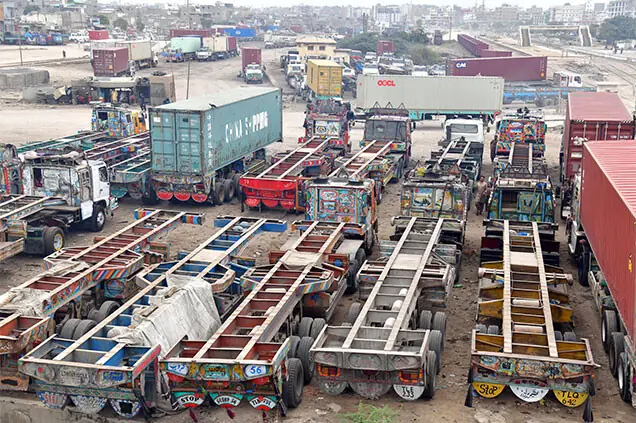
ISLAMABAD: Pakistan’s nationwide truckers’ strike ground into a fourth day on Tuesday after a fresh round of talks between the government and the country’s largest transport alliance again failed to produce a breakthrough, leaving oil tankers, container trucks and freight haulers parked nationwide with no resolution in sight.
Malik Shehzad Awan, president of the All Pakistan Goods Transport Alliance, told reporters after Tuesday’s talks that the deadlock persisted despite detailed discussions with federal and Sindh government representatives. “Negotiations have not been successful, and we have decided to continue the strike,” Awan said, adding that the alliance remained open to further talks but needed to see “meaningful and visible progress,” not just verbal assurances.
The strike began Aug. 8 after last-minute negotiations between transporters and Communications Minister Abdul Aleem Khan collapsed. Fuel tankers, trailers and freight trucks were taken off the road late on Aug. 7 in anticipation, halting the movement of everything from imported raw materials to export-bound textiles in a country that depends heavily on road transport to move goods between ports, factories and markets.
A first round of talks on Monday morning also ended without agreement, and a second round held that afternoon fared no better. Mohammad Owais Chaudhry, an advocate who serves as spokesman for the transporters under the All Pakistan Goods Transport Ittehad platform, said the alliance had made its position clear and did not intend to soften it. “We have clearly presented our position before the government and will not show any flexibility on it,” Chaudhry said, adding that the strike would only end once the government accepted the transporters’ demands.
Three Sets of Demands
The transporters have organized their grievances around three areas, each falling under a different arm of government. The first concerns axle-load limits and highway tolls: the alliance wants the permissible weight for 10-wheeler trucks raised to 35 tonnes from 27.5 tonnes, and toll rates cut — a matter for the National Highway Authority and the communications ministry.
The second, and most contentious, involves how Pakistan prices diesel. The government moved to daily price revisions, calculated off a seven-day rolling average of international benchmarks, after the outbreak of the US-Iran war earlier this year sent global energy markets into swings. A senior official on the government’s negotiating team said the mechanism reflects volatility abroad rather than any domestic policy choice. Transporters argue the daily changes make it nearly impossible to plan routes and pricing, and are pushing for a return to fortnightly or monthly adjustments, with some also seeking a rollback of fuel prices to their July 2024 level.
The third set of demands touches customs duties and income tax, including a cut to the withholding tax levied on cargo operators.
Despite the impasse, the government official said toll rates for heavy vehicles were still under consideration for reduction, and that authorities were weighing changes to the permitted axle load — signaling more movement on the transporters’ first set of demands than on fuel pricing, where the government has held its position.
Mounting Economic Pressure
The standoff is drawing warnings from Pakistan’s business community as the disruption to freight movement stretches into a fourth day, with some officials cautioning that prices of essential food items could begin to climb if goods movement remains stalled. Muhammad Rehan Hanif, president of the Karachi Chamber of Commerce and Industry, called on federal and provincial governments to engage transport-sector representatives “at the highest level,” warning that a prolonged halt in the movement of goods and fuel could ripple through industrial production, raw-material supply and export shipments. The chamber offered to mediate.
Fawad Anwar, chairman of the Pakistan Textile Council, wrote to Prime Minister Shehbaz Sharif warning that the strike threatens to disrupt supply chains for one of the country’s largest export industries, which depends on uninterrupted trucking to move raw materials to mills and finished goods to port. Anwar acknowledged that resolving the transporters’ demands requires coordination across multiple government departments, but said the economic cost of the deadlock rises with each day it continues.
Fuel Retailers Add to the Pressure
The dispute risks compounding in the coming days: Pakistan’s petrol-pump operators have said they will begin their own indefinite, nationwide shutdown starting Aug. 15 unless separate demands over dealer margins are met. The Pakistan Petroleum Dealers Association, which represents roughly 14,000 dealers nationwide, is seeking an 8% margin on petrol sales and says it gave the government a 72-hour ultimatum that has since lapsed.
Malik Khuda Baksh, the association’s chairman, said dealers called off a planned shutdown two weeks earlier “on ethical grounds” after believing the government intended to act on their concerns, but that patience had since run out. Petroleum Minister Ali Pervaiz Malik had persuaded the dealers’ association to stand down in late July with assurances their concerns would be addressed; the dealers say that promise has gone unfulfilled, and their vice chairman wrote to the ministry on Aug. 7 seeking a review of the same daily-pricing mechanism at the center of the truckers’ dispute.
A shutdown of petrol pumps layered on top of an already-idled freight network would deepen the strain on a supply chain that moves the bulk of Pakistan’s imported and domestically produced goods by road.
Copyright © 2021 Independent Pakistan | All rights reserved